
Coastal landslide destabilizes cliffside Chalets in Devon as erosion risks intensify

A coastal landslide along the East Devon coastline has destabilised several beach chalets at Branscombe, leaving structures tilted and partially unsupported near the cliff edge, according to BBC reports. The incident, which followed recent storm activity, highlights the ongoing instability of coastal slopes formed of weak and highly erodible materials.
The landslip removed part of the ground supporting the chalets, causing visible displacement and damage to structural elements such as decking. These buildings, typically constructed on shallow foundations close to the cliff edge, are particularly vulnerable to ground loss during slope failures. As a precaution, sections of the coastal path have been closed, with authorities restricting public access due to safety concerns.
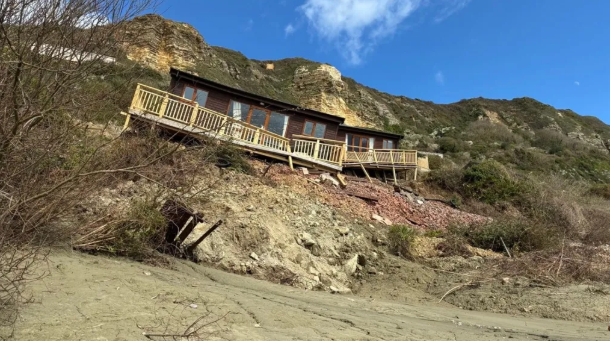
While detailed site investigations are ongoing, such failures along this coastline are commonly associated with a combination of wave-driven erosion at the cliff base, prolonged rainfall infiltration, and storm-induced loading. These factors can reduce the strength of coastal materials and trigger slope movement, particularly in soft sedimentary formations characteristic of the area.
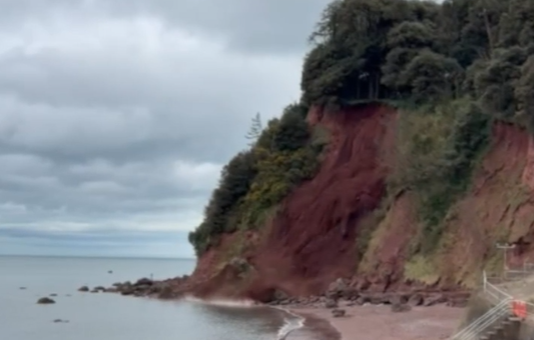
Further along the Devon coast in Shaldon, a separate cliff collapse was reported, with witnesses describing audible cracking sounds shortly before failure, as reported by local media. The event involved the sudden detachment of rock and soil, depositing debris at the base of the cliff. Local geology in this area consists largely of weak and weathered materials, which are prone to rapid erosion and episodic collapse.
Coastal retreat is a natural and ongoing process along much of the UK shoreline. In many locations, large-scale stabilisation measures such as retaining structures or rock armouring are either economically prohibitive or environmentally constrained. As a result, approaches such as managed retreat and adaptive land-use planning are increasingly being considered in national risk strategies.
Recent UK assessments indicate that thousands of properties may be at risk from coastal erosion in the coming decades. The damage at Branscombe illustrates how rapidly localised slope failures can impact infrastructure, particularly where development is located close to actively eroding cliffs.
Authorities and landowners are expected to carry out further assessments to evaluate the extent of instability and identify appropriate risk management measures. These may include improved drainage, monitoring, and controlled access. However, in highly dynamic coastal environments, long-term risk reduction often depends on adaptation rather than full stabilisation.
Sources: bbc.com, devonlive.com, bbc.com/news, gov.uk
Want to read more like this story?

Cracks open in South England's cliff indicating a potential collapse
Sep, 06, 2020 | NewsThick cracks that emerged on the top of a cliff in South England indicate a potential cliff collaps...

Massive cliff collapse in Jurassic Coast, UK
Apr, 12, 2021 | NewsA cliff collapse that occurred in England's Jurassic Coast is considered to be the largest to hit t...

Historic Cottage Threatened by Huge Cliff Collapse in Devon
Nov, 04, 2024 | NewsA dramatic cliff collapse in Devon, England, has left a historic cottage just 10 metres from a 120-...

Path to iconic lighthouse swept away by cliff collapse in England
Aug, 01, 2021 | NewsA public path leading to an iconic lighthouse located in England has been cut off by a cliff collap...

Coastal path section lost after major landslip at Stonebarrow
Feb, 16, 2026 | NewsThousands of tonnes of rock and mud have collapsed from Stonebarrow Hill at Charmouth, forcing the...
Cliff collapse in Isle of Wight, England: 8 people rescued
Apr, 18, 2020 | NewsEight people were rescued after a cliff suddenly collapsed in Isle of Wight, England. The incident...

British farmhouse demolished after landslide leaves it teetering over cliff edge
May, 10, 2024 | NewsAn 18th century farmhouse that was hanging over a cliff edge in England’s North Norfolk district wa...

Massive landslide struck North Norfolk, UK
Jan, 06, 2020 | NewsA massive landslide struck the coastal region of Trimingham, a village located in North Norfolk, UK...

Around 1000 destructive landslides in Auckland as a result of Cyclone Gabrielle
Feb, 16, 2023 | NewsA geologist has called for a priority study of the city's vulnerability and risk, while an Auckland...
On This Day
August 10th 1856
READ MORE
Related Video

Trending

China's Three Gorges Dam under pressure: Flood hazard downstream

Functional requirements of foundation structures


Landslide in Papua New Guinea: At least 12 people dead

Major wastewater tunnel procurement begins in southern Sweden