
Rocscience | On the comparison of 2D and 3D stability analyses of an anisotropic slope Sponsored
The Adoption of 3D Limit Equilibrium Method
2D limit equilibrium analysis is a powerful tool for problems involving uniform geometry. Three-dimensional limit equilibrium modeling can be an excellent method for problems with more complex geometry as it considers the normal and horizontal side resisting forces along the sides of the sliding mass. It is also becoming more widely available for commercial use and more user-friendly, allowing geotechnical engineers to better assess a slope’s stability in more detail.
Parametric Study of an Open Pit Mine
This paper summarizes the results of a parametric study using 2D and 3D LEM to demonstrate the variability in Factor of Safety (FOS) for a highly bedded open pit mine. This example uses an Iron ore mine located in the Pilbara region of Western Australia.
Slide2 and Slide3 were used to calculate the factor of safety of the slope. Slide2 uses the method of slices while Slide3 uses the method of columns, to find the force acting on the failure surface (i.e. mobilized stress) and these are compared to the available shear strength to evaluate the factor of safety.
To find the difference in FOS using 2D and 3D limit equilibrium methods, a series of models were computed with the following variables.
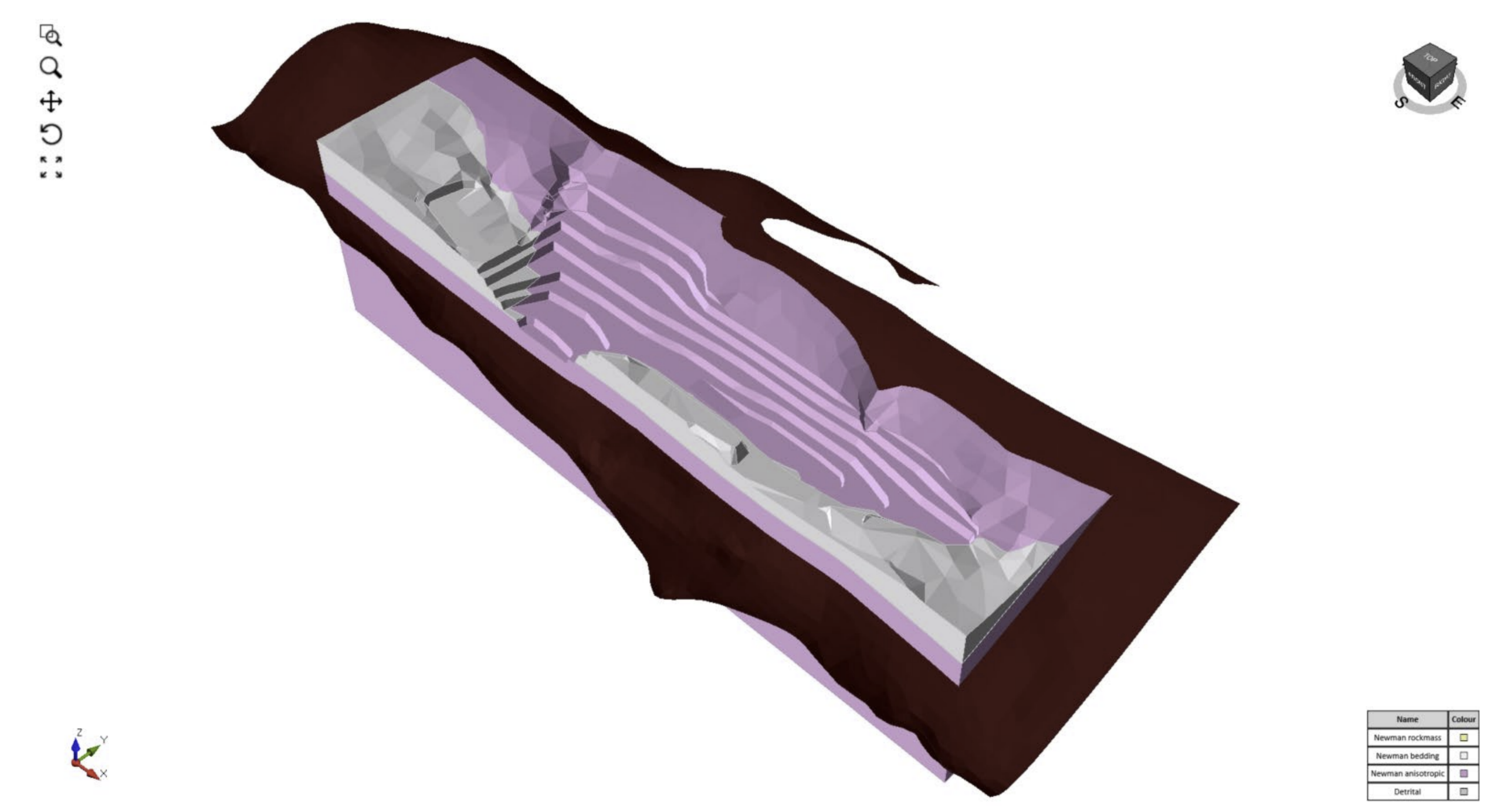
- 3D models using the mine design, natural surface topography and lithological surfaces exported from the geological model (Figure 1). The deposit was above the water table, so pore pressures were not considered. Anisotropy and true dip are included in 3D LE models;
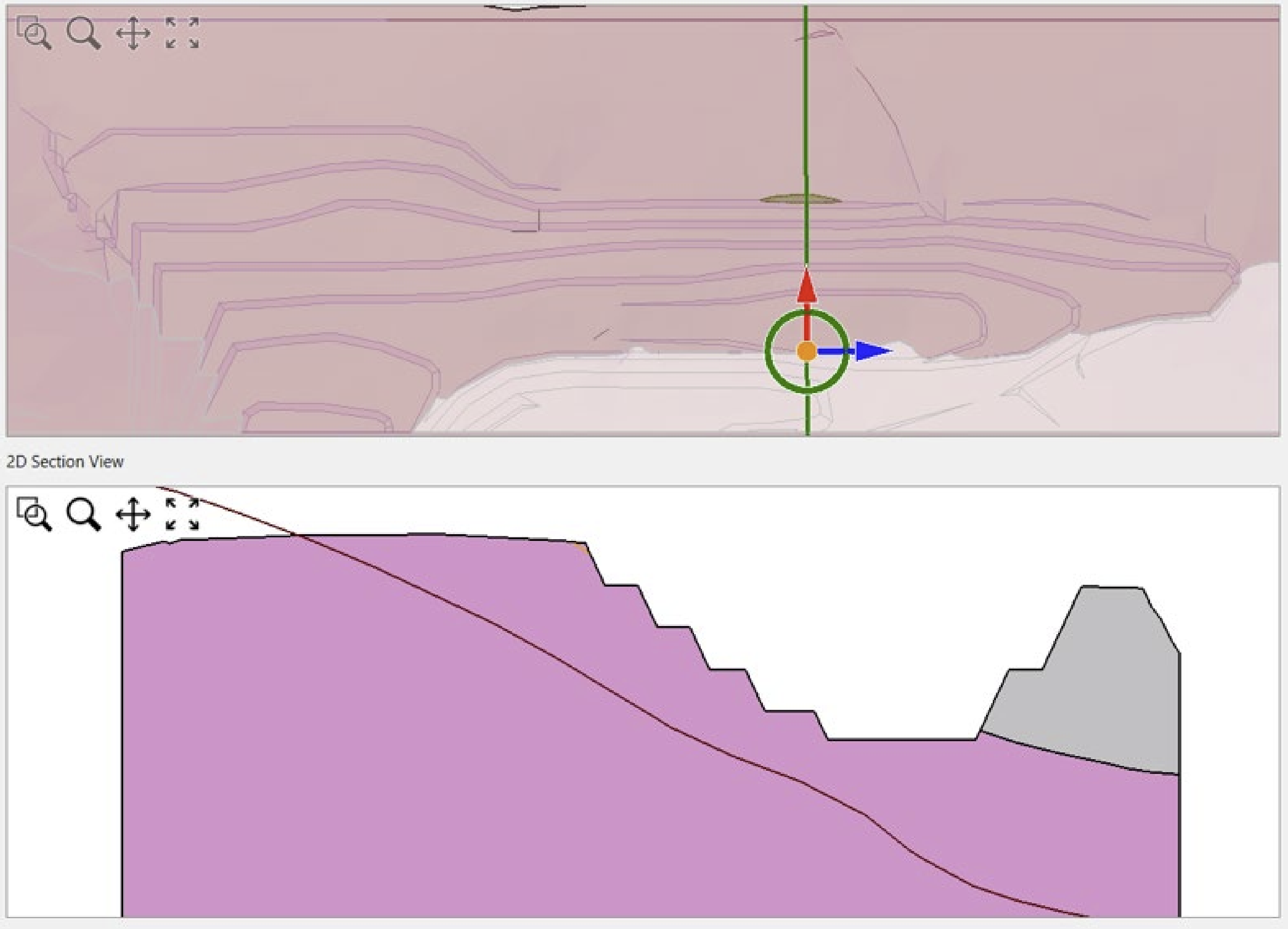
- 2D models using a 2D section cut through the middle of the critical slip surface calculated from 3D modelling (Figure 2). Apparent dip is inherently included in 2D LE models;
- 3D models derived by extruding the 2D section at varying lateral slope lengths (50 m, 100 m, 150 m, 200 m, 400 m). True anisotropy is not included in 2D extruded models. Instead, the third dimension is added by uniform extrusion of a 2D section.
- Cuckoo vs Particle Swarm slip surface search methods, at varying search options (i.e. number of search surfaces and search depth limits); and
- Linear (i.e. Mohr-Coulomb) and Non-Linear (Shear-Normal, Generalized Hoek-Brown and Barton-Bandis) material strengths.
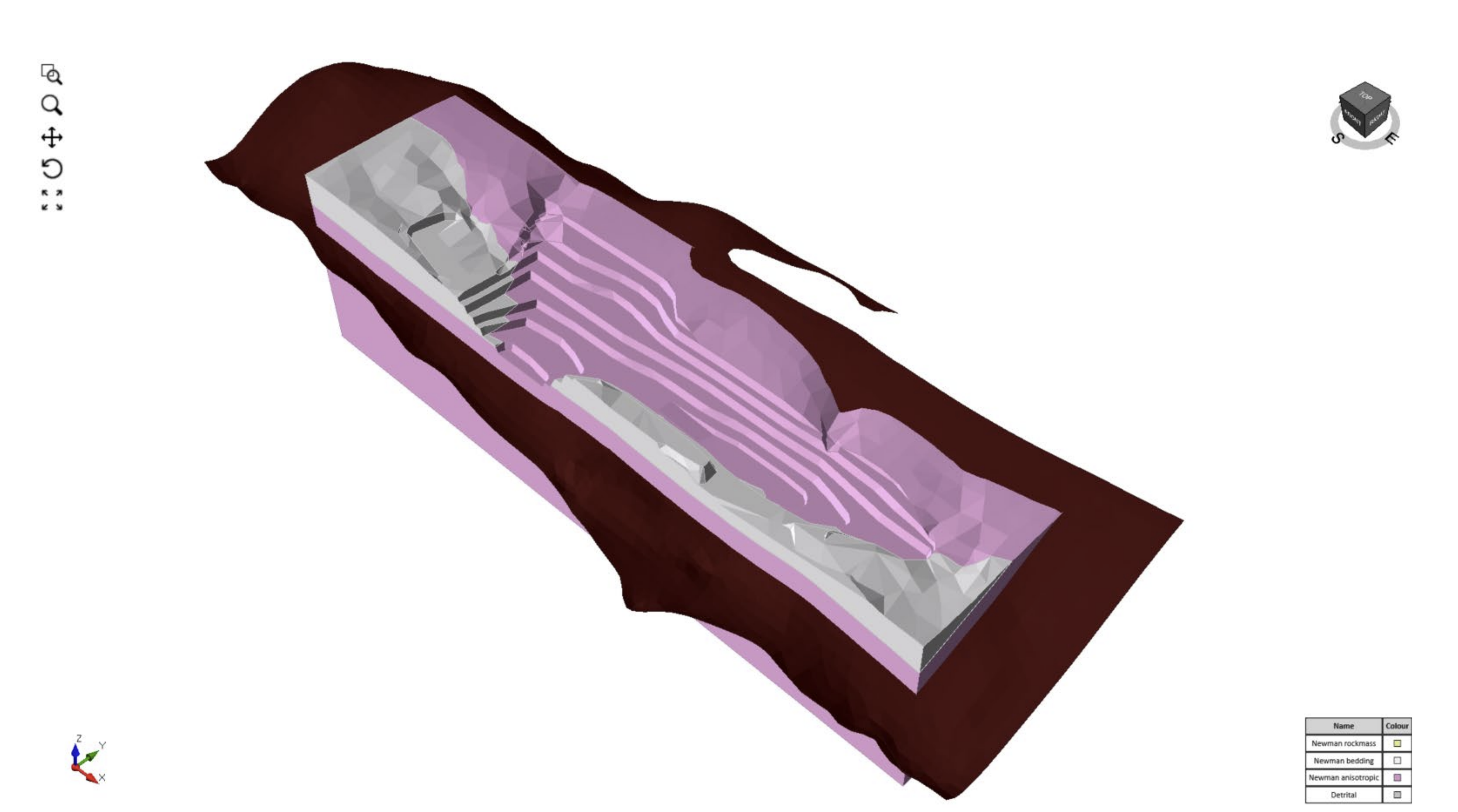
Figure 1 Parametric view of case study slope
Figure 2 Plan view map showing location and cross-section cut for Slide2 analysis from the Slide3 model
Results
Through this analysis, the following results were found about the performance of both the 2D and 3D methods.
For the full 3D analysis (Table 1), the results showed that when using nonlinear strength criteria, a lower factor of safety was calculated compared to linear strength models. The full 3D analysis also showed that the application of search depth limits generally results in a higher factor of safety when compared with no search depth limits being applied. The results of FOS vary from 0.81 to 1.14.
Dimension | Material Model | Search Method | Number of Nests / Particles | Slope Depth Limit | Critical FOSGLE | Reference Figure |
3D | Non-Linear (GHB + BB) | Cuckoo | 20 | None | 0.90 | Figure 4 A |
Cuckoo | 80 | 0.89 | Figure 4 B | |||
Particle Swarm | 20 | 0.90 | Figure 4 C | |||
Particle Swarm | 80 | 0.81 | Figure 4 D | |||
3D | Non-Linear (GHB + BB) | Cuckoo | 20 | 15m | 1.13 | Figure 5 A |
Cuckoo | 80 | 1.00 | Figure 5 B | |||
Particle Swarm | 20 | 1.08 | Figure 5 C | |||
Particle Swarm | 80 | 1.06 | Figure 5 D | |||
3D | Linear (MC) | Cuckoo | 20 | None | 1.10 | Figure 6 A |
Cuckoo | 80 | 1.11 | Figure 6 B | |||
Particle Swarm | 20 | 1.06 | Figure 6 C | |||
Particle Swarm | 80 | 1.11 | Figure 6 D | |||
3D | Linear (MC) | Cuckoo | 20 | 15m | 1.12 | Figure 7 A |
Cuckoo | 80 | 1.10 | Figure 7 B | |||
Particle Swarm | 20 | 1.14 | Figure 7 C | |||
Particle Swarm | 80 | 1.09 | Figure 7 D |
Table 1 Parametric study results – 3D LE analysis. Reference Figure’s correspond with the original paper figures.
Findings show that the FOS values from the 2D analysis (table 3) were generally lower than the 3D analysis varying from 0.73 to 0.88.
The difference in the factor of safety is also more pronounced when linear models are applied. This is because the rock mass strength at the sides of the failure surface is not considered in the 2D analysis but is included in the 3D analysis due to the 3D shape of the slip surface.
Dimension | Material Model | Search Method | Slope Depth Limit | Critical FOS GLE | Reference Figure |
2D | Non-linear (GHB + BB) | Cuckoo | None | 0.73 | Figure 8 A |
Particle Swarm | 0.84 | Figure 8 B | |||
Linear (MC) | Cuckoo | 0.84 | Figure 8 C | ||
Particle Swarm | 0.88 | Figure 8 D | |||
3D | Non-linear (GHB + BB) | Cuckoo | 15 m | 0.80 | Figure 9 A |
Particle Swarm | 0.80 | Figure 9 B | |||
Linear (MC) | Cuckoo | 0.85 | Figure 9 C | ||
Particle Swarm | 0.85 | Figure 9 D |
Table 2 – Parametric Study Results – 2D LE analyses. Reference Figure’s correspond with the original paper figures.
The results from the extruded models also show that length of extrusion of the 2D sections will affect the factor of safety. The factor of safety will be higher when the extrusion length is smaller and thus the slope is more confined (Figure 3).
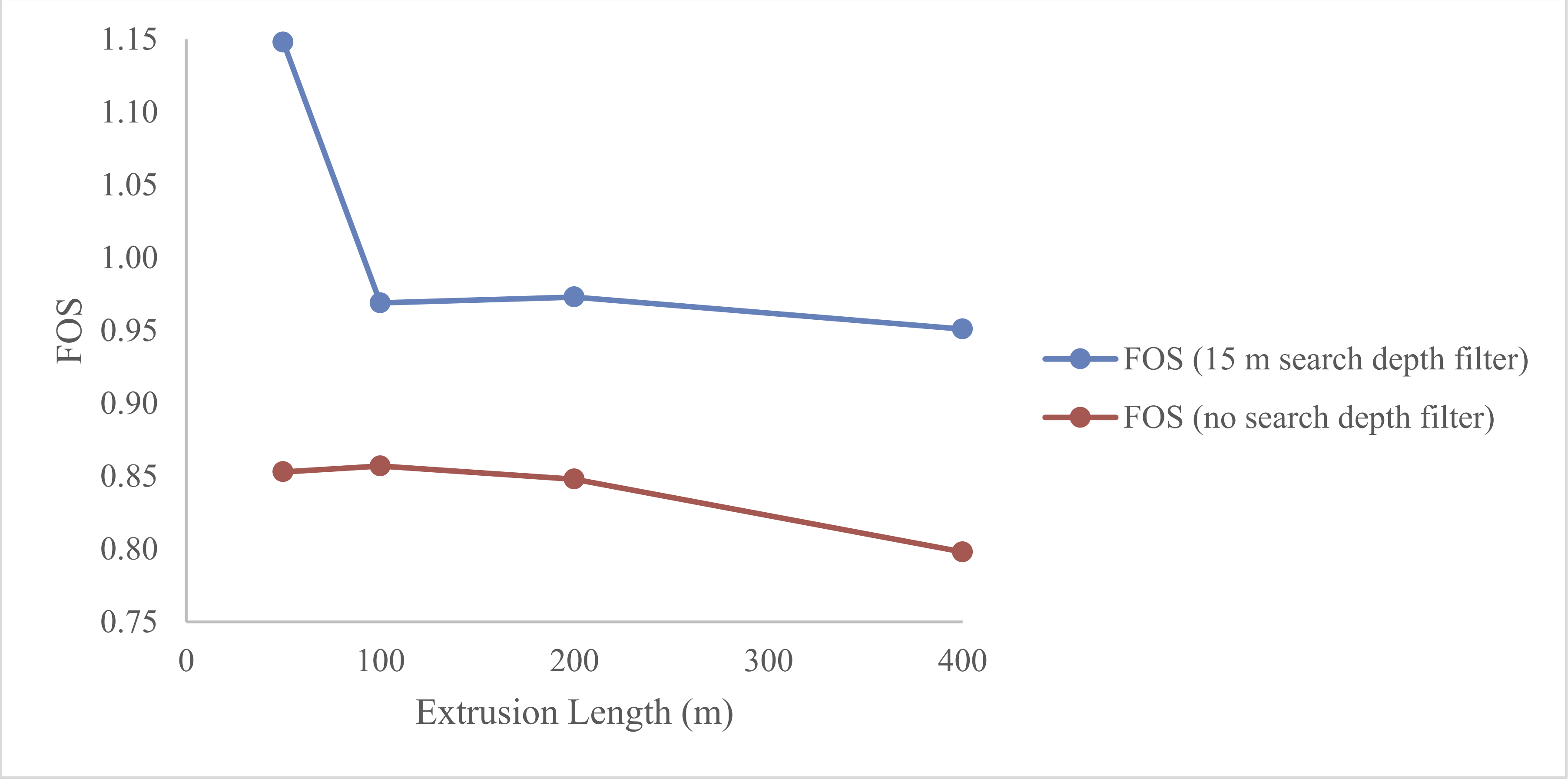
Figure 3 2D extruded non-linear GLE FOS
How can this help you with your projects?
This paper highlights the variance in FOS between 2D and 3D LE methods and that 3D LEM analysis consistently produces a higher FOS for anisotropic rock masses by capturing a more realistic representation of the slip surface.
3D LE is becoming widely adopted for complex engineering problems by giving you a better representation of your problem. If you want to benefit from the insight that 3D analysis provides, start a free two-week trial of Slide3.
Want to read more like this story?

3D Slope Stability Analysis of an Open Pit Mine in Minas Gerais, Brazil
Jul, 08, 2022 | NewsBy Thiago Bretas and Felipe Vilela, BVP Engenharia. Two-dimensional (2D) limit equilibrium analysis...
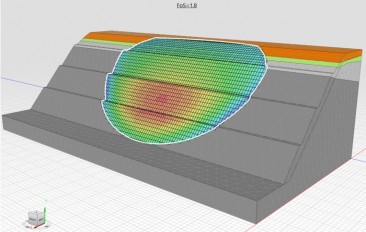
Effect of Joint Orientation on Inter Ramp Stability
Mar, 09, 2026 | NewsAnisotropy is an important factor in controlling the stability of rock slopes because it affects th...

Rocscience | Does 3D Slope Stability Analysis Always Produce Higher Factors of Safety than 2D?
Jul, 13, 2022 | NewsBy Reginald Hammah and Frema Awuku-Asabere A lot has been written about 3D slope stability analysis...

Why Run PLAXIS 3D Analysis?
Jun, 07, 2021 | NewsMost geotechnical engineers use FEA software packages for their geotechnical design. It is especial...

How Geotech’s can overcome time crunch: UAV Photogrammetry and 3D LEM Analysis
Aug, 23, 2022 | NewsWhen it comes to open pit mines, generally, the steeper the slopes, the greater the ore extraction,...

Importing pore-water pressure results from SEEP3D into a two-dimensional SLOPE/W analysis
Mar, 02, 2026 | NewsThis example replicates the “Rapid drawdown” examples illustrated in SEEP/W and SIGMA/W. The purpos...

2D or 3D LE? That is the Question - Yeager Airport Case Study
Jun, 02, 2021 | NewsWhen is 2D slope stability analysis sufficient and when should 3D analysis be used in conjunction w...

Rocscience | Vallcebre Landslide Stability Analysis Using Geophysical Data and Limit Equilibrium Methods in Slide3 and Slide2
Apr, 12, 2023 | NewsLandslides are complex bodies that are often made of heterogeneous geological materials and gradati...

Rocscience | Enhancing Integrations: Export Anisotropy from Slide3 to Slide2
Mar, 06, 2023 | NewsAs we all know, anisotropic materials have one strength in one direction and another strength in an...
Form
Looking for more information? Fill in the form and we will contact Rocscience Inc. for you.
On This Day
August 11th 1988
READ MORE
Trending

Quick Clay Failure on Norway’s E6 at Levanger

Keller North America announces recent leadership changes
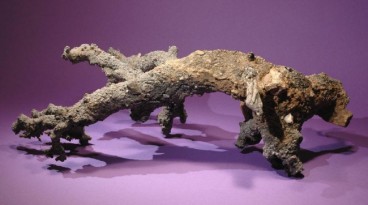
Fulgurite: A rare phenomenon

Life after gINT - Rethinking geotechnical data management for a new era
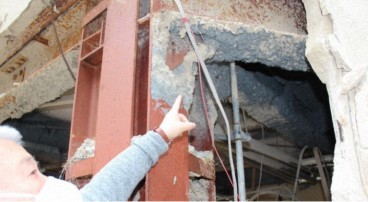
Asbestos remains a deadly infrastructure risk across the UK
Major earthquake in southern Philippines causes deaths and widespread damage