From Conservative to Precise: Settlement Prediction in Layered Soils with Settle3, RS2, and RS3 Sponsored
In geotechnical design, settlement prediction is only as reliable as the stress distribution used to drive it. Long before consolidation theories, constitutive models, or serviceability criteria enter the discussion, a more fundamental question must be addressed: are we calculating the induced stress correctly for the soil profile in front of us?
For homogeneous or near-homogeneous ground, classical Boussinesq-based approaches have served engineers well for more than a century. They are simple, transparent, and appropriately conservative in many practical situations. But for layered ground, especially where stiffness contrast is significant, the stress calculation method can change the entire engineering story.
In such conditions, the stress calculation method is no longer a minor modelling choice. It can reshape the entire engineering interpretation of a problem. What appears to be a safe and conservative estimate may, in reality, represent a substantial overprediction of settlement when stiffness contrasts redirect stress paths through the profile.
This article presents a controlled comparison of settlement prediction workflows in Settle3 against finite element reference models in RS2 and RS3. The goal is straightforward: hold the geometry, load level, and stratigraphy constant, and observe how different stress computation methods influence the predicted response.
At the center of this comparison is a method that carries a deeply personal and special legacy within Rocscience: The Multiple-Layer stress solution developed by our late colleague Dr. Vijayakumar Sinnathurai, together with Dr. Thamer Yacoub, through work that translated rigorous elastic theory into a practical engineering tool. Their collaboration helped bring a mathematically sophisticated method into everyday geotechnical design through Settle3.
The results that follow illustrate not only the engineering implications of stress calculation choices, but also the value of bringing deeper analytical rigour into practical settlement analysis workflows.
The Rocscience Legacy: Story Behind the Method
Vijay was not only a brilliant mathematician at Rocscience; he was also a thoughtful scientific and engineering collaborator. Many of us remember long technical afternoons discussing derivations, boundary behaviour, and the practical meaning of assumptions embedded in everyday design tools, along with many memorable personal conversations. He had a rare ability to hold mathematical rigour and engineering usability in the same frame.
The Multiple-Layer stress option in Settle3 reflects that mindset. It is elegant in formulation, practical in application, and highly relevant to real layered-soil projects. This work is both a technical comparison and a recognition of his contribution.
Problem Definition
The benchmark problem is a circular storage tank load on layered soil. We compare stress and resulting settlement using:
- Settle3 with Boussinesq stress calculation
- Settle3 with Multiple-Layers stress calculation
- RS2 and RS3 Finite Element models as reference
Across comparisons, the objective is straightforward: hold geometry, load level, and stratigraphy constant, then evaluate how the stress engine changes predicted response.
For linear elastic materials, the governing equations are linear and the finite element method provides a convergent approximation to the exact continuum solution as the mesh is refined (Zienkiewicz, Taylor & Zhu, 2013; Brenner & Scott, 2008). For this linear-elastic benchmark study, RS2/RS3 FEM results are used as high-fidelity numerical references for comparing Settle3 stress-calculation methods.

Brief Theory and Background
The Boussinesq method uses the theory of elasticity to calculate the vertical stress under a point load in a homogeneous, semi-infinite half space:

Where σL is the loading stress at any point and the meaning of the other symbols are as shown:
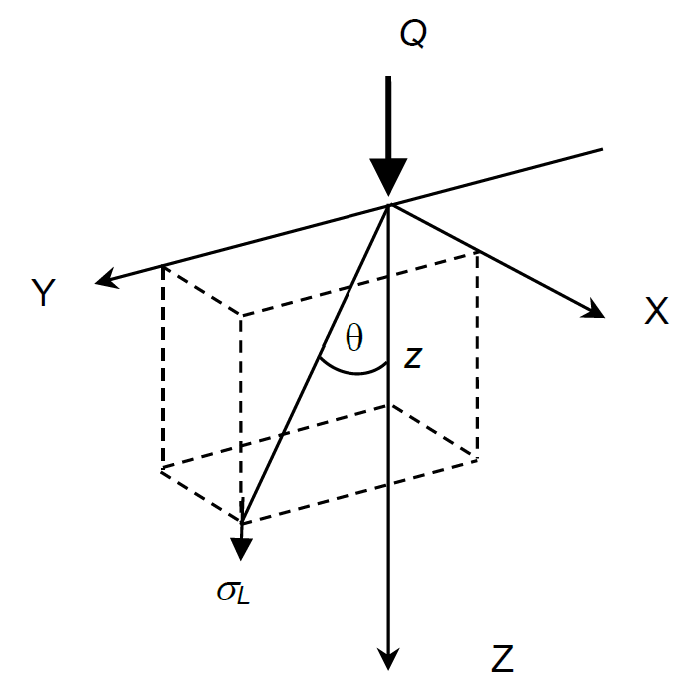
Useful solutions for stresses under different footing shapes can be obtained by integrating over the area of the footing. From the Boussinesq equation, it can be observed that the formulation is independent of material properties.
The Settle3 Multiple-Layers method is built on a more rigorous elastic framework than simplified one-layer stress approaches or the Boussinesq method. For an arbitrarily shaped foundation on a layered elastic medium, stresses and displacements are computed by integrating point-load solutions (Green’s functions) over the loaded area. Efficient evaluation of these point-load solutions follows the Hankel-transform computational scheme introduced by Yue (1995, 1996).
For each homogeneous elastic layer, the governing partial differential equations and inter-layer continuity conditions (matching stress and displacement at interfaces) are transformed into ordinary differential equations with algebraic boundary relations. Yue’s formulation solves this coupled transformed system using specially constructed transform-domain functions, and stresses and displacements are recovered through inverse transforms. In this formulation, each layer’s elastic properties—Young’s modulus and Poisson’s ratio—are explicitly used, so stiffness contrast and lateral deformation characteristics directly influence the computed stress and displacement fields.
Because these transform-domain functions are highly complex, direct implementation is numerically intensive. In practice, two levels of integration are required:
(1) evaluation of point-load responses, and
(2) numerical quadrature over the distributed load footprint.
In Settle3, these computational levels are reorganized to improve efficiency without sacrificing accuracy. Numerical accuracy is further enhanced using the boundary-conversion method of Vijayakumar, Yacoub, and Curran (2000), which converts area integrals into boundary integrals. This improves stability and mitigates singularity issues associated with point-load Green’s function solutions. In regions with rapidly varying stress gradients, particularly near load edges, an adaptive local subdivision scheme is applied.
Model Framework and Controlled Inputs
The key comparison cases include:
- Single-layer profile (baseline calibration case)
- Soft-top over stiff-bottom profile (10 m over 40 m)
- Stiff-top over soft-bottom profile (10 m over 40 m)
Representative model settings verified from project files include:
- Circular load radius = 7 m
- Uniform vertical load = 25 kPa
- Two-layer modulus contrast with E values of 10,000 kPa and 200,000 kPa
- Equivalent layered geometry in Settle3 and FEM models
A 7 m tank radius is appropriate for this benchmark because it produces a representative loaded footprint relative to the 10 m top layer thickness, making layer-interface effects clearly visible in stress and settlement comparisons. The model geometry and setup for Settle3 and RS2 are presented in Figure 3a and 3b respectively.
For the models the one-layer and multilayer files use the same geometric and loading setup, with the solution method changed from Boussinesq to Multiple-Layers (see Figure 1). This is the most important control in the study because it isolates method effect from setup effect.


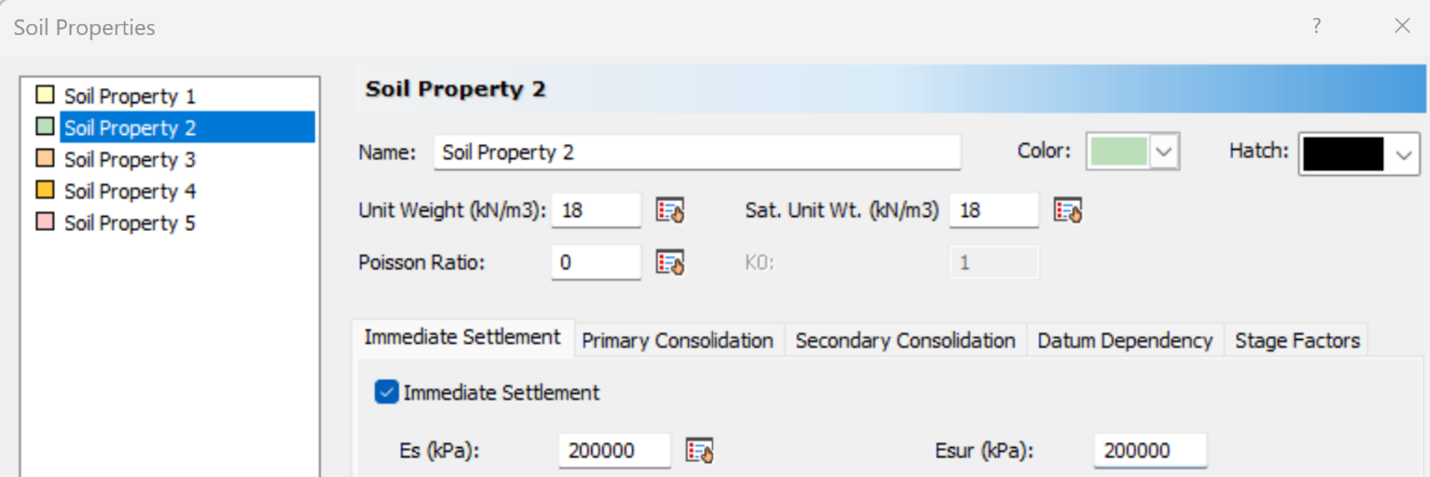
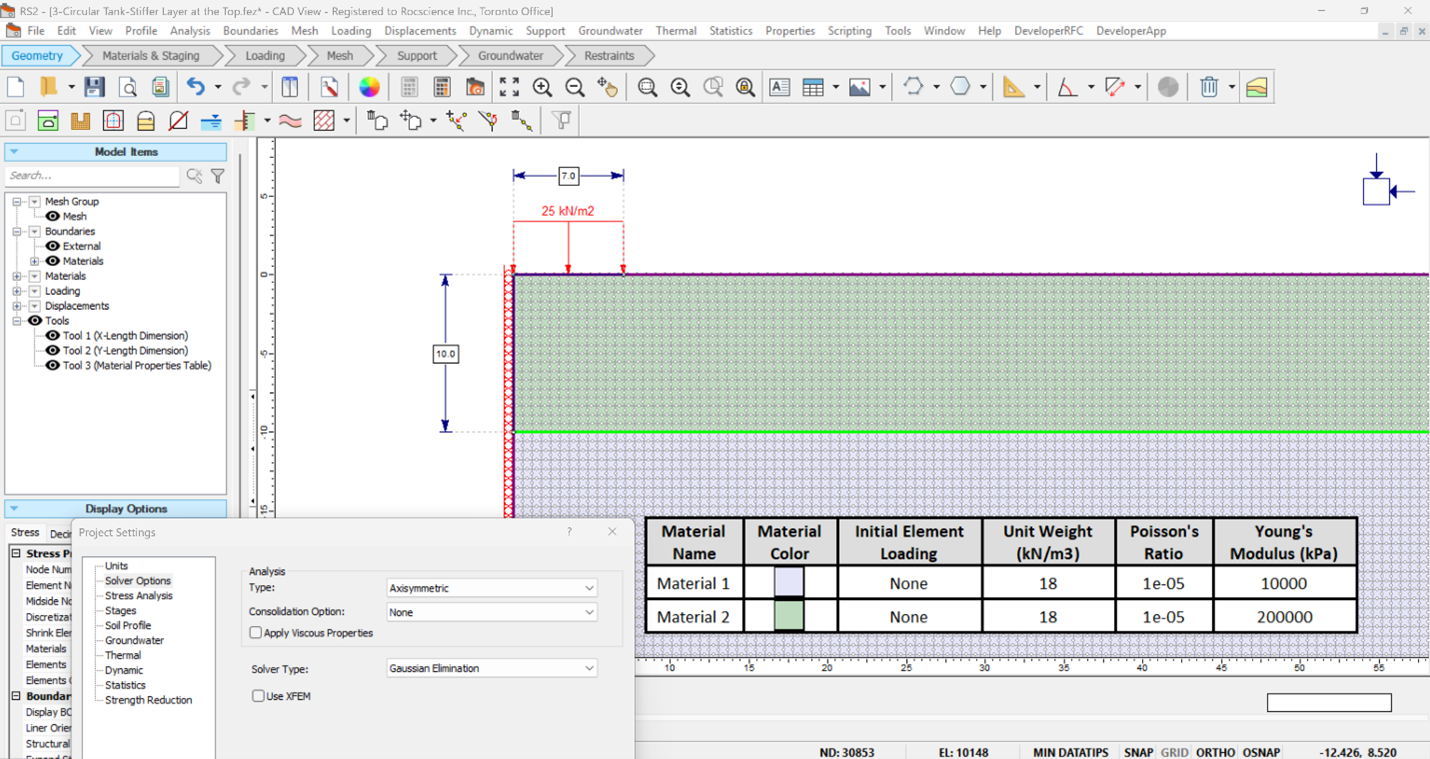
The Poisson’s ratio in the FEM model is set to a very small value so in terms of comparison and setting benchmarks, FEM results can reproduce the Boussinesq solution for a single layer problem. Note that the formulation of Boussinesq method, in calculation of loading stress, was independent of any material properties.
Summary of the assumptions used in this comparison:
- Linear-elastic material behaviour in the benchmark models.
- Matched geometry/loading/stratigraphy across Settle3 and FEM models.
- Very small Poisson’s ratio used in FEM and Settle3 Multiple-Layer methods to align with the comparison setup.
- Focus on stress-engine comparison rather than constitutive-model calibration.
Results Overview
1) Single-layer baseline
In the single-layer case, Settle3 Boussinesq, Settle3 Multiple-Layer, RS2, and RS3 show expected alignment trends. This baseline is useful because it demonstrates that differences are not caused by arbitrary model inconsistency.
Figure 4.a shows the simulation results in terms of variation of loading stress and settlement under the center of the load using different methods. Figure 4.b shows a side-by-side comparison of the loading stress and settlement bubbles (distribution contours) from Boussinesq of Settle3 against RS2.

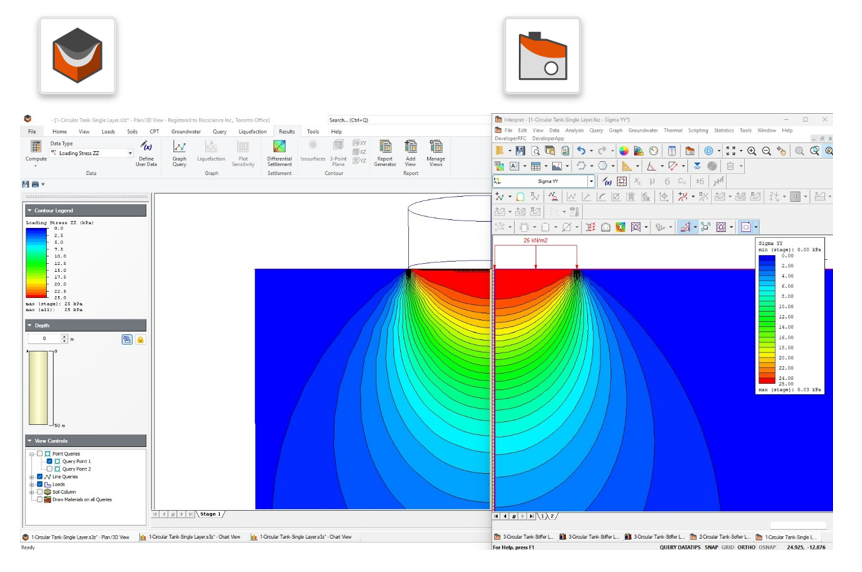
For a better comparison between the results Table 1 summarizes some key results of stress and settlement calculations.
| Depth (m) | Settle3- Boussinesq Loading Stress (kPa) | Settle3-Multiple Layers Loading Stress (kPa) | RS2 (FEM) Loading Stress (kPa) | RS3 (FEM) Loading Stress (kPa) | |
| 0 | 25 | 25 | 25 | 25 | |
| 10 | 11.097 | 11.097 | 11.28 | 11.12 | |
| 20 | 3.89943 | 3.899 | 4.05 | 3.955 | |
| 30 | 2.29419 | 1.87 | 2.60 | 2.15 |
Table 1a. Calculate Loading Stress at different depth under the center of the load using different methods in Settle3 compared to FEM solutions
| Depth (m) | Settle3- Boussinesq Settlement (mm) | Settle3-Multiple Layers Settlement (mm) | RS2 (FEM) Settlement (mm) | RS3 (FEM) Settlement (mm) | |
| 0 | 31.0332 | 31.0332 | 31.996 | 31.545 | |
| 10 | 11.6812 | 11.6812 | 12.541 | 12.239 | |
| 20 | 5.00091 | 5.00091 | 5.6981 | 5.546 | |
| 30 | 1.86996 | 2.29419 | 2.8241 | 2.751 |
Table 1b. Calculate Settlement at different depth under the centre of the load using different methods in Settle3 compared to FEM solutions
All methods in this case are in very close agreement, and the solution is very close to exact solution.
2) Soft-top over stiff-bottom profile
With a softer top layer over a stiff base, the Settle3 Multiple-Layer response tracks FEM behavior more closely than Boussinesq Method. Both stress distribution and settlement trends indicate improved representation of layered stiffness effects by Multiple-Layers method. However, comparing the single layer problem in previous section it is obvious that the results are starting to deviate form each other.
Figures 5 illustrates these findings, in graphs of variation of loading stress and settlement under the center of the load using different methods, and a side-by-side comparison of the loading stress and settlement bubbles (distribution contours) from Boussinesq and Multiple-Layer methods of Settle3 against RS2.


For a better comparison between the results Table 2 summarizes some key results of stress and settlement calculations.
| Depth (m) | Settle3- Boussinesq Loading Stress (kPa) | Settle3-Multiple Layers Loading Stress (kPa) | RS2 (FEM) Loading Stress (kPa) | RS3 (FEM) Loading Stress (kPa) | |
| 0 | 25 | 25 | 25 | 25 | |
| 10 | 11.097 | 14.9106 | 15.411 | 15.34557 | |
| 20 | 3.89943 | 5.66152 | 6.44085 | 6.269389 | |
| 30 | 2.29419 | 2.57863 | 3.10705 | 3.017277 |
Table 2a. Calculate Loading Stress at different depth under the centre of the load using different methods in Settle3 compared to FEM solutions
| Depth (m) | Settle3- Boussinesq Settlement (mm) | Settle3-Multiple Layers Settlement (mm) | RS2 (FEM) Settlement (mm) | RS3 (FEM) Settlement (mm) | |
| 0 | 19.9361 | 21.9703 | 22.15 | 22.05 | |
| 10 | 0.584058 | 0.820881 | 0.94656 | 0.924 | |
| 20 | 0.250045 | 0.344736 | 0.42735 | 0.416 | |
| 30 | 0.114709 | 0.152135 | 0.20336 | 0.198 |
Table 2b. Calculate Settlement at different depth under the center of the load using different methods in Settle3 compared to FEM solutions
As expected, the loading stress in the soft-top case matches the single-layer case for the Boussinesq-based method because that formulation is independent of material properties. Surface settlements are likewise close across methods, and no significant differences are observed at that elevation.
3) Stiff-top over soft-bottom profile
This is where the engineering impact is most pronounced. The Boussinesq method becomes markedly conservative relative to FEM, while the Settle3 Multiple-Layer option remains closely aligned with FEM trends. In the presented results, the Boussinesq method overestimates settlement by approximately a factor of two in the stiff-top condition.
Figure 6 illustrates these findings through: (1) plots of loading stress and settlement variation beneath the center of the load for different methods, and (2) side-by-side contour comparisons (stress/settlement bubbles) from Settle3 Boussinesq and Settle3 Multiple-Layer against RS2. The stress contours from Boussinesq differ noticeably from RS2, whereas the Multiple-Layer contours are in close agreement with RS2.


For a better comparison between the results Table 3 summarizes some key results of stress and settlement calculations.
| Depth (m) | Settle3- Boussinesq Loading Stress (kPa) | Settle3-Multiple Layers Loading Stress (kPa) | RS2 (FEM) Loading Stress (kPa) | RS3 (FEM) Loading Stress (kPa) | |
| 0 | 25 | 25 | 25 | 25 | |
| 10 | 11.097 | 3.29451 | 3.7654 | 3.989811 | |
| 20 | 3.89943 | 1.52346 | 1.6901 | 1.616441 | |
| 30 | 2.29419 | 0.914039 | 1.0407 | 0.990037 |
Table 3a. Calculate Loading Stress at different depth under the centre of the load using different methods in Settle3 compared to FEM solutions
| Depth (m) | Settle3- Boussinesq Settlement (mm) | Settle3-Multiple Layers Settlement (mm) | RS2 (FEM) Settlement (mm) | RS3 (FEM) Settlement (mm) | |
| 0 | 12.1065 | 6.00886 | 6.1542 | 5.915 | |
| 10 | 5.84058 | 5.23029 | 5.393 | 5.159 | |
| 20 | 2.50045 | 2.76224 | 2.8878 | 2.747 | |
| 30 | 1.14709 | 1.43554 | 1.5732 | 1.492 |
Table 3b. Calculate Settlement at different depth under the centre of the load using different methods in Settle3 compared to FEM solutions
As expected, the calculated loading stress in this case is the same as in the single-layer case for the Boussinesq-based method, because that formulation is independent of material properties. This is precisely why the Boussinesq method can significantly overestimate settlement in layered profiles with strong stiffness contrast.
Why This Matters for Design
Conservative methods are valuable and often necessary. However, layered ground conditions are common in practice, and a method that is conservative in principle can become misleading in magnitude when stiffness contrasts are high. Overestimation at this scale can propagate into unnecessary design changes, cost escalation, and avoidable construction constraints.
The key point is not to replace engineering judgement with a single “always correct” method. Rather, it is to apply the appropriate level of stress fidelity for the ground conditions being modelled.
Practical Recommendation
For settlement analysis under stratified soils:
- Use one-layer/Boussinesq-style stress as a familiar baseline and quick conservative check.
- Use Settle3 Multiple-Layers as the preferred routine approach where stiffness contrast is present.
- Use RS2/RS3 FEM for deeper verification in high-consequence or highly complex cases.
In practical terms, Settle3 makes this upgrade accessible. Engineers can move from the conventional one-layer assumption to layered stress treatment with minimal workflow friction.
Legacy and Continuity
The Multiple-Layer stress option is not merely a feature in a menu. It demonstrates what happens when mathematical depth is translated into day-to-day engineering utility. Vijay helped make that possible, and his work continues to shape how we evaluate stress and settlement in real projects.
For those of us who worked with him, this comparison is more than validation. It continues conversations that began years ago: how to keep geotechnical tools both trustworthy and practical, and how to support better engineering decisions with the least unnecessary conservatism. That same mindset continues to guide the development of Rocscience software today.
Conclusion
The selection of a stress computation method is not a cosmetic modelling choice. It can materially alter predicted settlement and, therefore, influence design outcomes.
The comparisons presented here illustrate this clearly. For homogeneous conditions, classical Boussinesq solutions remain reliable and consistent with finite element predictions. However, once layered stiffness contrasts are introduced, the limitations of the one-layer assumption become increasingly apparent.
In such cases, the Settle3 Multiple-Layer formulation provides results that align closely with FEM solutions in RS2 and RS3, while preserving the efficiency expected from a settlement analysis tool.
This balance of analytical rigour combined with practical usability captures the purpose behind the method’s development. It allows engineers to move beyond simplified assumptions when the ground conditions demand it, while still working within an efficient analytical workflow.
Ultimately, settlement analysis is not about selecting the most complex model available. It is about choosing the model that best represents the ground conditions being evaluated. When layered soils govern the response, incorporating layered stress solutions becomes not just an improvement in accuracy, but a step towards more informed and reliable engineering decisions.
Source: From Conservative to Precise: Settlement Prediction in Layered Soils with Settle3, RS2, and RS3
Want to read more like this story?
SO-Foundation
Feb, 07, 2015 | Software
UniSettle 4.0
Jun, 13, 2023 | Software
Settle3
Oct, 02, 2020 | Software
Rocscience | Settle3's New Section Designer
Sep, 13, 2022 | NewsSettle3 is one of the industry's leading 3D Settlement and Foundation Analysis tools. It allows you...

Solving Complex Geotechnical Analysis Challenges
Aug, 31, 2022 | NewsGeotechnical challenges are everywhere, starting from the soil interaction with the foundation of o...

Settlement Analysis using Settle3 | REM Light Rail Construction
Mar, 02, 2023 | NewsWhen a major part of your infrastructure project lies over a long stretch of peatland, various prec...

Rocscience | Undrained analysis of a deep excavation in clayey soils using PLAXIS Hardening Soil model in RS2
Apr, 28, 2023 | NewsWhen analyzing a geotechnical problem, different design parameters are utilized depending on draine...

3D Modeling of Soil-Foundation-Structure Interaction: Case History at Fly Ash Silo, Maasvlakte Rotterdam
Sep, 14, 2020 | EducationNote: This Case History was first presented in Plaxis Bulletin, Autumn issue 2013, by L.F.J. Bekke...
Finite Element / Finite Difference
Oct, 13, 2025 | EducationOverview The Finite Element Method (FEM) has established itself as a powerful numerical technique i...
Form
Looking for more information? Fill in the form and we will contact Rocscience Inc. for you.
On This Day
August 10th 1874
READ MORE
Related Video

Trending
Seven Frequently Asked Questions about Helical Piles

Block caving: A new mining method arises

Categories of isolated foundation footings
Maharashtra's longest road tunnel to be completed soon

Carnian Pluvial Episode: That time when it rained for 1-2 million years
Tailrace tunnel breakthrough advances Australia’s largest renewable project

A Legacy of Leadership, Mentorship & Service: Gary L. Seider P.E.