PLAXIS 3D Study Finds Winged Piles Can Cut Uplift Settlement by Up to 95% in Sandy Soil Sponsored
A PLAXIS 3D numerical study of under-reamed 'winged' piles in sandy soil has found that adding a wing near the pile tip can cut uplift-induced settlement by up to 95% compared with a conventional straight-shaft pile at the same applied load.
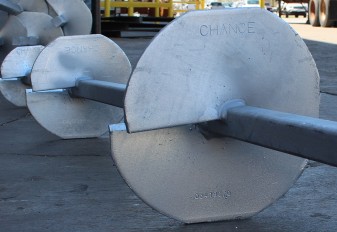
The study, presented at ICSMGE 2026 by Maher Jebur, Firas Ghrairi, Adnan Qahtan and Mahdi Karkush of the University of Baghdad, Khawla Aljuari of the University of Mosul, Askar Zhussupbekov and Gulnaz Zhairbayeva of L.N. Gumilyov Eurasian National University in Astana, and Issakulov Abilkhair of K. Zhubanov Aktobe Regional University, used PLAXIS 3D to analyse the pullout performance of winged piles in sandy soil, using soil properties taken from Al-Muthanna Governorate in southern Iraq. Winged, or under-reamed, piles carry one or more enlarged 'wing' sections along the shaft to mobilise additional soil resistance, and are used in structures that experience tensile or pullout forces, including transmission towers, bridge abutments and submerged platforms.
Modelling the Pile-Soil Interface in PLAXIS 3D
The PLAXIS 3D model represented a pile of 0.45 m diameter and 12 m length with a wing diameter of 1.0 m, tested with the wing placed at four different depths along the shaft, measured from the pile head: L, 0.75L, 0.5L and 0.25L, and compared against a conventional uniform straight-shaft pile with no wing. The sandy soil was modelled using the Mohr-Coulomb constitutive model to represent its shear strength and dilatancy, while the pile itself was modelled as a linear elastic material. Interface elements were added around the periphery of the pile and its wing to reproduce the frictional and adhesive contact between soil and pile, and the model domain's lateral and bottom boundaries were extended well away from the pile to avoid boundary effects on the computed stresses and deformations. PLAXIS 3D discretised the domain with 10-node tetrahedral elements, and a mesh sensitivity analysis found that a global 'Fine' coarseness setting gave an adequate balance of accuracy and computational efficiency.
The loading sequence was run in PLAXIS 3D as four stages: an initial K0 procedure to establish in-situ geostatic stresses, deactivation of the soil volume within the pile cluster to represent borehole formation or pile installation, activation of the pile and wing structure together with the interface elements to simulate soil-pile interaction, and finally an applied axial displacement at the pile head to simulate the pullout condition, with reaction forces recorded to determine uplift capacity. Before running the winged-pile cases, the authors validated the modelling approach in PLAXIS 3D against published experimental pullout test data for a 4.5 m under-reamed pile, reporting a high degree of correlation between the simulated and measured load-displacement response, which they state confirmed the constitutive models, interface parameters and boundary condition assumptions used.
PLAXIS Contours Show the Wing's 'Bulb Effect'
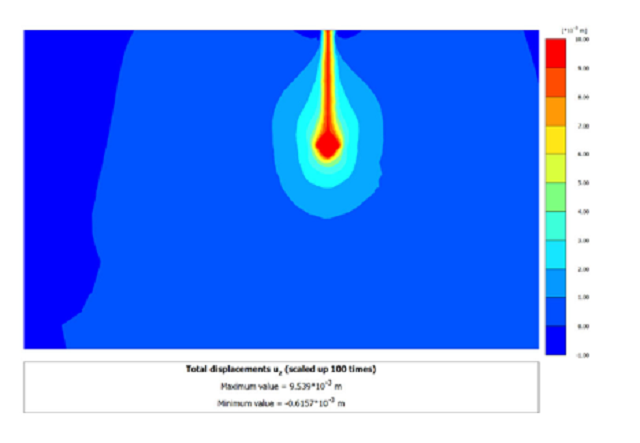
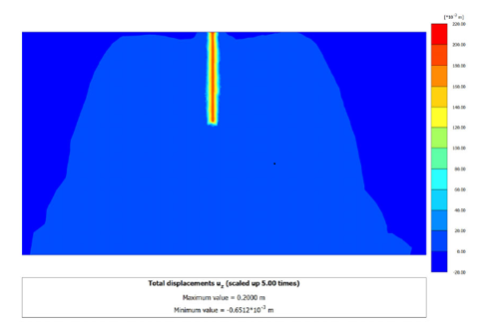
Running the calibrated model across the five pile configurations, PLAXIS 3D's uplift displacement contours showed the conventional uniform pile mobilising a narrow column of soil directly around the shaft, with an uplift displacement of about 0.20 m under the applied load.
By contrast, the winged pile configurations mobilised a distinctly bulb-shaped mass of soil around the wing, with recorded displacements of 0.009 m for the wing positioned at L, 0.013 m at 0.75L, 0.020 m at 0.5L, and 0.051 m at 0.25L. The pile with the wing at position L, which produced the smallest displacement of any configuration, achieved an approximately 95% increase in uplift capacity relative to the conventional pile at the same 20 mm vertical displacement, the largest improvement among the configurations tested.
The authors conclude that placing wings on a pile considerably reduces uplift-induced settlement, by between 74% and 95% depending on the pile's geometry and the embedment depth of the wing, and that a properly designed and positioned wing can significantly improve pullout capacity and soil-pile interaction relative to a conventional, non-winged pile in sandy soil.
Source: Numerical Analysis of Uplift Resistance for Winged Piles in Sandy Soil
Want to read more like this story?

How to Model Piles in PLAXIS
Jun, 17, 2021 | NewsThe problem of analyzing and designing deep foundations is relevant to many civil engineering struc...
Pile Foundations
May, 29, 2024 | EducationPile foundation is actually a slender column or long cylinder made of materials such as concrete...

PileGroup
Mar, 14, 2015 | Software
GEO5 Pile Group
Aug, 16, 2019 | Software
Pile Group Settlement (GEMS)
Aug, 19, 2022 | Software
Coffee Corner: Geotechnical Analysis (PM) - Pile Group Behaviour: From Single Pile to Group Efficiency
Apr, 17, 2026 | EventPile-supported foundations are often evaluated based on the assumptions of single-pile behavior. How...

VERSAT-P3D
Nov, 13, 2013 | Software
RSPile
Oct, 02, 2020 | Software
Driven Pile Professional Software
Jun, 13, 2023 | SoftwareForm
Looking for more information? Fill in the form and we will contact Seequent, The Bentley Subsurface Company for you.
On This Day
August 17th 1959
READ MORE
Related Video

Trending

Fehmarnbelt tunnel advances with first element ready for immersion

Geotechnical Engineering 2032 Boom: Trends, Challenges, and Emerging Opportunities

Emergency protocols activated following offshore 7.7 magnitude earthquake in Japan
Active landslide threatens long-term connectivity in southern Bulgaria
Tailrace tunnel breakthrough advances Australia’s largest renewable project

A Legacy of Leadership, Mentorship & Service: Gary L. Seider P.E.