PLAXIS 2D Dynamic Analysis Shows Hammer-Induced Pore Pressure Can Cut Offshore Monopile Driving Resistance by 62% Sponsored
A PLAXIS 2D dynamic finite element study of offshore monopile driving has found that excess pore pressure generated by hammer blows can reduce soil resistance to driving by up to 62%, a mechanism the authors say is missing from standard driveability calculations and is central to the industry's poorly understood 'pile run' problem.
The paper, presented at ICSMGE 2026 by Indrasenan Thusyanthan of Aramco and Anastasios Batilas, Martin Gichura and David Champness of Venterra Group, addresses pile run, the sudden and uncontrolled freefall of a pile during installation. As offshore wind developers install ever-larger monopiles in areas with limited prior driving experience, the authors note that traditional Soil Resistance to Driving (SRD) methods, which are based on back-analysis of historical pile-driving records, do not account for the excess pore water pressure generated by hammer blows, even though this pore pressure build-up reduces effective stress and can trigger pile run.
From CPT-Based SRD to a Coupled PLAXIS Model
The authors first reviewed four established CPT-based SRD methods, Alm and Hamre, Maynard et al. (2019), Jones et al. (2021), and MonoDrive, and selected the Maynard et al. (2019) method, developed specifically for large-diameter monopiles and giving the most conservative (lowest) SRD estimate, as the baseline for their study. To go beyond this static baseline, they built a two-dimensional axisymmetric, fully coupled, nonlinear dynamic finite element model in PLAXIS 2D Ultimate, representing a hollow steel monopile 8.0 m in diameter, 65 m long, with a 0.08 m wall thickness and a total self-weight of about 10 MN, driven by an IHC S-2000 hydraulic hammer with an ancillary weight of about 5.5 MN.
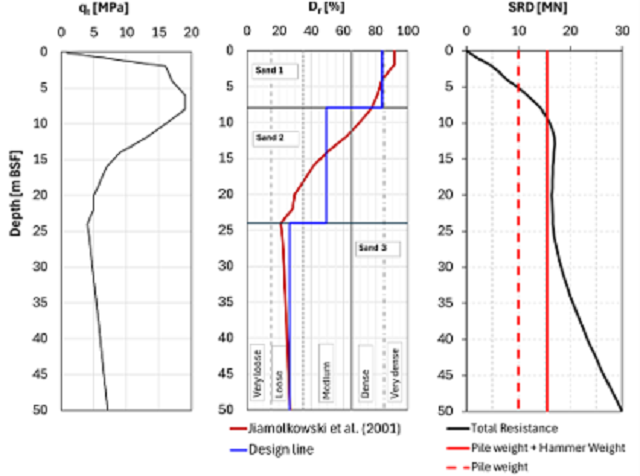
The dynamic soil response was modelled using UBC3D-PLM, an effective stress elastoplastic constitutive model capable of simulating liquefaction of sandy soil under dynamic loading. Because UBC3D-PLM is not well suited to establishing initial stress conditions, the Hardening Soil small-strain (HS-small) model was used for the first stage of the analysis, the K0 procedure that generates in-situ stresses, before the pile was wished in place at 9 m below ground level, the depth at which the combined pile and hammer weight of 15.5 MN equilibrates with the calculated SRD. The mesh was sized according to the lowest shear wave velocity and highest input frequency, and the model domain extended 50 m laterally and 100 m vertically, with viscous boundaries to prevent spurious wave reflections, dimensions confirmed by a sensitivity study to be free of boundary effects
Hammer impacts were simulated in PLAXIS as a half-sine wave line load applied at the pile head, with hammer energy ranging from 200 to 2000 kJ (the IHC S-2000's specified minimum and maximum), blow rates of 5 to 35 blows per minute, and up to 125 blows, corresponding to the refusal criterion in ISO 19901-4:2016. The coupled dynamic-consolidation analysis was run for two seabed permeability values, representative of coarse sand and a fine sand-silt mixture, to examine how drainage conditions affect pore pressure build-up during driving.
Hammer Energy and Blow Count Drive Pore Pressure and SRD Loss
The PLAXIS results showed that hammer energy has a significant effect on the computed SRD profile. At high blow rates combined with a low number of blows, SRD decreased by up to 29%, averaging about 6.5%. At high blow rates combined with a high number of blows, SRD decreased by up to 62%, averaging about 29%, with the largest reductions, up to 62%, occurring with high hammer energy (2000 kJ) and a high number of blows, which the authors attribute primarily to liquefaction of the deeper Sand 03 layer. Varying the number of blows at low hammer energy (200 kJ) produced SRD reductions of up to 21% (average about 2.5%), while at high hammer energy (2000 kJ) reductions ranged from 6% to 62% (average about 30%); the authors note that the SRD reduction was largely independent of blow rate itself, with only a 0.3-1.2% average difference across blow rates at a given energy level.
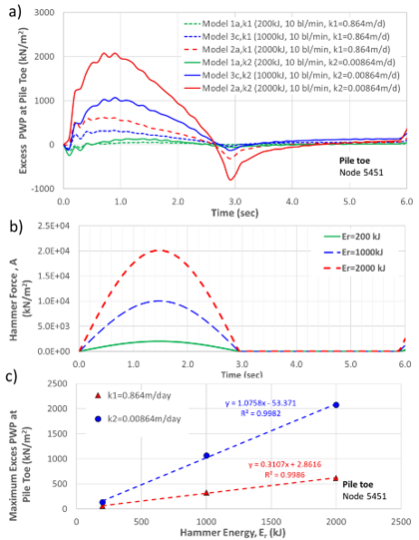
The model showed that excess pore water pressure generation increased approximately linearly with hammer energy, and that the sand with higher hydraulic conductivity generated lower excess pore pressure than the sand with lower hydraulic conductivity, for the same hammer energy.
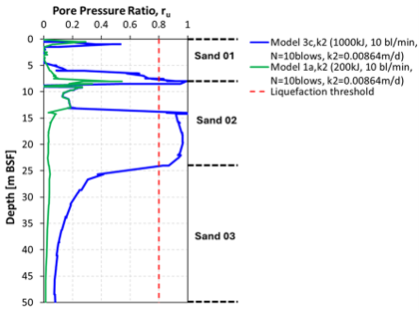
Comparing the pore pressure ratio with depth after 10 blows, the authors found that the lower-permeability case reached a pore pressure ratio above 0.8, the threshold used in the literature to define liquefaction, across much of the modelled depth, whereas the lower-energy case remained well below that threshold. The authors state this highlights the role of temporary liquefaction, driven by low soil permeability and high hammer energy, in triggering pile run.
The authors conclude that a two-dimensional axisymmetric, fully coupled, nonlinear dynamic finite element analysis using the UBC3D-PLM model can assist pile run risk prediction by capturing the excess pore pressure generation that conventional SRD calculations do not account for. They note that excess pore pressure build-up during impact driving depends on both soil permeability and hammer energy, and recommend that improved SRD prediction methods be developed by integrating CPT-based analytical approaches, such as Maynard et al. (2019), with numerical model outputs that incorporate these dynamic effects and excess pore pressure generation, to better reflect real-world installation conditions.
Source: Insight into Pile Run Risk of Offshore Pile during Installation
Want to read more like this story?

Pile Driving Hammer Performance
Apr, 22, 2019 | EventWhen: Tuesday, December 2, 2014 Who should attend:Geotechnical, structural and construction engi...

Webinar on Pile Driving Hammer Performance
Dec, 04, 2019 | EventPile Dynamics, Inc. (PDI), will present a webinar on Pile Driving Hammer Performance. Thie session...

Webinar on Pile Driving Hammer Performance
Apr, 22, 2019 | EventWhen: Tuesday, December 1, 2015 Who should attend: Geotechnical, structural and construct...
Pile Driving Hammer Performance
Apr, 22, 2019 | EventLecturer: Dr. Frank Rausche, is a principal of Pile Dynamics, Inc. He has been involved in the resea...
Webinar on Pile Driving Hammer Performance
Apr, 22, 2019 | EventWhen: Tuesday, December 11, 2018 This session will begin at 9:00 am Eastern Time (New York Time) an...
PLAXIS 2D PM4Sand analysis cuts predicted liquefiable layer thickness by up to 81% versus simplified methods
Jul, 15, 2026 | NewsA comparison of three liquefaction assessment methods for an offshore wind site has found that a ful...
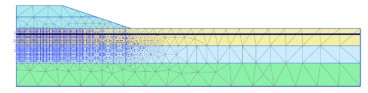
Consolidation Analysis for Embankments
Aug, 12, 2022 | NewsConstruction of embankments on soft soil presents a challenge. Soft soil deposits have a high moist...

GRLWEAP14 Wave Equation Analysis
Dec, 19, 2013 | Software
Webinar on Pile Driving Hammer Performance
Apr, 22, 2019 | EventWhen: December 6, 2016 This program corresponds to 1.5 Professional Development Hours. A Certificat...
Form
Looking for more information? Fill in the form and we will contact Seequent, The Bentley Subsurface Company for you.
On This Day
August 25th 1933
READ MORE
Related Video

Trending
Active landslide threatens long-term connectivity in southern Bulgaria


PLAXIS example: Westergaard's added mass for hydrodynamic pressures

Rock Mass Classification Systems: A Global Review of Use and Dominant Approaches
How does the Leaning Tower of Pisa survive earthquakes
Nepal’s Himalayan settlements face escalating flood and landslide threats