PLAXIS 2D PM4Sand analysis cuts predicted liquefiable layer thickness by up to 81% versus simplified methods Sponsored
A comparison of three liquefaction assessment methods for an offshore wind site has found that a fully coupled PLAXIS 2D dynamic analysis using the PM4Sand constitutive model predicted a critical liquefiable layer thickness up to 81% smaller than a standard simplified empirical method, with direct implications for offshore foundation design cost.
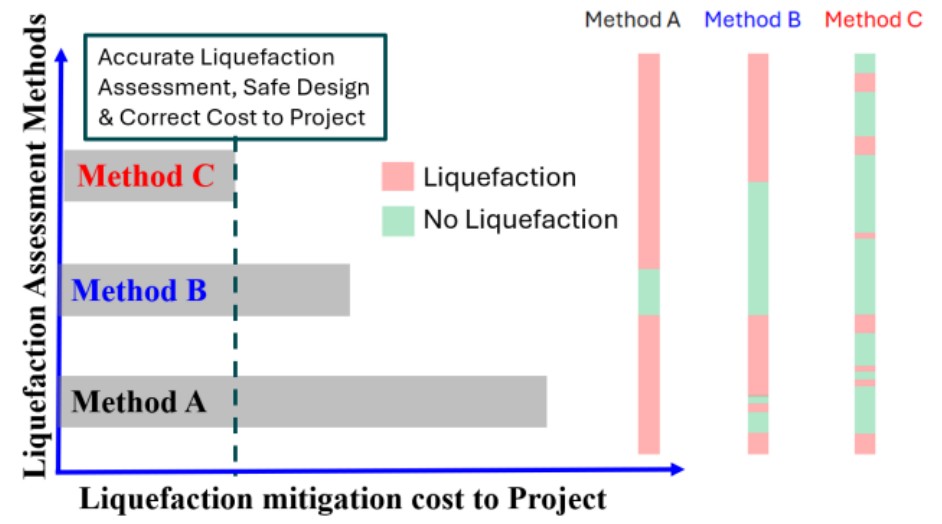
The study, presented at ICSMGE 2026 by Anastasios Batilas and Efstathia Chioti of Venterra Group (Gavin & Doherty Geosolutions), Dublin, and Indrasenan Thusyanthan of Aramco, addresses liquefaction assessment for offshore wind turbine foundations in seismic regions. The authors compared three methods on a single offshore soil profile, derived from a cone penetration test with pore pressure measurement (CPTu) to 60 m below seabed level, classified into nine main layers of sand, stratified sand-clay mixtures and clay: Method A, the simplified CPT-based empirical procedure of Boulanger and Idriss (2014); Method B, a one-dimensional nonlinear site-specific response analysis (1D SSRA) carried out in DEEPSOIL; and Method C, a two-dimensional, fully coupled, nonlinear dynamic finite element analysis carried out in PLAXIS 2D Ultimate using the PM4Sand constitutive model.
Building and Calibrating the PLAXIS 2D Model
For Method C, PM4Sand, a stress-ratio controlled, critical-state compatible bounding surface plasticity model for sands, was used to model the dynamic behaviour of the sand layers, while the Hardening Soil model with small-strain stiffness (HSsmall) was used for the clay layer, since the authors note that PM4Sand does not accurately capture initial stress conditions on its own. The analysis was run in two stages in PLAXIS: an initial K0 procedure to establish in-situ stresses, followed by a dynamic analysis with an Undrained A drainage type to allow excess pore pressures to develop, using two strong earthquake recordings of moment magnitude 7.7 applied at the modelled bedrock. Mesh element sizes were set according to the lowest shear wave velocity and the highest frequency of the input motion to ensure the mesh could resolve the propagating wave.
The primary PM4Sand parameters for each sand layer, apparent relative density, the shear modulus coefficient, and the contraction rate parameter, were calibrated using two stress-controlled cyclic direct simple shear laboratory tests on samples retrieved from 9.1 m and 44.6 m below seabed level. The shear modulus coefficient was fitted to match the measured shear wave velocity, while the contraction rate parameter was calibrated in PLAXIS's SoilTest single-element tool to reproduce the target cyclic resistance ratio measured in the laboratory, with the onset of liquefaction defined as 3% single-amplitude shear strain. The authors report that the calibrated PM4Sand model, run as a single-element simulation, closely reproduced the laboratory cyclic direct simple shear results for the 9.1 m sample.
Three Very Different Estimates of Liquefiable Thickness
Comparing the three methods on the same soil profile and earthquake inputs, the authors found substantial differences in the predicted extent of liquefaction. Method A produced a factor of safety below 0.75 across almost the entire 55 m depth examined for both earthquake records, implying that all of the non-cohesive soil layers in the profile would liquefy. Method B produced a factor of safety below 0.75 to about 15 m depth and only marginally below 1.0 down to about 25 m, giving a critical liquefiable layer thickness of about 42 m, a 24% reduction compared with Method A, since Method B identified soil layers between 25-33 m and 52-57 m bsl as not liquefiable.
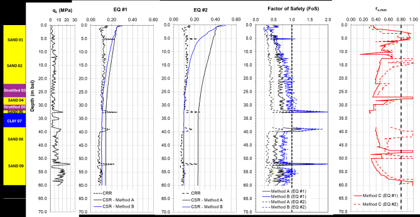
For Method C, using a threshold of maximum excess pore pressure ratio (ru,max) of 0.8 or greater to define liquefaction, the PLAXIS PM4Sand model computed ru,max generally below 0.8 across most of the profile, with only thin sections reaching or exceeding the threshold. For the first earthquake record, liquefaction was predicted between 2.3-5.5 m, 27-28 m, 47-48 m and 58.5-60 m bsl, a total thickness of 6.7 m; for the second record, liquefaction was predicted across a somewhat larger set of thin zones totalling 10.2 m. The authors report a maximum critical liquefiable layer thickness from Method C of about 10.5 m, representing an 81% reduction compared with Method A and a 75% reduction compared with Method B.
What the Difference Means for Offshore Foundation Design
The authors attribute the difference partly to the fact that Method A's stress reduction coefficient depends only on earthquake magnitude, not on the specific ground motion record, producing high variability in cyclic stress ratio and factor of safety between the two earthquake recordings used in the study, whereas Method B's site response analysis produced a much more consistent factor of safety profile between the two records. They also note that only Method C, through its fully coupled effective-stress formulation, can track pore pressure generation during shaking and distinguish between full and partial liquefaction, capabilities that the CPT-based and 1D site response methods do not provide.
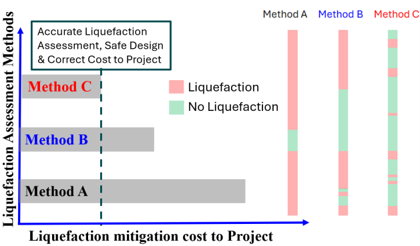
The authors conclude that Method A is overconservative and appropriate only for initial screening assessments, not detailed design; Method B is suited to conceptual and front-end engineering design stages and is acceptable for detailed design but will not by itself produce an optimised foundation design; and Method C, the PLAXIS 2D PM4Sand analysis, is recommended for cost optimisation during detailed design of offshore wind foundations, on the basis that its more accurate and in-depth liquefaction assessment can lead to foundation designs that are both safe and cost-effective.
Want to read more like this story?

Liquefaction and Earthquake Modelling in PLAXIS
Jun, 30, 2021 | EducationThe following was prepared by Dr. Ronald B.J. Brinkgreve, and first presented by Virtuosity. Geotec...

PLAXIS 2023.2 New release is out!
Sep, 07, 2023 | NewsThis latest release solidifies Seequent's Connected Geotechnical Workflow, reducing the need for du...
Optimizing Soil Improvement with PLAXIS: Techniques and Benefits
Nov, 12, 2024 | NewsSoil improvement refers to the process of modifying the physical properties of soil to improve its...

Public release of the NASEM Report on Liquefaction Assessment
Feb, 02, 2017 | NewsThe National Academies of Science, Engineering & Medicine (NASEM) recently released a report of...

Numerical & Constitutive Modeling
Mar, 29, 2024 | EducationNumerical Modelling in Geotechnical Engineering: A Gateway to Simulating the Ground Complexity A...
Considerations and Applications of FEA
Oct, 13, 2025 | EducationSetting up an FE model in geotechnical engineering is a process that requires careful consideration...
LIQUITER
Jun, 13, 2023 | Software
DIANA Finite Element Analysis
Feb, 28, 2020 | Software
PLAXIS 2D Dynamic Analysis Shows Hammer-Induced Pore Pressure Can Cut Offshore Monopile Driving Resistance by 62%
Aug, 05, 2026 | NewsA PLAXIS 2D dynamic finite element study of offshore monopile driving has found that excess pore pre...
Form
Looking for more information? Fill in the form and we will contact Seequent, The Bentley Subsurface Company for you.
On This Day
August 25th 2005
READ MORE
Related Video

Trending
Seven Frequently Asked Questions about Helical Piles

Block caving: A new mining method arises

Categories of isolated foundation footings
Maharashtra's longest road tunnel to be completed soon

Carnian Pluvial Episode: That time when it rained for 1-2 million years
Emergency ground stabilisation protects rail works near Salford Central