
Landslide Prediction System successfully tried in Thailand
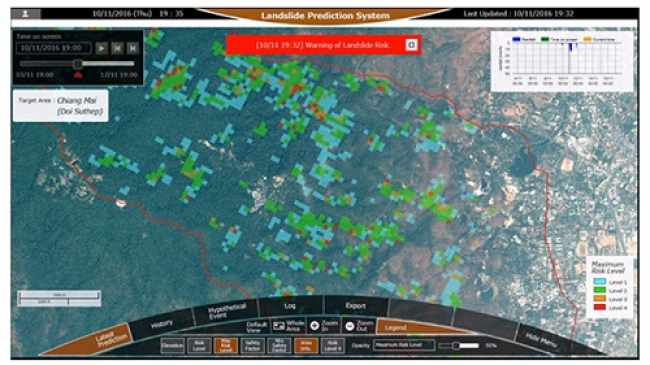
NEC Corporation (Japan), in collaboration with Thailand's National Disaster Warning Center (NDWC), announced a few days ago the completion of the trial for a prediction system that identifies areas prone to landslide danger in Thailand.
Before setting the system on trial, NEC Corporation and the NDWC conducted verification experiments with a flooding simulation system in Uttaradit Province, Northern Thailand, from November 2015 to March 2016. Then, they moved on to confirm the effectiveness of their Landslide Prediction System with a trial in Chiang Mai Province, Northern Thailand, that took place between November 2016 and March 2017.
This Landslide Prediction System is one of the modules of NEC's "Integrated Risk Management System". This system consists of a shared platform with functions such as data integration, visualization, and early warning, and disaster modules specialized for particular disasters such as landslides, flooding and earthquakes. The disaster modules or functions can be selected individually as required, or several disaster modules can be combined in order to predict multiple disasters simultaneously.
The Landslide Prediction System performs a simulation based on meteorological data (observed rainfall and forecast rainfall), topographical data (elevation values, land use purposes), and soil data (soil depth, hydraulic conductivity, porosity, cohesion force, internal friction angle, etc.), making it possible to predict the degree of landslide danger.
Furthermore, the system can perform detailed simulations using a 50m quadrilateral mesh and provide hourly-basis prediction for a period of up to seven days in advance. This allows NDWC to issue warnings to threatened areas before the landslides occur, helping to reduce potential damage. Moreover, even during periods when no disaster is forecast, areas at risk of landslides can be identified by performing simulations using previous rainfall data, which enables hazard maps to be prepared.
Landslides triggered by heavy rains are a frequent phenomenon in Thailand, causing injuries and serious damage to property and transportation networks; thus, investing on measures for reducing them was a priority issue for the Thai government. NEC conducted the trial in collaboration with the Embassy of Japan in Thailand, as part of the "Research and study for the development of a landslide simulator in Thailand" project, commissioned by Japan's Ministry of Internal Affairs and Communications. The trial supports a greater disaster prevention cooperation project between Thailand and Japan, with the two countries aiming to cooperate in a wide range of areas, including the development of more sophisticated disaster prevention Information and Communication Technology and the use and application of the technologies.
The landslide prediction system is optimized for Thailand and is expected to have a role in the operations of the Department of Disaster Prevention and Mitigation and the NDWC", according to RADM Thavorn Charoendee, Executive Expert of NDWC, while the Thai government plans to continue work on the project, in order for the simulation area to be expanded.
According to Minoru Hirata, NEC's General Manager of Smart Infrastructure Division, the corporation will harness the experience and knowhow gained through this trial to promote the system to other Asian countries that also experience frequent damage from landslides.
Source: www.nec.com
Want to read more like this story?
Landslides
Oct, 31, 2019 | Education

Can satellites be used as an early warning system for landslides?
Aug, 04, 2017 | NewsA joint team of researchers from Newcastle University (UK), Chengdu University of Technology, Tongji...

NASA maps landslides in central America caused by hurricane Eta
Nov, 10, 2020 | NewsNASA is currently mapping the landslides that were triggered during the passage of Hurricane Eta th...

Real time warning system for landslides
Aug, 09, 2018 | NewsA state-of-the-art system that is capable of warning people before landslides occur will be installe...

Landslide in Italy causes serious infrastructure damage
Dec, 03, 2013 | NewsA shallow landslide occurred in the Italian town of Montescaglioso last Tuesday, destroying roa...

Urban areas at greater risk for landslides due to the effects of precipitation
Aug, 09, 2021 | NewsA new study indicates that urbanized areas are more prone to landslides caused by precipitation tha...

Two landslides struck Indonesia: At least 13 casualties
Jan, 10, 2021 | NewsAt least 13 people have been reported dead after 2 major landslides struck in Indonesia. The ground...

Video: NASA generated landslide map reveals most landslide prone areas!
Apr, 22, 2015 | NewsRain-induced landslides have hit a death toll of nearly 20,000 since 2007. For an overview of the la...

45% of Himachal Pradesh at Risk of Landslides and Floods – What Can Be Done?
Feb, 19, 2025 | NewsA recent geospatial study has revealed that over 45% of Himachal Pradesh is highly susceptible to l...
On This Day
August 25th 1970
READ MORE
Related Video

Trending

Lake Chippewa’s floating island that has to be boat-pushed every year

How to Model Piles in PLAXIS

3 Types of Retaining Walls and Revetments


How Do Dams Trigger Earthquakes?
Nepal’s Himalayan settlements face escalating flood and landslide threats