
Europe's huge potential renewable energy: Manipulating onshore windfarms
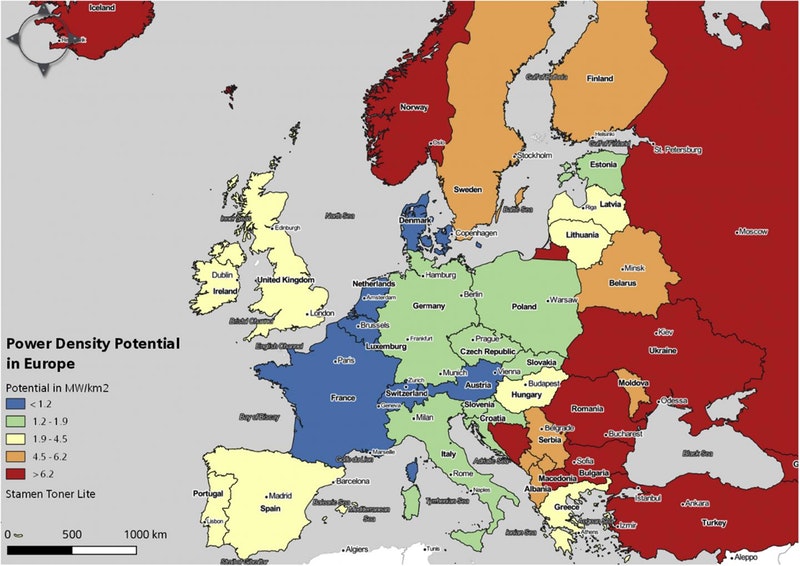
According to a new study, published in Energy Policy Journal, Europe is capable of producing enough energy to power the whole planet using onshore windfarms.
Scientists from the British University of Sussex and the Danish Aarhus University examined the potential capacity of Europe's terrain showing that it could produce more than 100 times the amount of energy currently generated.
In particular, the analysis showed that onshore windfarms may reach a capacity of 52.5TW. The attempt would involve the construction of 11 million more wind turbines across an area of 5 million km2.
According to Benjamin Sovacool, co-author of the study and Professor of Energy Policy at the University of Sussex, the research's purpose is not to incite Europe to construct all those wind farms but to show the high wind power potential that the continent has.
“The study is not a blueprint for development but a guide for policymakers indicating the potential of how much more can be done and where the prime opportunities exist. Our study suggests that the horizon is bright for the onshore wind sector and that European aspirations for a 100% renewable energy grid are within our collective grasp technologically. Obviously, we are not saying that we should install turbines in all the identified sites but the study does show the huge wind power potential right across Europe which needs to be harnessed if we’re to avert a climate catastrophe,” Prof. Sovacool, stated.
Researchers used spatial analysis conducted through GIS (Geographical Information System) to reveal that about 46% of Europe's terrain can be used for the installation of wind turbines. Detailed data used in GIS allowed the team to better understand Europe's onshore windfarm potential than previous studies and to exclude areas with "socio-technical constraints" such as inhabited territories, roads, restricted areas or lands with unsuitable terrain for wind farm facilities.
The study revealed that Russia, Norway and Turkey are the countries with the higher potential capacity while some flat parts of Western Europe that experience strong winds are also favorable.
If all the potential land was exploited, the produced energy could meet the global demand in 2050. This fact shows that renewable energy could fully provide humanity with the needed power and is very encouraging for the future.
“Critics will no doubt argue that the naturally intermittent supply of wind makes onshore wind energy unsuitable to meet the global demand. But even without accounting for developments in wind turbine technology in the upcoming decades, onshore wind power is the cheapest mature source of renewable energy, and utilizing the different wind regions in Europe is the key to meet the demand for a 100% renewable and fully decarbonized energy system,” Peter Enevoldsen, lead author of the study and Assistant Professor in the Center for Energy Technologies at Aarhus University, stated.
Source: University of Sussex
Want to read more like this story?

Dynamic response of wind turbines under combined wind-earthquake loading
Sep, 03, 2021 | NewsA new study investigates the combined effect of wind and earthquake forces to assess the dynamic be...

How to manipulate windmills full power in a large wind farm
Oct, 10, 2018 | NewsWind turbines convert the wind's kinetic energy into electrical energy. As wind farms utilize m...

Best Alternatives for Fossil Fuels
May, 24, 2021 | NewsThe issue of climate change is becoming more and more relevant every year. Of course, it should’ve...

PLAXIS-Powered Geotechnical Solutions for Wind Energy: Onshore, Offshore, and Floating Systems
Jul, 30, 2025 | EventIn the second webinar of the Green Energies series, we will focus on the geotechnical analysis and...

The Rise of Offshore Wind Energy and the Role of Geotechnical Modelling with PLAXIS and SACS
Nov, 03, 2025 | NewsOffshore wind energy has emerged as a cornerstone in the global transition toward sustainable energ...

First US offshore wind farm under construction!
Apr, 30, 2015 | NewsThe construction of the first offshore wind farm has just started on US ground in Block Island , a s...

Japan’s largest offshore wind farm begins commercial operation in Kitakyushu
Mar, 04, 2026 | NewsJapan’s largest offshore wind power facility has officially begun commercial operations. The 220 MW...

How abandoned mines can be reused as gravity batteries
Jan, 11, 2023 | NewsA new study proposes that abandoned mines can be reused as gravity batteries and store excess energ...

The Heat Beneath Us: Geothermal Energy Fuels AI’s Ambitions
Jan, 01, 2025 | NewsAs artificial intelligence (AI) continues to revolutionize industries, its rapid growth is posing a...
On This Day
August 18th 1886
READ MORE
Related Video

Trending

Tiebacks vs. soil nails: Choosing the right earth retention solution
When Dams Fail: The Growing Crisis of Tailings Management

Mexico City’s sinking crisis mapped by next-generation satellite
Landslide in Northern Peru Forces Evacuation of Over 170 Residents
Sinkhole outside home in Huntington Station, on Long Island: 3 fall into
Nepal’s Himalayan settlements face escalating flood and landslide threats