
Dynamic response of wind turbines under combined wind-earthquake loading
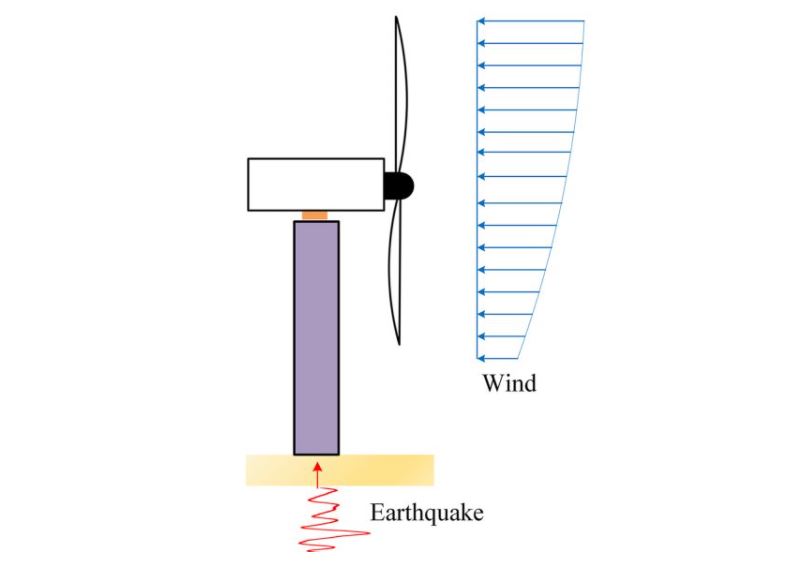
A new study investigates the combined effect of wind and earthquake forces to assess the dynamic behavior of wind turbines.
The demand for renewable energy is nowadays at its peak. Wind power is a great source of clean energy and is harvested via wind farms placed in numerous regions across the world. The annual power generation from such facilities is higher than 50GW and is expected to further rise in the following years given the urgent need to replace fossil fuels and tackle the effects of climate change. Inevitably, some winds farms are established in earthquake-prone regions and the combined excitation under wind and earthquake forces must be thoroughly assessed.
The study, recently published in the Journal of Renewable and Sustainable Energy, aims at establishing a numerical model that will consider the seismic shaking, the wind forces and the operating wind turbines to evaluate the performance of the wind turbines. This is referred to as the "fully coupled model". Such models have been tested before but the research team emphasizes that a solid interpretation of the results is still missing. The authors studied a 5MW wind turbine subjected to a combination of wind load and input ground motion with the latter being retrieved from a list of earthquake records.
The study provides some interesting findings. The results from the sophisticated numerical models suggest that the wind that acts as a dynamic load for the wind turbine also exerts a damping effect on the response of the structure. In particular, when shaking is strong, the energy absorbed due to the aerodynamic damping is higher than the actual wind loading generates hence, the damping effect prevails. On the contrary, the dynamic load of winds is dominant if the ground shaking is weak. In addition, the directivity of the earthquake plays an important role in the dynamic response of a turbine. The research team found out that in weak and strong earthquakes the least favorable direction of the shaking is parallel and perpendicular to the direction of the wind. “The input angle of earthquakes influences the seismic response of wind turbines, because of the asymmetry of aerodynamic damping and blade stiffness,” Xiuli Du, co-author of the study and Professor/Vice President at the Beijing University of Technology, stated. Moreover, the timing of both seismic and wind excitation (wind being a stochastic parameter) is critical for the anticipated behavior of a turbine.
The authors emphasize the randomness that governs the numerical analyses due to inevitable uncertainties in both the shaking motion and the wind forces. Hence, a large number of wind samples and ground motions were employed to achieve a maximum error of 5% in the average response amplitudes of the structures.
The results of the study are significant when it comes to better designing wind turbine structures in tectonically active regions. The towers that support the turbines do not have redundant members and even a local failure may lead to a complete collapse of the system.
Sources: Xi et al. (2021), AIP
Want to read more like this story?

How to manipulate windmills full power in a large wind farm
Oct, 10, 2018 | NewsWind turbines convert the wind's kinetic energy into electrical energy. As wind farms utilize m...

The Rise of Offshore Wind Energy and the Role of Geotechnical Modelling with PLAXIS and SACS
Nov, 03, 2025 | NewsOffshore wind energy has emerged as a cornerstone in the global transition toward sustainable energ...

First US offshore wind farm under construction!
Apr, 30, 2015 | NewsThe construction of the first offshore wind farm has just started on US ground in Block Island , a s...

PLAXIS-Powered Geotechnical Solutions for Wind Energy: Onshore, Offshore, and Floating Systems
Jul, 30, 2025 | EventIn the second webinar of the Green Energies series, we will focus on the geotechnical analysis and...

Europe's huge potential renewable energy: Manipulating onshore windfarms
Aug, 26, 2019 | NewsAccording to a new study, published in Energy Policy Journal, Europe is capable of producing enough...

Japan’s largest offshore wind farm begins commercial operation in Kitakyushu
Mar, 04, 2026 | NewsJapan’s largest offshore wind power facility has officially begun commercial operations. The 220 MW...

Best Alternatives for Fossil Fuels
May, 24, 2021 | NewsThe issue of climate change is becoming more and more relevant every year. Of course, it should’ve...

World’s first floating wind farm powers up offshore Scotland
Oct, 20, 2017 | NewsThe world's first floating wind farm recently started to deliver electricity off the coast of Peterh...

New connector aims to reduce downtime and enhance safety in floating offshore wind farms
Jun, 01, 2026 | NewsFloating offshore wind is advancing quickly, but one of its practical challenges remains the safe an...
On This Day
August 7th 2010
READ MORE
Related Video

Trending

Active landslide threatens long-term connectivity in southern Bulgaria


PLAXIS example: Westergaard's added mass for hydrodynamic pressures

Rock Mass Classification Systems: A Global Review of Use and Dominant Approaches

How does the Leaning Tower of Pisa survive earthquakes


Levee Digital Twin Platform Launches for California's Yuba River Corridor