
The Economic Benefits of Testing Driven Piles Sponsored
Read an article by Patrick Hannigan, President of GRL Engineers Inc., and Brent Robinson, Vice President of Pile Dynamics Inc., to learn how using reliable testing methods can save money for pile driving projects.
We have all heard grumbles that the only thing testing does is increase driven pile foundation cost. In actuality, several modern codes reward the increased reliability and reduced uncertainty obtained through more reliable testing methods with higher resistance factors in LRFD (Load and Resistance Factor Design) codes or lower factors of safety in ASD (Allowable Stress Design) based codes. Two good examples of this philosophy are incorporated into the AASHTO LRFD Bridge Design Specifications (2020) which govern highway design practice in the USA, and the Australian Standard, AS 2159-2009: Piling - Design and Installation (2009). The codified testing philosophy in these documents saves money by lower pile capacity and thus shorter piles, or higher loads per pile resulting in fewer piles for the project.
The AASHTO LRFD Bridge Design Specifications state that the uncertainty in “nominal resistance” (e.g., ultimate capacity) is strictly due to the reliability of the resistance determination method used in the field during installation. AASHTO Table 10.5.5.2.3-1 (Figure 1) lists resistance factors for different driven pile resistance determination methods. Piles could also be driven to a predetermined depth based on the AASHTO resistance factor for the static analysis method. However, the AASHTO resistance factors for static analysis methods range from 0.35 to 0.50 depending on the soil conditions and analysis method which are substantially less reliable than most field methods.

In the Australian Piling Standard, a geotechnical strength reduction factor, Øg , is determined based on a site’s average risk rating, foundation redundancy, the percentage of piles tested, and the selected test type. As shown in the Figure 2, the geotechnical strength reduction factor for a moderate risk site ranges from 0.62 to 0.90 depending on test type, percentage of piles tested and group redundancy. Hence, the higher the percentage of piles tested (up to a limiting value), the greater portion of the geotechnical strength that can be used for the driven pile foundation.

The total foundation cost of a given field testing method can be quantified based on the total pile length costs, testing method costs, and the schedule impact cost associated with the testing method. These costs will vary depending upon a project’s geotechnical conditions and associated design construction, and contract delivery costs.

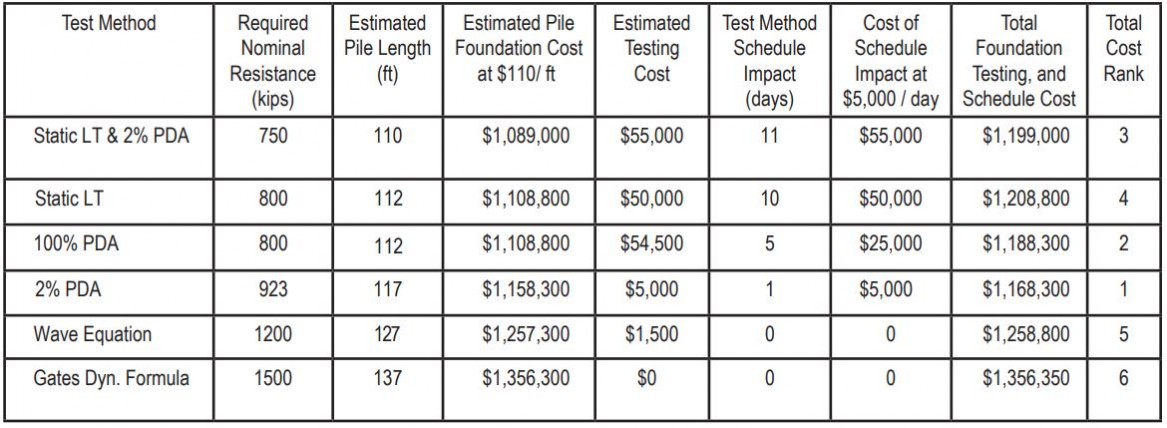
Source: The Economic Benefits of Testing Driven Piles. Newsletter #98
Want to read more like this story?

The Benefits of Dynamic Pile Testing
Sep, 25, 2017 | NewsAny structure is only as good as its foundation. For a deep foundation to perform satisfactorily, i...
Pile Foundations
May, 29, 2024 | EducationPile foundation is actually a slender column or long cylinder made of materials such as concrete...
Driven Pile Professional Software
Jun, 13, 2023 | Software
RSPile
Oct, 02, 2020 | Software
Predicting Eccentric Stresses for Large Diameter Open Ended Pipe Piles
Jun, 16, 2022 | NewsThis is a summary of technical paper "Predicting Eccentric Stresses for Large Diameter Open Ended P...

High-capacity driven-pile Foundation for a 33-story high-rise in Milwaukee, Wisconsin, USA
Nov, 05, 2019 | NewsNominated for the Top Project Award, GRL Engineers, Inc., has been recognized for the contributions...

5 Questions about Load Tests on Helical Piles [Answered]
Feb, 09, 2022 | NewsHelical pile installers and designers get this question all the time: “Do I need to do full scale l...

Dynamic and Static Load Testing at Valley View Bridge Project
Apr, 17, 2019 | NewsThe addition of a third structure, between the two existing bridge structures, carrying I-480 over...

Pile Group - GEO5
Jun, 13, 2023 | SoftwareOn This Day
August 7th 1976
READ MORE
Related Video

Trending

Quick Clay Failure on Norway’s E6 at Levanger

Keller North America announces recent leadership changes

Fulgurite: A rare phenomenon
Nepal’s Himalayan settlements face escalating flood and landslide threats