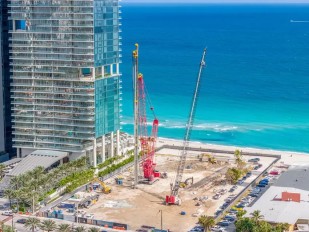
Soil nailing identified as key to Swanage Green Seafront slope stability

Technical investigations into Swanage’s Green Seafront have confirmed progressive slope instability affecting Sandpit Field, Weather Station Field, and the Spa beach hut terrace. Monitoring surveys commissioned since 2022 identify ongoing downslope movement parallel to Shore Road, driven by a combination of weak near-surface soils, deteriorating drainage, and elevated groundwater pressures. A total of 55 geotechnical and structural defects have been recorded, including cracking of retaining walls, distorted pavements, and localised ground settlement, raising concerns over public safety and long-term serviceability of these key coastal assets.

Repeated instrumentation and visual inspections undertaken through 2023–2025 show that short-term maintenance measures are no longer sufficient. Without intervention, continued soil creep and progressive failure mechanisms could significantly accelerate degradation of the slope system.

A feasibility study evaluated several stabilisation techniques, including slope regrading, sheet piling, terraced retaining structures, and reinforced earth solutions. However, the geometry of the slope, space constraints, and sensitivity of the public realm limit the viability of large-scale regrading or intrusive retaining systems.
Independent assessment concluded that soil nailing, combined with sub-horizontal drainage, provides the most effective and proportionate solution. The proposed system involves installing steel nails up to 20 m long into stable strata, creating a reinforced soil mass capable of resisting shear deformation. Drainage elements are designed to relieve groundwater pressures, addressing one of the primary drivers of instability.
Soil nailing offers controlled installation using small rigs, minimising disturbance while achieving long-term stability. Corrosion protection measures are specified to achieve a 100-year design life, making it suitable for a coastal environment. Two schemes remain under consideration: a £4.5 million stabilisation-only option and a £6.5 million enhanced scheme that integrates public realm improvements. Final selection will follow statutory consultation and planning approval. Subject to approvals, construction is anticipated to commence in autumn 2027.
The Swanage project illustrates the importance of long-term ground monitoring, groundwater management, and selecting stabilisation methods aligned with both geological conditions and community use of infrastructure.
Sources: swanage.news, newcivilengineer.com, swanage.gov.uk
Want to read more like this story?
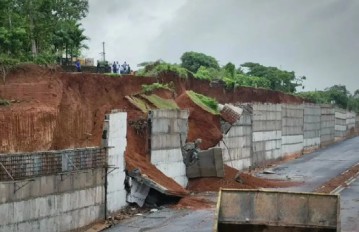
Heavy rain triggers retaining wall collapse at highway construction site in Karnataka
Jul, 02, 2026 | NewsA retaining wall and part of a hillside collapsed at an under-construction National Highway site nea...

Slope Stability: Example Analysis
Jul, 12, 2021 | EducationSlope Stability Analysis In this chapter of the Geoengineer.org series on Slope Stability, a s...
Classification and Mechanics of Retaining Structures
Feb, 06, 2026 | EducationThe Function of Retaining Walls A retaining wall is defined as a structure whose primary funct...

Commercial Construction Projects: a short description of different types of retaining structures
Mar, 08, 2022 | NewsRetaining wall systems are designed and manufactured to hold earth elements like rock and/or soil....

Slope Stability
Jun, 02, 2019 | EducationA slope is an inclined ground surface which can be either natural or human-made. Slope stability...

The Slope That Looked Safe: Anatomy of a Retaining Wall Failure
Apr, 11, 2025 | NewsIn a quiet riverside development, a seemingly routine retaining wall project turned into a landslid...
Slope Stability Analysis
Jun, 02, 2019 | EducationAssessing a slope’s stability is a challenging yet important aspect of civil engineering. In its...
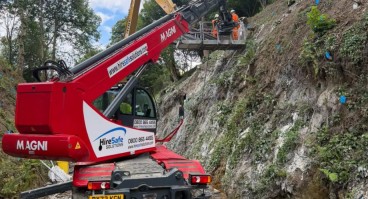
Soil nails replace temporary barriers at Dinah's Hollow landslip route
Jul, 12, 2026 | NewsA long-running slope stability problem on the C13 at Dinah's Hollow in Dorset has reached the halfwa...

Slope (Oasys)
Nov, 06, 2013 | SoftwareOn This Day
August 6th 1918
READ MORE
Related Video

Trending

Dubai approves $9.2bn fully underground gold line metro

How to prevent copper wire theft from light poles
The quicksand of Morecambe Bay

Model Structures and Visualize Structural Forces
Rapid Drawdown in Dam and Levee Design: A Hydrogeologic Perspective in Slide2
Nepal’s Himalayan settlements face escalating flood and landslide threats