India to become the 4th country to land on the moon
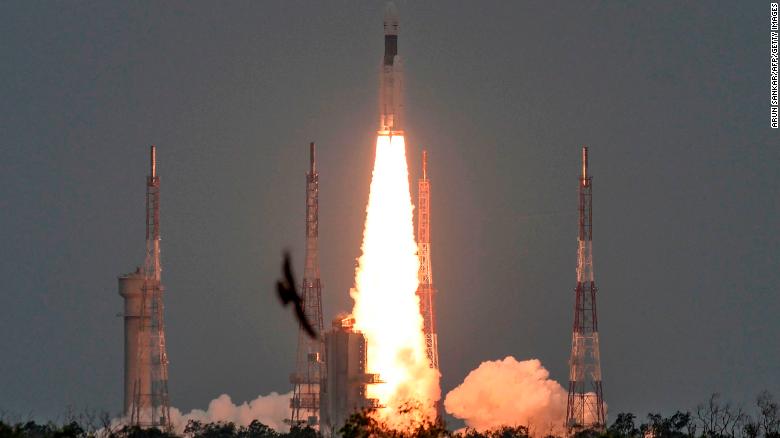
Three countries, U.S., Soviet Union and China, have managed to land a spacecraft on the moon's surface. On early Saturday (local time), September 7, 2019, India will attempt to become the 4th nation to accomplish such an achievement.
The Indian Chandrayaan-2 mission was launched on July 22, 2019, from the Satish Dhawan Space Center located in Sriharikota Island. It is the nation's 2nd space mission after the Chandrayaan-1 which was launched in 2008, an operation that provided significant evidence concerning the presence of ice on the moon, a fact that was announced by NASA in 2009.
The mission consists of 3 parts: An orbiter, a lander called Vikram and a rover called Pragyan. Earlier in August, Chandrayaan-2 spacecraft entered the orbit around the moon in an attempt that lasted almost half an hour. "Our hearts almost stopped today until it completed its job. But still the landing is the terrifying moment... because that is a phase that we are doing for the first time," Kailasavadivoo Sivan, chairman of the Indian Space Research Organization (ISRO), stated.
On September 2, 2019, the mission's lander and rover were separated from the orbiter, according to The Indian Space Research Organization (ISRO). Vikram has started lowering its orbit around the Moon and it will continue until it is about 100 kilometers above the surface. Vikram will be in this position at 1.40 a.m. local time on September 7. Then, a descent will begin and, hopefully, the lander will touch the lunar surface approximately 15 minutes later. The landing position is located in the moon’s polar region. It will be the first mission landing so close to the South Pole.
Landing on the moon is a challenging task. The lander has to use its own rocket engines to reduce its velocity and avoid crashing on the moon's surface. Common techniques applicable on Earth (such as parachutes) do not function due to the lack of atmosphere. In an approach known as soft landing, the vehicle will simultaneously descend and move horizontally across the lunar surface. Its horizontal velocity must be reduced to zero before it touches the surface.
The total cost of the mission will reach $150 million.
The operation will be broadcasted by National Geographic and Hotstar. The live coverage will begin at 11.30 p.m. Indian time on September 6, 2019.
Want to read more like this story?

USGS releases the first meticulous geological map of the Moon
Apr, 20, 2020 | NewsThe United States Geologic Survey (USGS), in collaboration with NASA and the Lunar Planetary Instit...

Moon is making the days on Earth longer
Jun, 18, 2018 | NewsA study shows evidence that as the distance between Earth and the moon increases year by year, the d...

NASA's InSight lander stops drilling after hitting an impenetrable material
Mar, 08, 2019 | NewsNASA's Mars Insight lander has paused drilling operations after hitting a hard material beneath the...

Earth and Moon struck by asteroid shower 800 million years ago
Jul, 21, 2020 | NewsAccording to a new study, a vast meteoroid bombardment struck the Earth and the Moon about 800 mill...
Artemis II Completes Lunar Geological Reconnaissance: What It Means for Geotechnical Engineering
Apr, 09, 2026 | NewsWith its crew now on the return trajectory toward an April 10 splashdown, NASA's Artemis II mission...

NASA launches new rover mission to planet Mars: Soil and rock samples will be retrieved and sent back to Earth
Jul, 30, 2020 | NewsOn Thursday, July 30, 2020, NASA launched a rover mission to Mars that will retrieve soil and rock...

Philae makes historic landing on comet 510 million kilometers away. Anchoring system fails. Are unexpected site conditions to be blamed for failure to anchor?
Nov, 13, 2014 | NewsThe European Space Agency made history yesterday by successfully landing Philae to Comet 67P. Philae...

NASA records biggest ever 'Monster quake' on Mars, estimated to be magnitude 5
May, 11, 2022 | NewsNASA’s InSight Mars lander has detected the strongest quake ever detected not only on Mars but on a...

Marsquakes detected by NASA's InSight Mission
Mar, 07, 2021 | NewsNASA's InSight Mars Lander has recently retrieved clear data of two relatively strong quakes that o...
On This Day

Related Video

Trending

New crustal stress map of North America

Using Terzaghi’s Equation in Foundation Design

Parameters Variation: Model Customization and Sensitivity Analyses


UK geothermal projects expand from Cornwall power to Birmingham heating

Emergency ground stabilisation protects rail works near Salford Central