
Barcelona’s new tunnel lets the city breathe easy
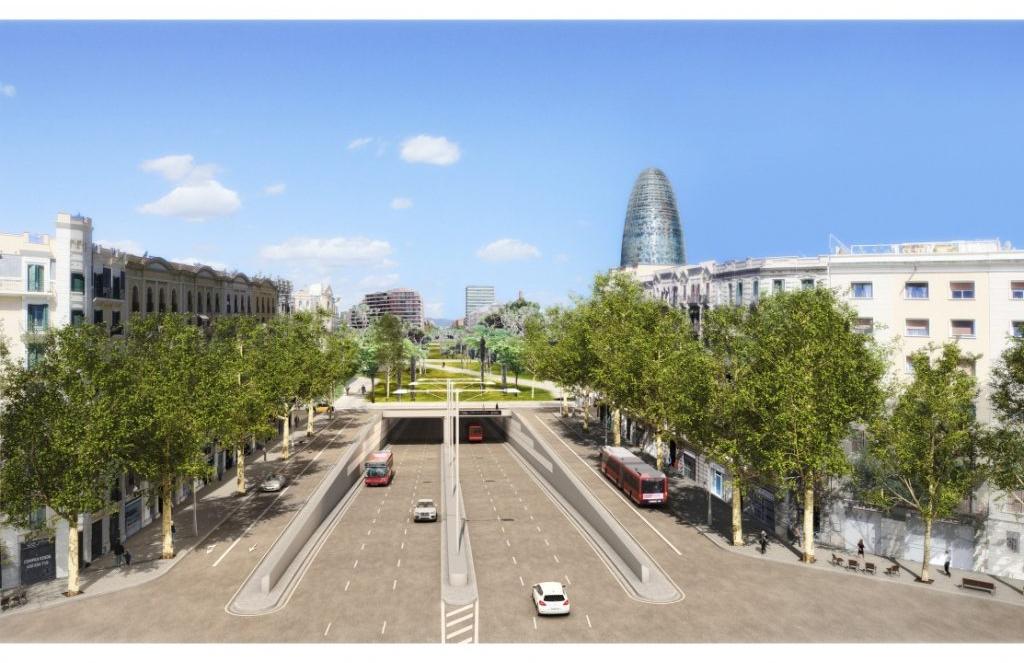
Barcelona’s new tunnel was considered one of the most complex urban planning operations in the city. The much-awaited tunnel, under the Plaza de las Glòries in Barcelona, opened the previous weekend. The new infrastructure facility moves the car traffic underground for a stretch of about one kilometre in the core of the Catalonian capital. Μuch-needed peace, quiet and clean air are provided to the district.
Since 2019, the urban area that had been reclaimed from the street traffic above the ground has been converted into a green space (of 20,000 square metres), which got expanded a little bit more in September with the creation of the Clariana playground.
Today, the tunnel is in operation for car traffic going in the direction to Besós, or the northeast peripheries. The traffic arm in the opposite direction to Llobregat is expected to open up in January next year. The tunnel is located in the vicinity of the Agbar Tower, possibly the most famous contemporary architectural landmark of Barcelona.
It is assumed one of the most complex works carried out so far in the city and has resulted in a 957-meter tunnel (1,157 if the two ramps are added), with two independent unidirectional circulation tubes that reach a maximum depth of 25 meters in the area below the square. Thus, the tunnel goes under the L1 Metro line and the R1,2,3,4 light railway lines.
It consists of two sections: the first one, 508 meters long, between the streets of Los Castillejos and Badajoz, at a maximum depth with respect to the square and below the railway lines of 25 meters, and the second, 449 meters, between the streets of Badajoz and the Rambla del Poblenou, with an average depth of 10 meters.
The tunnel incorporates the latest technology in security measures and control, with emergency exits separated by a distance of 200 meters and new control of tunnel operators that has moved and opened its headquarters within the Municipal Services Center, in the Torrent de l'Olla street.
This infrastructure is expected to channel the traffic that circulates through this area, which is 78,000 vehicles per day. Of these vehicles, 43,000 circulate into the city and 35,000 out. Before the start of the works, the total figure at this neuralgic point reached 95,000 vehicles.
Source: themayor.eu
Media
- Glories Barcelona Tunnel opening after 12 Years|New constructed Tunnel Glories Barcelona Visit
Want to read more like this story?

8 new U.S. tunnels under way: fascinating and challenging
Jan, 10, 2014 | NewsWhether you live in the U.S. or not you will find the following tunnels that are currently being bui...

3 major East Coast tunnel, the Hudson Tunnel, the Howard Street Tunnel and the Chesapeake Bay Bridge Tunnel, projects move forward
Jan, 11, 2022 | NewsThree major tunnel projects that connect key transportation arteries on the East Coast are advancin...

Photo gallery: 9 of the world's greatest tunnels!
Jul, 14, 2014 | News2014 is the year of the 20th anniversary of the opening of the Channel Tunnel linking France with th...

China: The longest underwater highway tunnel is open to vehicle traffic
Jan, 04, 2022 | NewsAt a length of 10.79 kilometers (6.65 miles), the Taihu tunnel is the longest underwater highway tu...

Third tunnel to connect the European and Asian sides of Istanbul under the Bosporus announced
May, 10, 2023 | NewsUpdated plans for the construction of the Great Istanbul Tunnel were announced by Turkey’s Transpor...

Video: Digging smart tunnels under London - an underground high-tech lab!
Jun, 19, 2014 | NewsCrossrail - the largest infrastructure project currently under construction in Europe - wi...

New tunnel in Swiss Alps changes railway transport in Europe
Sep, 04, 2020 | NewsA significant step has been made for the completion of a great railway project in Europe. The Cen...

Mott MacDonald used PLAXIS to Extend One of the Seven Engineering Wonders of the Modern World
Oct, 23, 2019 | NewsThe Chesapeake Bay Bridge-Tunnel carries US 13, the main north-south thoroughfare on Virginia’s eas...

Drilling for the 5.63-kilometer-long Učka Tunnel in Croatia has been completed
Sep, 18, 2023 | NewsIt was announced that drilling for the new 5.63-kilometer-long Učka Tunnel in Croatia has been comp...
On This Day
August 7th 1927
READ MORE
Related Video

Trending

Dubai approves $9.2bn fully underground gold line metro

How to prevent copper wire theft from light poles

The quicksand of Morecambe Bay

Model Structures and Visualize Structural Forces
Rapid Drawdown in Dam and Levee Design: A Hydrogeologic Perspective in Slide2

Deadly mining landslide in Central African Republic raises safety concerns