A Tribute to Michele Jamiolkowski
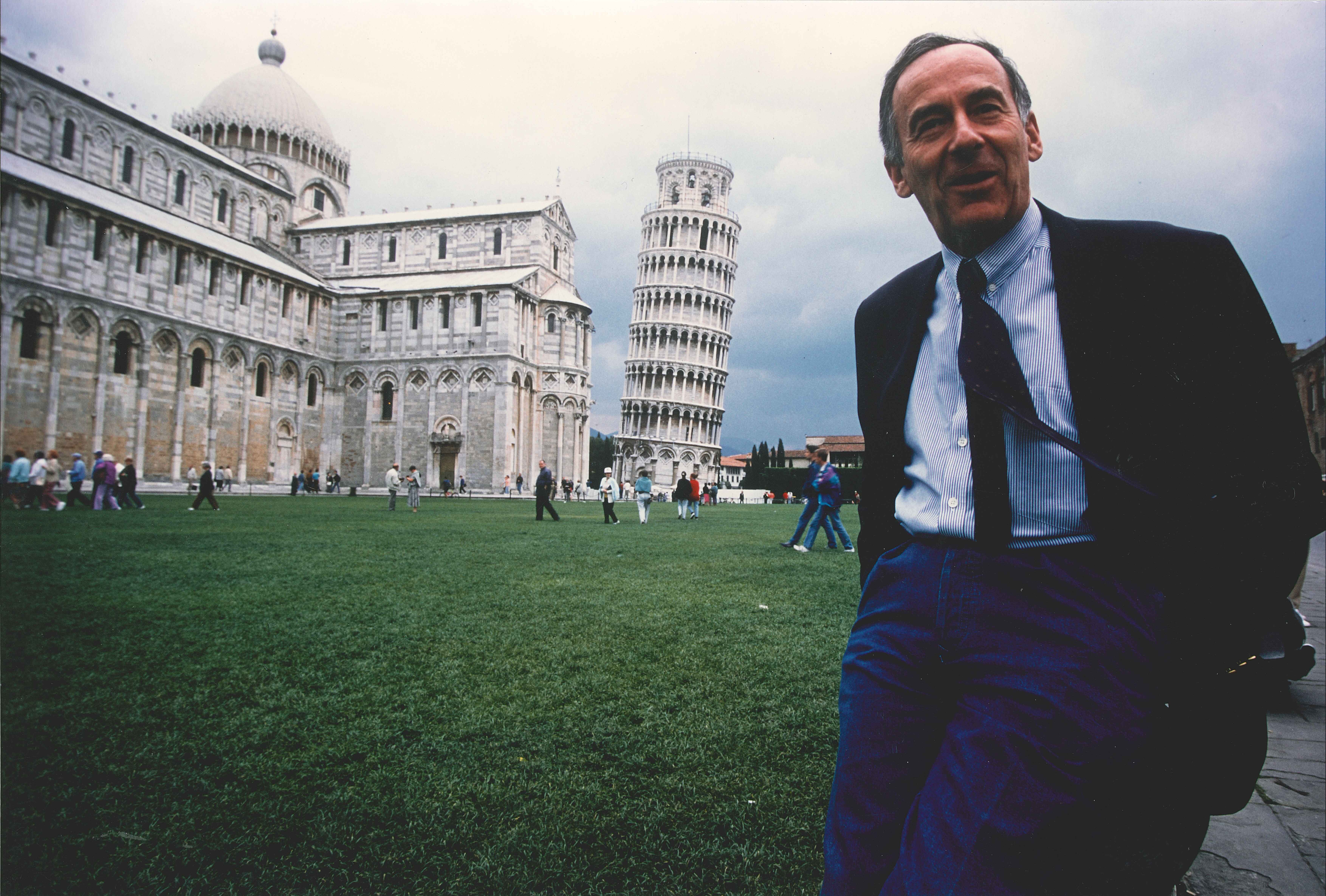
The “savior of the Leaning Tower of Pisa”
February 27, 1964. Diagnosing that the Leaning Tower of Pisa is now dangerously tilted, the Italian government requested international help to prevent its collapse. Fast forward to 1989. After more than two decades of stabilization studies, the tower has not stopped leaning dangerously. Despite this, it still remains open to the public, welcoming around one million visitors a year. But developments will be accelerated by an event 190 km (118 miles) away. On March 17, 1989, Pavia's nearly similarly aged Civic Tower collapsed without warning, killing 4 people and injuring 15. The Italian government, fearing that a similar event could happen to the Leaning Tower of Pisa, decides to close the Tower and carry out extensive stabilization work. The tower closed on January 7, 1990, and an international committee of 14 members was formed to resolve the problem of the Tower's tilt. For the position of chairman of the committee, a person with deep knowledge and an indomitable ability to solve problems had to be chosen. The choice was no surprise: it was Professor Michele Jamiolkowski.
From Auschwitz to the top of Geotechnical Engineering
Although his successful endeavour to stabilize the Tower (in close collaboration with Professors John Burland and Carlo Viggiani) earned him the nickname "savior of the Leaning Tower of Pisa", this was not the only notable achievement in the life of the Polish-born Italian geotechnical legend Michele Jamiolkowski. Born in 1932 in Stryi (then part of the Second Polish Republic, now part of Ukraine), he had a turbulent childhood, due to the geopolitical developments of the time. Surviving two occupations by foreign powers (the Soviet Union and Nazi Germany) and the Auschwitz concentration camp where he was imprisoned, he found his way to science by studying Soil Mechanics and Engineering Geology at the Faculty of Geology of the University of Warsaw, where he graduated with an MSc in 1959. After attending postgraduate studies at the University of Kiev (Soviet Union), the University of Laval, Quebec (Canada) and the Massachusetts Institute of Technology, Cambridge (USA), he became a research assistant in the Polytechnic University of Turin in 1965. In 1969 he received a professorship at the same university, where he served as Associate Professor of Geotechnical Engineering from 1969 to 1981, and as Professor from 1981 until his retirement in 2006.
Jamiolkowski made admirable contributions to solving many practical problems. In addition to stabilizing the Leaning Tower of Pisa, he was involved, among others, in the important project of flood prevention in Venice (MOSE), the development of the world's second largest copper mine tailings deposit at Zelazny Most in Poland, and the conservation of the protection shelter (sarcophagus) of the Chernobyl nuclear power plant.
Breaking the Waves in Venice
Specifically, in Venice he served as a Geotechnical Consultant for the design of the so-called “MOSE” (Modulo Sperimentale Electromeccanico - Electromechanical Experimental Module) Gates, a system of 78 mobile gates situated at key locations to isolate the city of Venice when high tides strike. The system first went into operation on October 3, 2020, and proved successful in preventing the city from flooding. MOSE is designed to prevent flooding for tides that reach up to 3 meters, which is far beyond any recorded incident in the past (the record is 1.94 meters, recorded back in 1966).
Extending the life of copper mines in Poland
At the giant Żelazny Most copper mine tailings dam in Poland, the owner company KGHM, on the recommendation of the World Bank, appointed an International Board of Experts (IBE) to oversee the tailing dam’s construction and ensure its stability. Michele Jamiolkowski was appointed Chairman of the board, with the other members being Dr. D. Carrier and Professors R.D. Chandler and K. Hoeg. The board, assisted by local geotechnical expert Professor W. Wolski, supervised the safe construction of the tailings dam using Peck’s Observational Method.
Ensuring environmental safety in Chernobyl
The next project Jamiolkowski was involved in was of capital importance to Europe's environmental safety. The sarcophagus of the 4th Unit of the Chernobyl Nuclear Power Plant, built hastily and under difficult conditions, was rapidly deteriorating, even allowing the inflow of rainwater. Managed by the European Bank for Reconstruction and Development (EBRD) the Shelter Implementation Plan (SIP) construction management program was a conservation program foreseeing to make the seriously deteriorating reactor shelter stable and environmentally safe. Jamiolkowski was a member of the twelve-member advisory committee (called “International Advisory Group” (IAG), under the chairmanship of Dr. Carlo Mancini), making a decisive contribution to the progress of this difficult project. Later, the second leg of the program led to the construction of a new, sliding shelter, named "New Safe Confinement (NSC or New Shelter)", which would enclose the older one to allow it to be dismantled. The new shelter was completed in July 2019.
Preservation of Rome's important antiquities
Rome is known for its antiquities and important historical monuments, most of which are from the Roman era. It was important to ensure that Line C of the Rome Metro, designed to pass under many of these monuments, would have the least possible interaction with them. To guarantee the preservation of the monuments and historic buildings, the construction company of the line appointed a Scientific Technical Committee (STC) to analyze potential interactions between the new line and the historical monumental heritage. Jamiolkowski was the chairman of this committee as well, with Professors Burghigoli, Macchi, Funicello, Carbonara, and Kovari as members.
Other activities
Active in the business field as well, in 1964 he founded the well-known Engineering Consulting Company “Studio Geotecnico Italiano”. The company participated in the aforementioned “MOSE” project and in safeguarding the Bell Tower in St. Mark’s Square in Venice. Also, since 1985 he had been a geotechnical consultant for the design of the proposed bridge over the Strait of Messina.
Besides a practical problem solver, an exceptional academic and educator
Although he excelled in dealing with practical problems, his contribution to academia and education was no less important. A prolific author and co-author of over 270 scientific papers, he was also editor of the International Journal of Geomechanics and Geotechnical Engineering and co-editor of the Soil and Rock International Journal, as well as Ombudsman of ISSMGE’s International Journal of Geoengineering Case Histories. His primary research interests included soil improvement, laboratory and in situ testing, mechanical behavior of soils, bearing capacity and settlements of shallow foundations, and soil dynamics.
An important contribution to Italian educational matters was the first PhD Program in Geotechnical Engineering in Italy, in 1979, of which he was one of the founders. He was also very active in the international scientific community giving a huge number of lectures internationally and participating in numerous conferences.
Last but not least, he was the president of the International Society for Soil Mechanics and Geotechnical Engineering (ISSMGE, then International Conference on Soil Mechanics and Foundation Engineering (ICSMFE)), from 1994 to 1997.
Honors, Awards and Recognitions
Jamiolkowski received numerous awards in his long career.
Among the most important are certainly the Terzaghi Award (named after Karl von Terzaghi) and the Ralph Peck Lecture Award, both awarded by the American Society of Civil Engineers (ASCE) in 2001 and 2005, respectively.
He was awarded an Honorary Doctorate in Civil Engineering from the Technical University of Bucharest, Romania and from the University of Ghent, Belgium. He was an Honorary Professor in Academia Sinica of Guangzhou, China, a corresponding member of the Polish Academy of Science, an Honorable International Member of the Japanese Geotechnical Society, and a Foreign Associate of US National Academy of Engineering. He was also recipient of the De Beer Prize assigned by the Belgian Geotechnical Society (1994-1998), the Italian Prize "Savior of the Art" (2005) and the Award for the best JGS 2003 Paper ("The Stabilization of the Leaning Tower of Pisa) from the Japanese Geotechnical Society (2005). In 2013 he was invited by the Institution of Civil Engineers (ICE) to London, to deliver the prestigious 53rd Rankine Lecture, that dealt with geotechnical aspects of the development of the Zelazny Most Copper Mine Tailings Pond, in Poland
As the icing on the cake of a multifaceted career, just weeks before his passing, he, and Harry Poulos, were awarded the inaugural lifetime achievement Medal by ISSMGE.
Epilogue
Michele Jamiolkowski passed away in his beloved city, Turin, on June 15, 2023, about a month before he would have turned 91. On December 2, 2023, the city of Bologna in Italy announced that the condition of the leaning Garisenda Tower was critical. The savior of the Leaning Tower of Pisa is no longer alive to help save this leaning tower too...
This article is from 2024 Special USA & Canada Geotechnical Business Directory edition, available as an e-book and in-print, and distributed for free during the Geo-Congress 2024 through ARGO-E GROUP’s booth.
Want to read more like this story?
How does the Leaning Tower of Pisa survive earthquakes
May, 22, 2018 | NewsDespite the hazardous inclination of approximately five degrees, the Leaning Tower of Pisa (in Italy...

Leaning tower of Pisa has become slightly straighter
Dec, 07, 2018 | NewsThe leaning tower of Pisa, located in Italy, is now stable and according to a recent report, its til...

The leaning tower of Bologna closes amid settlement concerns
Oct, 21, 2023 | NewsBologna’s leaning 48-meter tall Garisenda Tower was closed during the weekend, after worrying movem...

Michele Maugeri (1944 - 2014)
Feb, 24, 2015 | EducationOn 1 November 2014, after a strong battle against illness, Professor Michele Maugeri passed away.&nb...

Tower of Pisa losing its tilt
Nov, 01, 2013 | NewsAccording to an annual report on the monument’s stability, the leaning Tower of Pisa has straightene...

Worsening condition of Bologna’s “leaning tower” to require €20 million restoration work
Dec, 12, 2023 | NewsThings for Bologna’s leaning Garisenda Tower appear to have taken a turn for the worse, according t...

Kim Dong-Soo, pioneer in geotechnical engineering, dies at 59
Nov, 10, 2020 | Education7th March 1961 – 3rd November 2020 The following obituary is distributed by Dr. Choong-gi Chung, Pr...

Special announcement: ISSMGE's International Journal of Geoengineering Case Histories is now indexed in Georef Database
Dec, 03, 2014 | NewsISSMGE's International Journal of Geoengineering Case Histories has recently launched a special anno...

Shamsher Prakash Foundation: 2016 SP Lifetime Achievement Award
May, 11, 2016 | NewsShamsher Prakash Foundation is pleased to award Mr W.D. Liam Finn and Mr. Richard Woods for SP Lifet...
On This Day
July 20th 1940
READ MORE
Related Video

Trending

Embankment Collapse on NH-66 in Kooriyad Triggers Engineering and Oversight Review
Fehmarnbelt tunnel advances with first element ready for immersion

Geotechnical Engineering 2032 Boom: Trends, Challenges, and Emerging Opportunities
Emergency protocols activated following offshore 7.7 magnitude earthquake in Japan
Asbestos remains a deadly infrastructure risk across the UK
Major earthquake in southern Philippines causes deaths and widespread damage