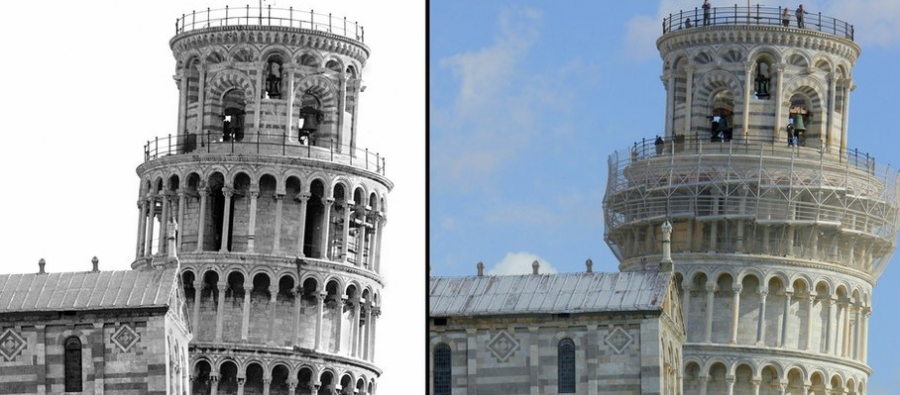
According to an annual report on the monument’s stability, the leaning Tower of Pisa has straightened up by an inch (2.5cm), due to stabilization efforts of the period between 1990 and 2001.
The first attempt at stabilization of the Tower was the injection of cement grout in the foundation in 1935 but it wasn’t successful inducing further lean. Later in 1993, lead ingots were used on the north side of the Tower’s base to counteract the southward tilt. Finally, soil excavation at the north part of the Tower proved to be the most reliable solution and the Tower had been straightened up by 44 cm in 2001. According to the paper Leaning Tower of Pisa: Behaviour after Stabilization Operations, later observations in the period between 2003 and 2008 indicate a reduction of the induced rate of northward rotation of the Tower and the rate of induced settlement of the centre of the foundation. Also, the drainage system stabilized the groundwater levels beneath the north side of the Tower’s foundation. The monument’s future shift cannot be definitely estimated but the authors of the aforementioned paper believe that even in the worst-case scenario it would take at least 200 years for the Tower to return to its previous inclination.
Source: MailOnline, Madrid Engineering Group
Nearby News
Want to read more like this story?

Leaning tower of Pisa has become slightly straighter
Dec, 07, 2018 | NewsThe leaning tower of Pisa, located in Italy, is now stable and according to a recent report, its til...

Worsening condition of Bologna’s “leaning tower” to require €20 million restoration work
Dec, 12, 2023 | NewsThings for Bologna’s leaning Garisenda Tower appear to have taken a turn for the worse, according t...
How does the Leaning Tower of Pisa survive earthquakes
May, 22, 2018 | NewsDespite the hazardous inclination of approximately five degrees, the Leaning Tower of Pisa (in Italy...

The leaning tower of Bologna closes amid settlement concerns
Oct, 21, 2023 | NewsBologna’s leaning 48-meter tall Garisenda Tower was closed during the weekend, after worrying movem...

A Tribute to Michele Jamiolkowski
Feb, 25, 2024 | NewsThe “savior of the Leaning Tower of Pisa” February 27, 1964. Diagnosing that the Leaning Tower of...

Video: Building under construction in South Korea tilts 5 times more than the tower of Pisa
May, 19, 2014 | NewsA seven-storey building under construction in the city of Asan, in South Korea tilted unexpectedly b...

San Francisco’s troubled Millennium Tower continues to sink
May, 19, 2022 | NewsThe iconic 58-storey residential building known as Millennium Tower at the city of San Francisco co...

March 31st: The Eiffel Tower was inaugurated, Sir Isaac Newton died, René Descartes was born, and our brand-new Civil Engineering “on this day calendar” is launched
Mar, 31, 2023 | NewsDid you know that the construction of the Eiffel Tower began in January 1887, and it took just over...
Numerical Analysis of a Cooling Tower Foundation Using FEM
Oct, 14, 2025 | EducationThis case study presents the application of the Finite Element Method (FEM) to design a ring founda...
On This Day
August 7th 1927
READ MORE
Related Video

Trending
Seven Frequently Asked Questions about Helical Piles

Block caving: A new mining method arises

Categories of isolated foundation footings
Maharashtra's longest road tunnel to be completed soon

Carnian Pluvial Episode: That time when it rained for 1-2 million years
Deadly mining landslide in Central African Republic raises safety concerns