Groundwater extraction causing alarming urban subsidence across India’s megacities

New research published in Nature Sustainability warns that India’s largest cities are sinking at alarming rates, threatening the safety of thousands of buildings and millions of residents. The study, led by scientists at Virginia Tech, identifies groundwater over-extraction as a principal driver of widespread land subsidence across Delhi, Mumbai, Chennai, Kolkata, and Bengaluru.
“When cities pump more water from aquifers than nature can replenish, the ground quite literally sinks,” said Susanna Werth, assistant professor of geosciences at Virginia Tech and co-author of the paper. Using satellite radar data from 2015–2023, the research mapped subsidence patterns over 13 million buildings covering urban areas home to nearly 80 million people.
Results show that 878 square kilometers of land, approximately 339 square miles, are actively subsiding, with 1.9 million people exposed to rates exceeding 4 millimeters per year. The analysis estimates that 2,406 buildings in Delhi, Mumbai, and Chennai already face high structural risk, a figure that could exceed 23,000 buildings over the next five decades if current conditions persist.
The findings underscore how subsidence compounds flood and earthquake hazards, weakening foundations and damaging buried utilities. “The silent strain we see today could lead to tomorrow’s disasters if cities do not adapt their infrastructure and groundwater management policies,” said lead author Nitheshnirmal Sadhasivam, a graduate researcher at Virginia Tech.
Co-author Manoochehr Shirzaei, associate professor of geosciences, highlighted the potential of satellite-based ground mapping to uncover hidden vulnerabilities before visible damage occurs. “Investing in adaptation now, through groundwater regulation, resilient urban design, and continuous monitoring, will save lives and resources in the long run,” he said.
The study concludes that subsidence-driven building damage is an emerging global challenge, particularly in fast-growing urban centers that depend heavily on groundwater. Without effective water management and urban resilience measures, scientists warn that India’s historic and economic hubs could face escalating infrastructure crises in the coming decades.
Source: Virginia Tech News
Want to read more like this story?

Sinking Cities: The U.S. Subsidence Crisis
May, 26, 2025 | NewsA recent study has revealed a trend affecting the stability of American urban infrastructure: land...
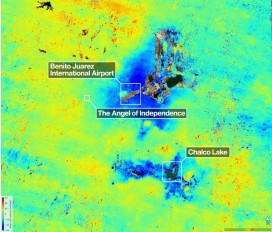
Mexico City’s sinking crisis mapped by next-generation satellite
May, 08, 2026 | NewsMexico City’s long-documented subsidence problem is receiving renewed attention after the NASA-ISRO...

The Rising Threat of Groundwater Flooding: Risks and GeoEngineering Solutions
Feb, 28, 2025 | NewsGroundwater flooding is an often-overlooked hazard, but as climate change intensifies, its risks ar...

Iran’s heritage sites threatened by accelerating land subsidence, experts warn
Nov, 03, 2025 | NewsCenturies-old monuments across Iran are facing increasing risks from land subsidence driven by deca...

New publication provides largest ever insight into world’s groundwater depletion rates
Jan, 24, 2024 | NewsA new study was recently published in the Nature journal, regarding the rates of groundwater level...

California expands groundwater and subsidence monitoring statewide
Oct, 10, 2025 | NewsCalifornia’s Department of Water Resources (DWR) has launched a major expansion of its groundwater...

New study suggests a method to replenish depleted aquifers
Apr, 15, 2019 | NewsScientists from Stanford University have introduced a new method to replenish aquifers by using floo...

Geoengineering Resilience: Building a Fire Station Over an Abandoned Mine in Colorado
Feb, 17, 2025 | NewsThe Frederick-Firestone Fire Station No. 5 in Colorado stands as a remarkable case study in geoengi...

California is sinking
Aug, 26, 2015 | NewsCalifornia enters the fifth year of a drought and more and more water is pumped from the aquifer....
On This Day
August 12th 2004
READ MORE
Related Video

Trending

Embankment Collapse on NH-66 in Kooriyad Triggers Engineering and Oversight Review

Fehmarnbelt tunnel advances with first element ready for immersion

Geotechnical Engineering 2032 Boom: Trends, Challenges, and Emerging Opportunities
Emergency protocols activated following offshore 7.7 magnitude earthquake in Japan
Stop Guessing, Start Designing: Introducing Support Designer in Slide2
Development program prepares new engineers for success