Dam Project in China to Be World’s Largest Robotic 3D Print
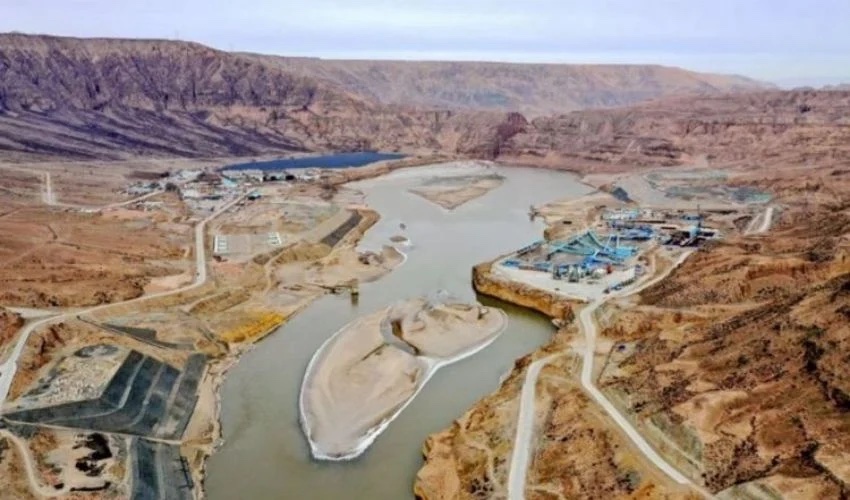
China is poised to build a hydropower dam in two years using artificial intelligence, construction robots, and zero human labor, the South China Morning Post first reported on Sunday, citing a paper published in April in the peer-reviewed Journal of Tsinghua University (Science and Technology).
The project, which is being carried out by the Science and Technology Department of Tsinghua University, is focusing on building the Yangqu Dam on the Tibetan Plateau layer by layer. After the two-year construction period of the dam, it will then be used to supply the Yangqu Hydropower Plant, which will provide the Chinese province of Henan with about 5 billion kWh of electricity every year. In concrete terms, this means that a total of 100 million people will be able to benefit from the 3D-printed dam, as it will secure their electricity supply. The electricity will be transmitted through a high-voltage transmission line of about ~4920ft, which has been built separately for the transmission of green energy aiming at sustainability. Liu Tianyue, one of the lead scientists of this project, comments that they want to “free people from heavy, repetitive and dangerous jobs” with this highly innovative project.
According to the Tsinghua University scientists, the Yangqu hydroelectric power plant is expected to reach a total size of ~520ft upon completion, which would make it the largest robotic 3D printing facility in the world, larger than the two-story office building in Dubai, the current world record holder.
At Yangqu, a central AI system will be used to oversee a massive, automated assembly line that starts with a fleet of unmanned trucks used to transport construction materials to parts of the worksite, per the scientists.
Once the materials arrive, unmanned bulldozers and pavers will turn them into a layer of the dam, and then rollers equipped with sensors will help to press each layer so that they become firm and durable, they said.
Per the paper, when a layer is complete, the robots will send information about the state of construction back to the AI system.
However, the mining of the construction material will still have to be done manually, the researchers noted.
The AI system and its army of robots will help eliminate human error, such as when roller operators don't keep to a straight line or when truck drivers deliver materials to the wrong spot, said lead author Liu Tianyun of Tsinghua University, according to SCMP.
The system will also allow on-site work to progress continuously without safety concerns for human workers, the researchers said, per the outlet.
According to the scientists, the completed Yangqu dam will provide 5 billion kilowatt-hours of power every year to China.
If successful, the building method could provide a blueprint for other construction projects, such as road construction, Liu's team said, as reported by SCMP.
Transmission line of about ~4920ft, which has been built separately for the transmission of green energy aiming at sustainability. Liu Tianyue, one of the lead scientists of this project, comments that they want to “free people from heavy, repetitive and dangerous jobs” with this highly innovative project.
According to the Tsinghua University scientists, the Yangqu hydroelectric power plant is expected to reach a total size of ~520ft upon completion, which would make it the largest robotic 3D printing facility in the world, larger than the two-story office building in Dubai, the current world record holder.
Sources: www.3dprintingmedia.network.com, www.businessinsider.com, www.3dnatives.com
Want to read more like this story?

China directs attention to solar and wind power: Beginning of an end for vast dam projects
Jul, 10, 2020 | NewsChina is leaning towards utilizing wind and solar power, something that will alter the country's st...

China considers shutting down numerous dam facilities
Sep, 04, 2021 | NewsBy 2019, China had constructed nearly 24,000 large dams (41% of the total large dams worldwide). Cu...
History of the Hoover Dam
Jun, 30, 2020 | NewsIntroduction Hoover Dam is the tallest arch dam constructed in the United States and forms one of...

Dam Engineering
Apr, 10, 2020 | EducationA dam is an infrastructure system that consists of several structures with the intent to collect,...
Aging dam infrastructure: A severe future threat
Jan, 22, 2021 | NewsAccording to a new report, issued by the United Nations University, aging water storage facilities...

Ethiopia: a controversial hydroelectric dam, built on the Blue Nile River, starts generating power
Feb, 19, 2022 | NewsA hydroelectric dam, built on the Blue Nile River in Ethiopia, will officially begin generating pow...

Dam Safety Association Presents Annual Awards
Nov, 27, 2006 | NewsAt each annual conference, the Association of State Dam Safety Officials recognizes individuals who...

Satellite data indicate over 2,500 U.S. dams are in poor condition
Dec, 21, 2025 | NewsDams across the United States are aging and underfunded, with geoscientists reporting that over 2,5...

The Cutting Edge of Tunneling: Exploring 3D Printing’s Role in Construction
Jan, 27, 2025 | NewsAs urbanization accelerates and infrastructure demands grow, innovative solutions are redefining co...
On This Day
August 11th 2012
READ MORE
Related Video

Trending

New crustal stress map of North America

Using Terzaghi’s Equation in Foundation Design

Parameters Variation: Model Customization and Sensitivity Analyses

UK geothermal projects expand from Cornwall power to Birmingham heating
Deadly mining landslide in Central African Republic raises safety concerns