Understanding Cableway Performance: New Insights From Torque Testing Sponsored

Hubbell Power Systems recently completed an extensive field and laboratory study to better understand why some customers were experiencing premature failures of cableway slots in concrete‑collar streetlight foundations. Although these foundations had been tested are rated for 10,000 ft‑lbs of torque, some field installations were reportedly failing below these values. The suspected culprit involved installation‑machine “crowd” forces—downward pressure applied during foundation installation—which could not be fully replicated in a traditional lab environment.
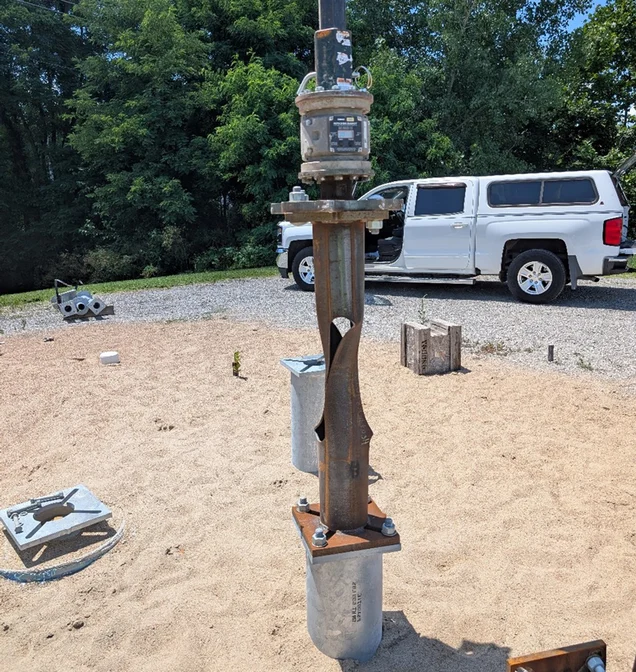
To address this, our team conducted a rigorous combined lab‑and‑field test series in Centralia, Missouri, using four different cableway geometries under multiple magnitudes of crowd. The findings provide new clarity on how cableway dimensions and installation forces interact to affect torsional capacity—and offer practical guidance for specifiers and installers.
Why We Tested: Replicating Real Installation Conditions
Earlier lab testing showed acceptable torque capacities, but lacked one real‑world factor: crowd force:
- Zero crowd tests conducted on the Hubbell Laboratories torque machine (calibrated to apply 25,000 ft-lbs of torque)
- Crowd applied field tests using a 2023 Terex digger derrick
A total of 36 samples were tested across four cableway sizes:
- 2.5" Wide × 12" Long
- 2.5" Wide × 18" Long
- 3.0" Wide × 12" Long
- 3.0" Wide × 18" Long
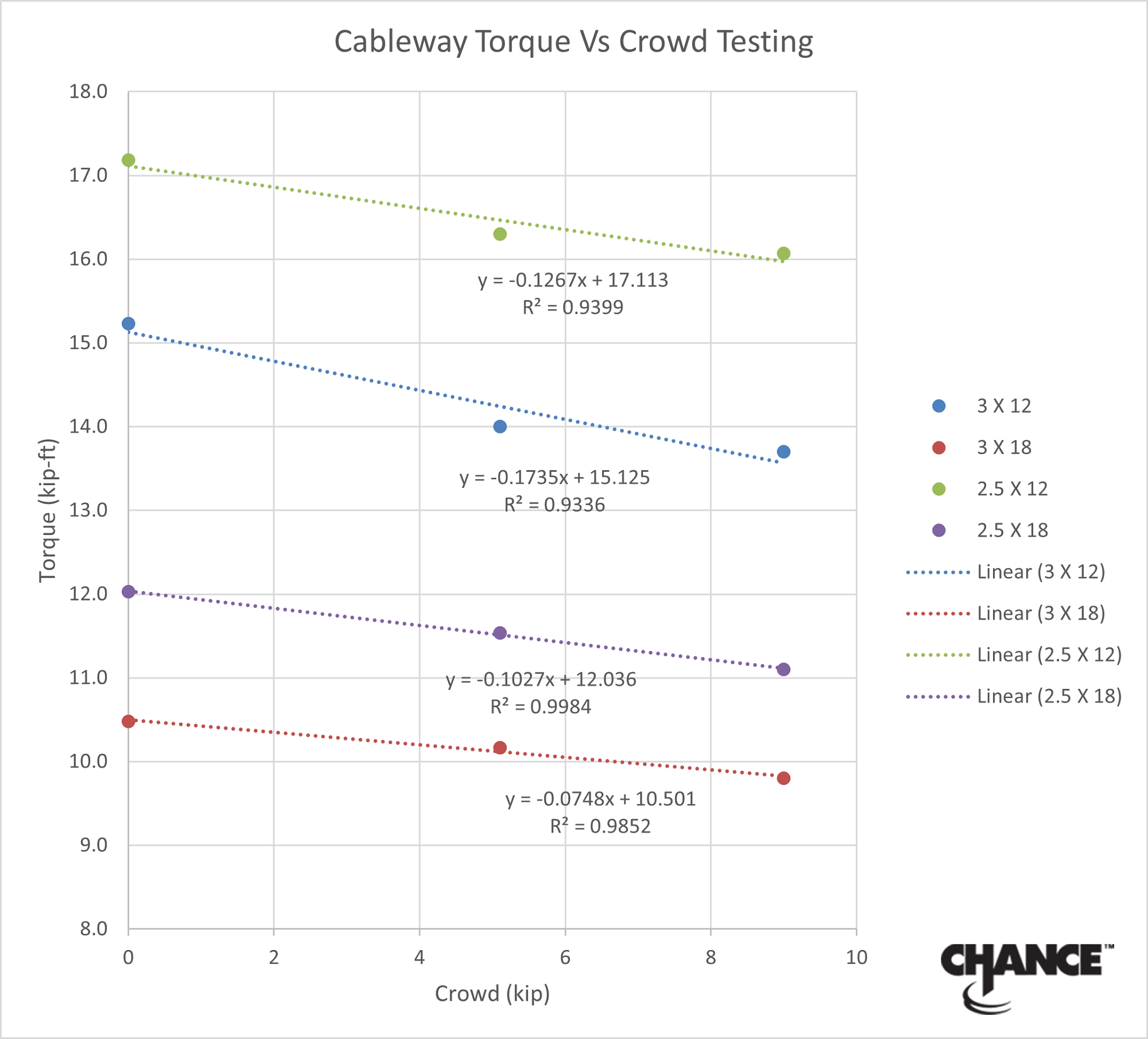
Each size was tested at 0 kip, 5.1 kip, and 9 kip of crowd. Three samples of each size were tested at each level of crowd force.
What We Found: Cableway Length Is the Dominant Factor
After analyzing the data—both directly and via a three‑way ANOVA—three variables emerged as statistically significant influencers of torque capacity:
- Cableway Length (largest effect)
Switching from a 12‑inch cableway to an 18‑inch cableway resulted in a 29.6% reduction in torque capacity. This was by far the most significant contributor to reduced strength. - Cableway Width
Increasing width from 2.5 inches to 3 inches caused a 12.7% reduction in torque capacity. - Crowd Force
Increasing crowd from 0 to 9 kips created an average 7.6% reduction in torque capacity.
These results confirm that all three variables—width, length, and installation crowd—measurably affect performance.
Visualizing the Trend: Torque vs. Crowd
The study plotted averaged torque values for each cableway size across the three crowd levels, producing linear trendlines with high correlation (R² values from 0.93 to 0.99). The takeaway is clear:
Higher crowd consistently reduces torque capacity across all cableway geometries, though geometry drives the majority of the reduction.
Practical Recommendations for Installers & Engineers
Based on the combined field and lab data, Hubbell recommends:
- Use the smallest applicable cableway length and width
Longer and wider cableways reduce the torsional capacity of 6" foundations.
- Minimize crowd force during installation
While crowd is necessary for proper installation, excessive downward pressure reduces torque capacity and increases the risk of deformation.
- Maintain awareness of combined effects
Cableway geometry and crowd interact—meaning the reductions stack.
For example, an 18" × 3" cableway under high crowd will experience both the reductions for the longer cableway as well as the wide cableway.
Hubbell is deeply committed to research, development, and rigorous testing as the foundation of everything we do. We continually invest in exploring new ideas, technologies, and methodologies to improve our products and services, ensuring they meet the highest standards of quality, performance, and reliability. We strive for continuous improvement, delivering innovative, dependable results to consistently meet customer needs and anticipate future challenges.
Want to read more like this story?

Measuring torque in pile installation via Hubbell's wireless system
Jun, 24, 2020 | NewsThe CHANCE wireless torque indicator, manufactured by Hubbell Power Systems, is a state-of-the-art...
How to Specify Helical Piles: A Practical Guide for Engineers
Jul, 06, 2026 | NewsHelical piles and anchors are widely used in foundation construction due to their efficiency, versat...

Why you Should Use at Least 2 Methods to Determine Helical Pile Capacity
Nov, 10, 2020 | NewsCHANCE® Foundation Solutions recently wrote a blog post arguing why you should use at least 2 me...

History of Torque Correlation (Kt) Factor
Jun, 25, 2020 | NewsGary Seider, Engineering Manager at Hubbell Power Systems, recently posted an interesting story on...

Using Torque Testing for Better Designs
Sep, 02, 2021 | NewsAll Engineers can relate to an experience we’ve had where what we designed was not how it turned ou...

High Capacity Grouted Piles Project
Sep, 05, 2022 | NewsA YMCA building and pool foundation were designed on grouted micropiles due to a layer of organic c...

A Wireless Torque for positive indication of anchor holding capacity in any soil type.
Dec, 06, 2016 | NewsUsing the CHANCE® Wireless Torque Indicator from Hubbell, you can install screw anchors to a pre-det...
Deep Foundation “Feedback”: Valuable Early Data From The Jobsite
Dec, 20, 2021 | NewsLearn how Geotechnical Engineers use valuable jobsite data to validate their recommendations for de...

Using Terzaghi’s Equation in Foundation Design
Nov, 25, 2022 | NewsTheoretical models to predict the capacity of helical piles are based on Soil Mechanics and an appr...
Form
Looking for more information? Fill in the form and we will contact CHANCE Foundation Solutions for you.
On This Day
August 9th 2001
READ MORE
Related Video

Trending

Keller North America announces recent leadership changes

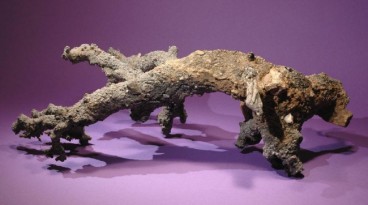
Fulgurite: A rare phenomenon

Life after gINT - Rethinking geotechnical data management for a new era
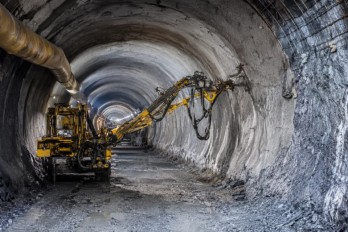
Major wastewater tunnel procurement begins in southern Sweden