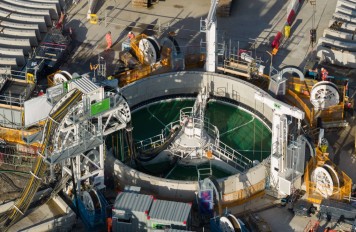
How to tackle underground stations inundation

As weather phenomena tend to become more intense, a crucial question is how to protect the underground infrastructure from flooding events.
A report published in July 2021 suggested that the previous year (2020) was the 5th wettest, 3rd warmest and 8th sunniest of all times. This statistic indicates that the world is currently experiencing extreme weather conditions. Despite multiple endeavors to alter the situation, it is evident that climate change is already affecting the world and its impact will increase in the future. Unfortunately, infrastructure was not designed to sustain all these ramifications. On the contrary, urbanization acts in favor of disastrous incidents such as flooding. For example, according to Dr. Dragan Savic's (professor of hydroinformatics at the University of Exeter) view about London “...the city has grown, we’ve concreted or asphalted over most of the land in the city, so there’s less capacity to soak up the rain that comes down".
Nonetheless, replacing the existing infrastructure with a more sustainable one is not an option since it would need incommensurate resources and time. Dr. Klaus Hans Jacob, a geophysist and flood expert, explains what needs to be done to protect underground infrastructure from flooding. Dr. Jacob's research focuses on the underground transportation system of New York city but the concept is applicable to multiple cities with similar issues.
New York's underground system has suffered significant damage over the past time period as the city was hit by Tropical Storm Henri and Hurricane Ida. Its subway network was constructed more than 115 years ago so evidently, the design could not have predicted the current weather phenomena. Unfortunately, despite evidence on what was to come, no proactive measures were taken to retrofit the system during the past decades. Dr. Jacob suggests that we need to repair the deficiencies of the existing underground stations rather than trying to establish new ones. This needs the installation of intelligent systems such as movable barriers that operate when flooding is expected. In addition, the entrances of the stations could be situated in high elevation points so that stormwater would not reach the stations in the first place.
Moreover, a secondary source of flooding must be thoroughly addressed to tackle the aforementioned issue. Underground infrastructure receives flooding from upper parts of infrastructure such as streets. Thus, pavement stormwater must be also be managed. This can be achieved by installing better sewer systems, planting more trees and implementing permeable surfaces so that rainwater can be directed to the soil beneath. This approach could also be applied on an individual level. For example, people should be advised to plant vegetation on the roofs of their houses in order to reduce runoff.
Dr. Jacob emphasizes that even this approach to protect underground infrastructure using smart methods and avoiding thoroughgoing changes, will not come at a low cost. At this point the funds dedicated to subways in the United States are insufficient.
Nevertheless, there are some examples in which such preventive measures have been installed and operate efficiently. In Tokyo, underground passages were reinforced with sliding barriers that can withstand the pressure of 15 meters of water.
Sources: Theconversation, Wired
Media
- Floodwaters gush into NYC subway stations
- Eyewitness News ABC7NY
Want to read more like this story?

The Rising Threat of Groundwater Flooding: Risks and GeoEngineering Solutions
Feb, 28, 2025 | NewsGroundwater flooding is an often-overlooked hazard, but as climate change intensifies, its risks ar...

The Berkeley Center for Smart Infrastructure: An interview with Prof. Kenichi Soga, Director of the Center
Feb, 26, 2024 | NewsThe following interview is from 2024 Special USA and Canada Geotechnical Business Directory edition...

World's most intricate subway networks
Feb, 19, 2019 | NewsUrbanization in large cities is constantly increasing the demand for advanced and complex metro netw...

New study finds signs of underground climate change and influence on civil infrastructure
Jul, 11, 2023 | NewsA new study by Alessandro F. Rotta Loria of Northwestern University, titled “The silent impact of u...

Seoul’s Underground Infrastructure Raises Ground Stability Concerns
May, 15, 2025 | NewsSeoul’s recent sinkholes have raised public safety concerns and questions on how existing and futur...

Dubai advances underground infrastructure vision with tunnels, caverns, and 100-year drainage network
Oct, 02, 2025 | NewsDubai is taking major steps toward a new era of subterranean development, with plans that combine t...

Hidden Potential: The Role of Underground Spaces in Urban Growth
Feb, 03, 2025 | NewsUnderground spaces have long fascinated humanity, from ancient engineering marvels like the Persian...

Video: Digging smart tunnels under London - an underground high-tech lab!
Jun, 19, 2014 | NewsCrossrail - the largest infrastructure project currently under construction in Europe - wi...

China devastated by extreme rainfalls: Dam destroyed to alleviate flooding
Jul, 19, 2020 | NewsChina decided to demolish a dam in order to reduce the upstream flooding and prevent further distra...
On This Day
August 26th 2017
READ MORE
Related Video

Trending
Active landslide threatens long-term connectivity in southern Bulgaria


PLAXIS example: Westergaard's added mass for hydrodynamic pressures

Rock Mass Classification Systems: A Global Review of Use and Dominant Approaches

How does the Leaning Tower of Pisa survive earthquakes
Emergency ground stabilisation protects rail works near Salford Central