
Rocscience Inc.'s Technical Workshop: Finite Element Modelling of Underground Excavations begins on Aug 26th 2026
Rocscience Inc.'s Technical Workshop: Finite Element Modelling of Underground Excavations begins on Aug 26th 2026
Create a free account and view content that fits your specific interests in geotechnical engineering Learn More
GranularSoils FoundationSettlement SPTdata StructuralStability
Estimating Settlement of Shallow Foundations on Granular Soils

Shallow foundations often give the illusion of simplicity—concrete blocks resting on firm ground, carrying the weight of entire buildings. But what lies beneath, particularly in granular soils like sand and gravel, can dramatically influence how those structures perform over time. A common oversight? Underestimating settlement.
Foundation settlement isn’t always sudden or catastrophic, but gradual shifts can lead to cracked walls, sloping floors, and overstressed structural elements. The design process demands close collaboration between structural and geotechnical engineers to ensure settlement remains within tolerable limits. While structural engineers focus on load paths and internal forces, geotechnical engineers dig deeper—literally—analyzing soil behavior and providing crucial recommendations on bearing pressures.
In granular soils, Standard Penetration Test (SPT) data becomes vital. These “N-values” are more than just numbers—they indicate the soil’s relative density and strength. But they must be corrected for factors like depth, moisture, and hammer energy. With proper interpretation, these values offer a window into how much a footing might settle over time.
Three Roads to the Same Destination
Estimating settlement isn’t a one-size-fits-all science. Thankfully, engineers have a toolkit of methods developed over decades, each offering slightly different perspectives. For granular soils, three standouts include:
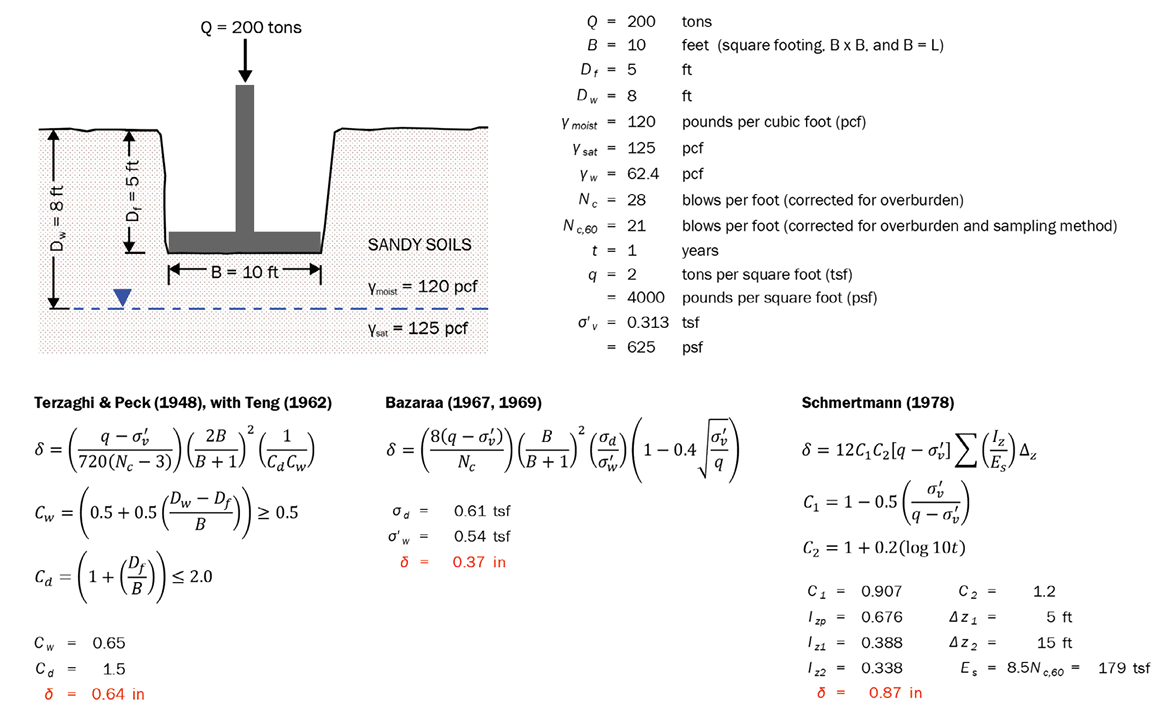
- Terzaghi & Peck (1948, revised by Teng in 1962): A pioneer in empirical methods, this approach provides graphical tools to estimate settlement based on observed behaviors of footings across varying widths and soil types.
- Bazaraa Method (1967-69): This method sharpens focus on corrected SPT values and includes groundwater corrections, offering a more nuanced take on real-world soil behavior.
- Schmertmann Method (1978): A modern, elasticity-based approach using strain influence factors, modulus of elasticity, and time-related corrections. It’s arguably the most detailed, capturing both short-term and long-term settlements.
In a sample case involving a 10-foot square footing on medium-dense sand, the three methods yielded settlements between 0.37 and 0.87 inches. While this range is manageable, the variability itself is telling. Soil conditions are never uniform, and design assumptions can shift with the slightest change in unit weight, modulus values, or SPT corrections. That’s why multiple methods should always be used side by side—like cross-checking a compass in unfamiliar terrain.
Beyond Numbers: The Human Factor
Settlement calculations are only as good as the data and judgment behind them. This means being vigilant about sampling quality, testing protocols, and groundwater observations. Even small errors—like mistaking field N-values for corrected ones—can lead to misjudging settlement by over 30%.
Equally important is understanding the context: Is the soil saturated? Is the structure sensitive to differential settlement? Will long-term creep affect connections or finishes? These questions often require going beyond the numbers and tapping into engineering intuition and field experience.
Finally, while granular soils don’t suffer from the compressibility issues of clays, they’re not immune to trouble. Factors like sudden wetting, vibrations, or prolonged loads can still induce movement. That’s why conservative design, informed by diverse settlement estimates, is critical.
Conclusion
Settlement isn’t just about the ground—it’s about the entire structure resting on it. In granular soils, careful estimation using multiple methods not only improves design accuracy but also strengthens confidence in the long-term performance of shallow foundations. When in doubt, double-check your N-values, vary your models, and talk to your geotechnical teammate. Because sometimes, what you don’t see beneath the surface can define the success of everything above it.
Source: structuremag.org
Want to read more like this story?
Soil Settlement
May, 13, 2019 | EducationSettlements refer to the soil’s movement in the vertical direction typically induced by stress chan...

Dartis Foundation
Jul, 04, 2024 | Software
GEO5 Settlement
Aug, 16, 2019 | Software
SO-Foundation
Feb, 07, 2015 | Software
SETOFF
Jun, 13, 2023 | Software
VertekCPT: Want to clarify the relation between SPT & CPT?
Apr, 21, 2015 | NewsTo determine the mechanical properties of soil, an engineer can rely on both CPT and SPT methods. L...

Settlement Analysis Software
Jun, 13, 2023 | Software
Optimizing Soil Improvement with PLAXIS: Techniques and Benefits
Nov, 12, 2024 | NewsSoil improvement refers to the process of modifying the physical properties of soil to improve its...
Shallow Foundation Design
Sep, 09, 2024 | EducationIn foundation engineering, there are two main modes of failure that the engineer needs to design a...
On This Day
August 11th 2012
READ MORE
Related Video

Trending

Jan, 15, 2026 | News
Tiebacks vs. soil nails: Choosing the right earth retention solution
May, 02, 2025 | News
When Dams Fail: The Growing Crisis of Tailings Management
May, 08, 2026 | News
Mexico City’s sinking crisis mapped by next-generation satellite

Apr, 18, 2026 | News
Landslide in Northern Peru Forces Evacuation of Over 170 Residents
Jan, 27, 2023 | News
Sinkhole outside home in Huntington Station, on Long Island: 3 fall into
Jun, 02, 2026 | News
Major wastewater tunnel procurement begins in southern Sweden


Jun, 11, 2026 | News