
Unprecedented cold weather may have triggered "Frost quakes" in Chicago
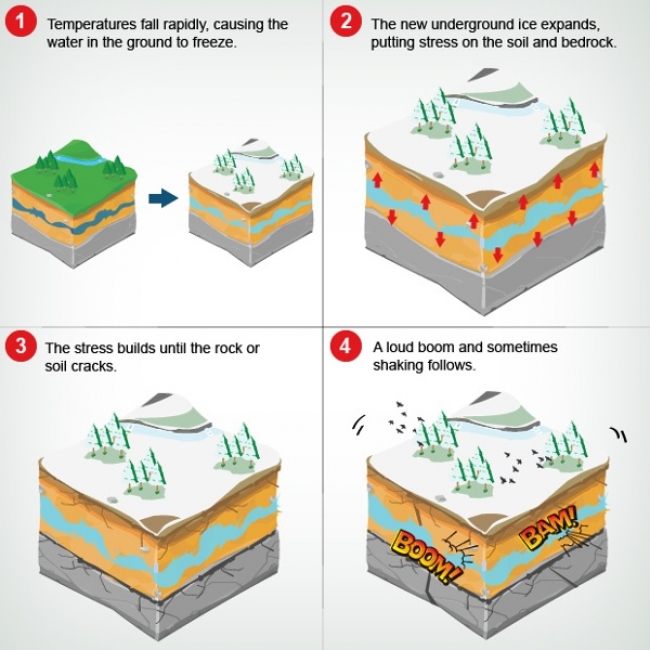
Freezing cold in Chicago may have caused shaking related to cracking action in frozen ground.
The polar vortex that has descended on the United States has provoked freezing temperatures in Chicago. This phenomenon could be associated with the so-called "frost quakes."
"Frost quakes" or cryoseisms, despite having similar effects, are not related to typical earthquakes that are caused due to faults' displacement. They are provoked as a result of water freezing near the surface of the earth due to the presence of cold air above. In an extreme freezing environment, water may also freeze deeper in the ground. Freezing causes water to expand putting stress in the surrounding soil or rock-mass ultimately causing severe cracking. This cracking can sometimes cause a sudden but localized shaking.
At least 3 conditions must be satisfied for a frost quake to occur:
- The ground must be saturated
- No snow must be on the ground as it will prevent the underground water from freezing and
- The temperature must drop enough to freeze the earth
According to Brent Hewett, a meteorologist at the NWS office in the Twin Cities region of Minnesota, cryoseisms have not occurred in the region because there is snow in the ground (condition 2 not satisfied).
On January 30, 2019, people in Chicago reported hearing loud noises and have "observed actual rivets in the ground after hearing the loud boom of a frost quake." The problem is that frost quakes cannot be verified. The induced cracks are not big enough and therefore difficult to be tracked down. Moreover, even if one crack is found it cannot be proven that it is associated with a cryoseism.
Charles Mott, a meteorologist at the National Weather Service (NWS) office working in Chicago stated that he hasn't noticed any frost quakes in recent days but it is possible that they have occurred.
Sources: Livescience.com, Forbes.com, Accuweather.com
Nearby News
Want to read more like this story?

“Frost quakes” felt around Chicago during recent cold wave
Jan, 13, 2024 | NewsChicago recently experienced a cold wave, which started on January 13 and reached temperatures as l...

Brine Freezing of Shafts FAQs
May, 09, 2019 | EducationWhat does freezing of shafts means? Since more than hundred years ago in water bearing non-competen...

Artificial ground freezing – past, present, and future
Jan, 19, 2023 | EventJoin Keller for the first webinar in their 2023 series titled "Artificial ground freezing – past, p...

Artificial Ground Freezing: Applications, Techniques, and Key Considerations
Aug, 27, 2025 | NewsArtificial Ground Freezing (AGF) is a temporary ground improvement technique widely applied in tunn...

New study shows that seasons affect the impact of earthquakes
Nov, 19, 2019 | NewsAccording to a new study, recently published in Seismological Research Letters, the season an earth...

Artificial Ground Freezing as a Tool in Urban Tunnelling
Dec, 12, 2024 | NewsThe construction of cross passages along High Speed 2’s (HS2) London tunnels represents the most ex...
Ground Freezing
May, 09, 2019 | EducationGround freezing is a soil stabilization technique that converts in situ pore water to ice by continu...

When the Ground Turns to Liquid: How Soil Turned Deadly in Myanmar’s Quake
Apr, 02, 2025 | NewsOn March 28, 2025, a devastating magnitude 7.7 earthquake struck Myanmar, shaking the region from i...

Keller implements ground freezing technique in New York's major tunnel project
Jul, 28, 2020 | NewsKeller applied ground freezing in the largest infrastructure project ever conducted in Suffolk Coun...
On This Day
August 12th 1978
READ MORE
Trending

China's Three Gorges Dam under pressure: Flood hazard downstream

Functional requirements of foundation structures


Landslide in Papua New Guinea: At least 12 people dead

Major wastewater tunnel procurement begins in southern Sweden