As the demand for lithium continues to rise, particularly from the electric vehicle and renewable energy storage sectors, hard rock lithium deposits—primarily hosted in spodumene-rich pegmatites—are becoming increasingly central to global supply chains. While market forces are accelerating the pace of project development, the underlying success of these operations rests on the geotechnical stability of their open pits. A recent synthesis of geotechnical data from case studies in Australia and Africa highlights the intricate slope design challenges that engineers face when dealing with pegmatite-hosted lithium orebodies.
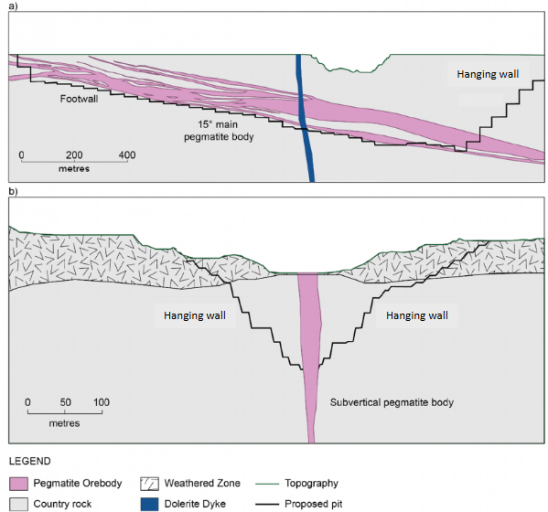
These deposits typically consist of gently to steeply dipping pegmatitic intrusions emplaced within metamorphosed country rocks such as amphibolite, greenschist, or gneiss. The geological geometry results in pit designs with hanging wall and footwall configurations, each presenting distinct geotechnical behaviors. Weathered zones near the surface (ranging from 5 to 60 meters in depth) pose localized slope instability risks due to low cohesion and increased pore pressures. However, at depth, rock mass conditions are generally favorable, with intact strengths often exceeding 100 MPa, shifting design considerations toward structural controls.
Structural and Lithological Controls on Slope Design
Effective slope design in these settings depends, according to a
recent research study on an accurate geotechnical model that incorporates lithological, structural, and hydrogeological data. Key geological features influencing slope performance include:
- The inclination and geometry of the pegmatite intrusion.
- Degree of weathering in the upper rock units.
- Rock mass strength differentials between pegmatite and country rock.
- Structural fabric including foliation, jointing, and regional shear zones.
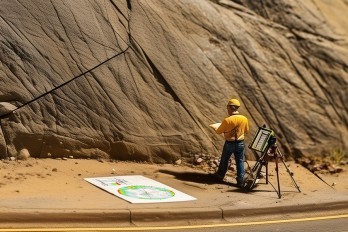
In the footwall, the structural orientation of the pegmatite—often aligned with steep foliation or shear planes—can lead to planar sliding mechanisms. In such scenarios, typical inter-ramp slope angles may be limited to 20–53°, with further reductions in weathered zones. Sheared contacts, especially where clay-rich gouge zones are present, pose additional failure risks and must be carefully modeled and monitored.
The hanging wall generally exhibits more favorable conditions for slope stability, allowing for inter-ramp angles between 46° and 60° in competent rock. However, steeply dipping foliation or bedding into the slope can result in toppling failures or wedge mechanisms, requiring reinforcement, controlled blasting, or installation of catch benches and barriers. Rockfalls are also a frequent concern on steep slopes, often mitigated through engineering controls such as rockfall traps or slope angle adjustments.
At the structural scale, geologists and engineers must account for both cooling joints—formed during pegmatite crystallization—and tectonic joints—resulting from regional deformation. Differentiating between these joint sets is essential for proper structural domain definition. In some cases, joints terminate at the pegmatite-country rock boundary, which can be favorable, while in others, continuous structures propagate failure paths through multiple lithologies.
Hydrogeological Constraints and Practical Design Limits
Hydrogeology also plays a significant role in slope stability. Pegmatite bodies typically act as low-transmissivity zones, compartmentalizing pore pressures. This leads to high hydraulic gradients behind pit walls, particularly in areas with sheared contacts or enhanced weathering. In these settings, groundwater inflow is often manageable through in-pit sump pumping, as advanced depressurization is not always necessary. However, surface recharge and delayed drainage across benches can result in soft ground conditions that hinder equipment mobility and elevate local failure risks.
Designing for these conditions requires a nuanced understanding of both intact rock behavior and discontinuity networks. For example, even in high-strength fresh rock, foliation in country rock can introduce strength anisotropy that complicates stability analysis. Laboratory testing, core logging, and stereographic analysis are critical tools in identifying dominant failure mechanisms and informing slope angle selection.
Recent data from lithium operations in Australia and Africa suggest that while bench-scale failures can be managed with conventional techniques, larger-scale planar or wedge failures require targeted geotechnical solutions. These may include structural mapping, real-time slope monitoring, controlled blasting patterns, or selective slope flattening in structurally weak zones.
Engineering Resilience Amid Market Expansion
Lithium demand has been influenced by trends in electric vehicle production and renewable energy storage. While alternative extraction and recycling methods are being explored, hard rock mining continues to represent a significant source of lithium in current operations.
Slope design plays a key role in ensuring safety and maintaining operational continuity. Performance issues such as slope failures can impact production schedules and associated costs. Engineering solutions aim to manage these risks and maintain the structural integrity of open pits.
As lithium projects advance from exploration to development, geotechnical assessments continue to inform pit design, stability analysis, and overall project planning.