
Excavation Dewatering in PLAXIS: An Iterative Approach to Find Pore Pressure Equilibrium for Better Stability
- Aug, 06, 2026 - Aug, 06, 2026
- Webinar Deep Excavations Stabilization Numerical & Constitutive Modeling
- English
- Authored by: Geoengineer.org

Convergence issues, cryptic error messages, and apparent signs of instability are common challenges in geotechnical analyses, often masking underlying pore pressure effects that are difficult to identify and interpret.
Apart from conspicuous design deficiencies, a staggering eight out of ten convergence issues could very well be traced back to an adverse pore pressure field. The situation becomes more complicated when the unloading response of undrained geomaterial is involved and, therefore, less straightforward to understand.
In this second instalment, the focus will be on identifying and telling pore pressure-induced noise apart from a genuine collapse.
You will learn:
- Typical situations where the phreatic way of generating pore pressure fields can hold back convergence.
- The underlying cause
Want to read more like this?

Pore-Water Pressure Definition for a Levee Stability Analysis
Feb, 24, 2026 | NewsThis example explores the effect of a flood event on the stability of a levee underlain by a confin...

How to Perform Dewatering in PLAXIS
Jun, 11, 2021 | NewsThe problem of changing water conditions is omnipresent in geotechnical engineering. Groundwater is...
Consolidation Analysis for Embankments
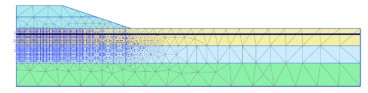
Aug, 12, 2022 | NewsConstruction of embankments on soft soil presents a challenge. Soft soil deposits have a high moist...

Bentley Webinar: Shaft, Excavation and Dewatering: Learn and evaluate most common convergence issues
Aug, 25, 2020 | EventGeotechnical engineers face complex challenges when analyzing and designing for projects involving...

Importing pore-water pressure results from SEEP3D into a two-dimensional SLOPE/W analysis
Mar, 02, 2026 | NewsThis example replicates the “Rapid drawdown” examples illustrated in SEEP/W and SIGMA/W. The purpos...

Vertek CPT: How pore pressure data is used to correct and analyze CPT data?
Feb, 27, 2015 | NewsIn continuation to the previous article provided by Vertek CPT University, pore pressure s...

Slope Stability of Embankments on Clay
Aug, 23, 2022 | NewsThe construction of an embankment on clay can generate excess pore pressure in the clay, causing sl...

GEO5 Slope Stability – Water Flow
Jan, 19, 2023 | Software
GEO5 Earth Pressures
Aug, 30, 2019 | SoftwareForm
Looking for more information? Fill in the form and we will contact Bentley for you. Alternatively, you can visit Bentley's website and speak with a Bentley Geotechnical Expert.

On This Day
July 19th 1900
READ MORE
Related Video

Trending

Plaxis 2D/3D Basic Course – Online Training


Piling & Ground Improvement Conference 2026 (DFI-PFSF)
Reading the Rock: Structurally Controlled Slope Instabilities with DIPS and RocSlope2

Course: Slope Stability Analysis of Open Pit Coal Mine Excavations and Waste Dumps
