
Contaminated Soil Remediation through Thermal Desorption -- Synthesis of Case Histories and Comparison of In-situ and Ex-situ Applications
Contents [show]
- Introduction
- Characteristics of Thermal Desorption
- Synthesis of Case Histories
- Comparison of Advantages and Limitations
- Analysis of the Application Trends of Thermal Desorption Technology
- Conclusion
- References
- Appendix A: Full Table of Thermal Desorption Case Histories
- Appendix B: A Foreign Case of Thermal Desorption: Shanghai Dyestuff Chemical Factory Site
Introduction
Thermal desorption refers to an environmental remediation technique in which contaminants such as organic compounds and metallic mercury in soil are volatilized and separated by heating. [1][2] Due to its versatility and applicability in different soil types, it is commonly used in remedial projects and is often selected for superfund sites where a high concentration of various contaminants is detected.
Thermal desorption is divided into in-situ and ex-situ thermal desorption. Regardless of the setting, it is generally an energy-intensive process that requires the application of heat to volatilize moisture, organic matter, and mercury. The volatilized moisture and pollutants are sent to the exhaust gas treatment system through the airflow or vacuum system. The processed soil may undergo further treatment, or the remedial action may be deemed complete if contaminant concentrations have reached desired levels.
This study focuses on the comparison of in-situ and ex-situ thermal desorption techniques by compiling a synthesis of case histories. It analyzes the advantages and limitations of the two methods, lessons learned, and future development trends. An extensive case study of thermal desorption in China is also included for viewer’s reference, due to the scarcity of English records for such cases.
Characteristics of Thermal Desorption
Thermal desorption requires heating the soil to a sufficient temperature through direct or indirect heat exchange under vacuum conditions or when a carrier gas is introduced, so that the organic pollutants can be volatilized or separated from the polluted medium and enter the gas.
Thermal desorption can selectively convert pollutants from one phase to another by adjusting heating temperature and residence time. By controlling the temperature of the thermal desorption system and the residence time of the contaminated soil, the pollutants can be volatilized selectively without chemical reactions such as oxidation and decomposition. It can effectively remove highly volatile organic compounds, and under the appropriate conditions, it can also remove semi-volatile or hardly volatile organic pollutants that have high boiling points and are difficult to decompose. For organic pollutants with different boiling points, they can be volatilized one at a time to achieve the desired remedial results.
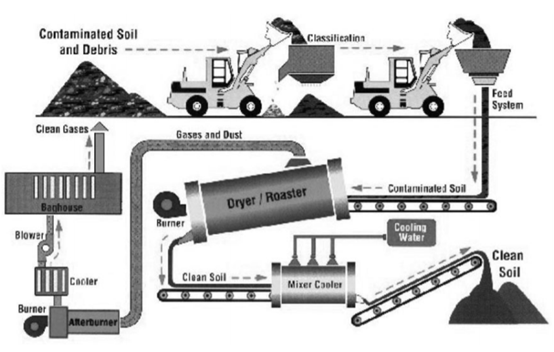
Thermal desorption mainly consists of two basic processes: one is heating the contaminated soil to volatilize the target pollutant into the gaseous phase for separation; the other is to condense, collect or incinerate the exhaust gas containing pollutants until it reaches environmental standards for discharge. According to the previous discussion, a detailed thermal desorption system typically has the following components, as shown in Fig.1[3].

Principles and Characteristics of In-situ Thermal Desorption Technology
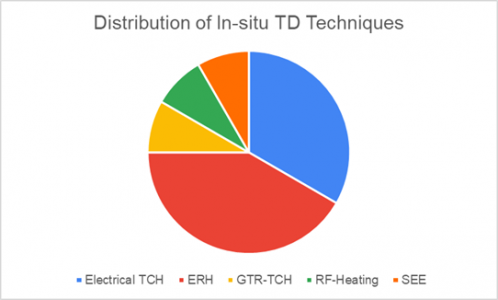
In-situ thermal desorption refers to the in-situ heating of the soil in the contaminated area so that the pollutants in it transform to the gas or liquid phase and then are captured by the in-situ extraction system and extracted to the subsequent treatment facility. The common in-situ thermal desorption system is mainly composed of a soil heating system, gas-phase extraction system, wastewater, and waste gas treatment system, control system, and other parts. At present, in-situ thermal desorption technology can be roughly divided into the following types according to different heating methods: electrical resistance heating (ERH), thermal conduction heating (TCH), steam enhanced extraction (SEE), radiofrequency thermal desorption technology (RF), hot air and hot water thermal desorption techniques. TCH can be further characterized into electrical heaters or gas-thermal remediation (GTR), depending on the heating element used. Among them, ERH and TCH are more widely used, with ERH being the most popular and outnumbering other in-situ thermal desorption technologies by a factor of three, according to the Federal Remediation Technologies Roundtable (FRTR). [9]

Principles and Characteristics of Ex-situ Thermal Desorption Technology
Ex-situ thermal desorption removes the contaminated soil in the contaminated area and transports it to the ex-situ thermal desorption equipment for heating treatment. Common ex-situ thermal desorption systems include feeding systems (such as screens, crushers, vibrating screens, chain conveyors, conveyor belts, iron removers, etc.), desorption systems (rotary drying equipment, thermal screw propulsion equipment, fluidization bed equipment, etc.), exhaust gas treatment system (cyclone dust collector, second combustion chamber, cooling tower, condenser, bag filter, leaching tower, ultrafiltration equipment, etc.). Ex-situ thermal desorption systems can be divided into high-temperature thermal desorption (HTTD) and low-temperature thermal desorption (LTTD). LTTD can raise the soil temperature to 90~320℃, and is primarily used to treat volatile organic compounds and chlorinated solvents; high-temperature thermal desorption is used to treat semi-volatile organic compounds, and can also be used for PCBs and mercury. This technology can raise the soil temperature to 320~560℃, but specialized setups can achieve even higher temperatures. Ex-situ thermal desorption systems can also be divided into direct and indirect thermal desorption, depending on whether the heating gas directly comes into contact with the contaminated soil (thus requiring treatment).
Synthesis of Case Histories
Thermal desorption technology has broad engineering application prospects. In the United States, its use in the environmental remediation field first began in the 1980s, with wide-spread full-scale use starting in the 1990s. With various implementations in Superfund projects and more cases in local or voluntary remediation projects, there is already a large number of thermal desorption project cases. Thermal desorption is also quickly gaining traction as a popular remedial technique in other countries.
This paper extracts 34 case histories of thermal desorption remediation projects; 29 of them are obtained from FRTR Cost and Performance Reports [12] and the other 5 are from academic papers. Six additional cases have been identified but are not included in the following analysis due to the lack of required details. In fact, most smaller remediation projects do not make their data publicly available.
Tab. 1. Overview and parameters of thermal desorption case histories. Full table with additional cases given in Appendix. [5][6][7][10][11][12]

Overview
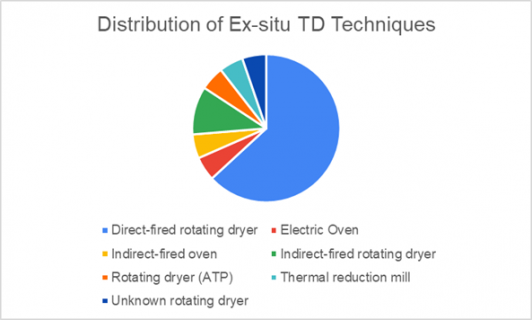
Among the 34 cases listed in Table 1, 14 of them are in-situ thermal desorption cases, and 20 of them are ex-situ cases. From Fig. 4, the most common technique used for ex-situ thermal desorption is rotary dryer (kiln) thermal desorption technology. For in-situ thermal desorption, ERH and TCH have been most widely implemented, as shown in Fig. 5.
In these cases, thermal desorption is mainly used in the remediation of sites contaminated with BTEX and other VOCs, chlorinated organics (CVOCs), PAHs, PCBs, and PHCs. The remediation efficiency of contaminants is usually above 90%, and can reach more than 99%.
Temperature
The processing temperature of the in-situ technology is mostly 100°C and the average is 161°C. Exceeding or reaching the boiling point of water can be a difficulty of this approach, as it consumes a lot of energy and time. In fact, for ERH, the maximum temperature is the boiling point of water, because moisture is the main conductor of electric currents between the electrodes. For TCH, although the soil can be heated above 100°C , the process of heating and boiling the pore water can account for more than 50% of the energy consumption and operation time. In the above cases, ERH is mainly used to treat CVOCs, while TCH can also be used to treat PCBs.
The processing temperature of the ex-situ technology can be relatively higher, ranging from 150°C to 700°C, with an average of 403°C. Hence, ex-situ thermal desorption is more versatile, and HTTD has been used to treat any combination of SVOCs, PAHs, PHCs, pesticides, and even mercury. LTTD can also effectively treat VOCs and CVOCs, but typically is not used to treat them alone due to the existence of lower-cost options (in-situ thermal desorption can be one of them). For the ex-situ approach, the single processing capacity of rotary thermal desorption equipment is relatively small, ranging from 1 to 8 ton/hr in the collected cases. The processing capacity of specialized thermal desorption stations is relatively large, ranging from 20 to 100 tons/hr.
Soil Conditions
Generally, thermal desorption technologies do not have specific limitations on the type of soil. In the above cases, soil classification range from coarse sand to fine silt and clay. For ex-situ processes, soil goes through a screening process to prevent larger pieces from damaging the equipment. Contaminants can also bond with finer soil particles and dust in the dryer and exhaust systems, resulting in the build-up of material and a decrease in thermal desorption efficiency. However, this is typically not a significant issue to overcome.
In-situ thermal desorption has somewhat more stringent conditions on soil, but it is still considered to be less demanding than other remediation techniques. For example, in-situ thermal desorption was used on a site when soil vapor extraction failed due to heterogeneous sand and clay formations.
Moisture Content and Groundwater
Ex-situ thermal desorption requires an optimal soil moisture content of around 15 to 20%. If soil is too wet, heating efficiency is reduced and the amount of contaminated water vapor increases. If soil is too dry, a lot of dust is created. To reduce the moisture content, lime is usually added to the soil. There is also a case in which the soil was too dry, and water had to be delivered to the site as on-site groundwater was heavily contaminated.
In-situ thermal desorption is very sensitive to moisture content and groundwater levels. As mentioned above, it directly affects treatment temperature, and saturation levels also affect heat transfer and gas flow. If groundwater recharges at the site at an overwhelming rate, a lot of energy will be wasted and the additional contaminated water vapor will require treatment. It will also be very difficult to consistently achieve desired treatment temperatures. In such cases, cutoff walls (e.g. sheet piles) or pumps have to be installed to prevent groundwater intrusion. However, for ERH, reduced moisture content after heating (pore water evaporates) can lead to reduced power delivery and efficiency, so water may have to be actively replenished.
Costs
Cost data were not provided for 7 of the cases. Regardless of in-situ or ex-situ thermal desorption technology, the system investment costs are very expensive and typically account for the majority of costs. The system investment is about 1 million to 4 million dollars, and the operating cost is mostly between 50 to 300 dollars/ton.

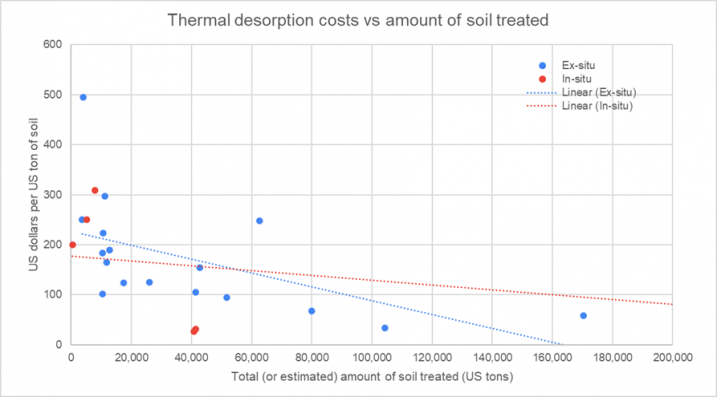
In Fig. 6, there is no visible difference between in-situ and ex-situ applications in terms of unit cost, and no clear trend exists as time progresses. However, Fig. 7 clearly indicates that unit costs decrease when the total amount of soil treated increases (i.e., scale of operation increases). For cases with more than 50,000 tons of soil treated, in all but one case the unit cost was lower than $100/ton. For the case with 389,000 tons (only case using SEE), the reported unit cost was even as low as $20/ton. As the amount of treated soil increases, the initial system investment costs are spread over a larger amount of soil Hence, overall unit costs decrease considerably.
The negative gradient of the linear regression line also proves the trends, which is more significant for ex-situ cases than for in-situ ones. On average, the unit costs for ex-situ thermal desorption decreases $1.43/ton per increase of 1,000 ton of treated soil. For in-situ, it is a $1.25/ton decrease per 1,000-ton increase, but the number is less compelling due to the few number of cases with cost data.
Synthesis Conclusions and Other Observations
- As mentioned above, in-situ applications of thermal desorption are more sensitive to the soil characteristics, moisture content, and groundwater conditions in the Target Treatment Area (TTA). The optimal efficiency and effectiveness of this technology greatly rely on the ability to detect, model, and predict underground conditions as well as heat and contaminant transfer. Costs may increase if operations cannot go as planned, and secondary treatment techniques may even be required if in-situ thermal desorption fails to achieve remedial targets. In the only case where the operation had failed entirely, hydrochloric acid vapor generated from the reaction of chlorinated solvents corroded and resulted in extensive damage to pipes and wells. This was not anticipated, and the expensive operation was shut down after being in operation for only 12 days. In another case, an unforeseen amount of rain increased groundwater levels and submerged the vapor wells, increasing project duration by months.
- During the collection of cases, most in-situ thermal desorption cases did not exceed 50,000 tons of soil treated. This is not only due to larger sites having potentially more heterogeneous ground conditions but also because not all areas in the TTA require the same temperature and duration of treatment. In larger projects, the TTA is divided into multiple decision units, each with its own control of temperature and heating duration. Nevertheless, as scale increases, a greater risk is introduced into the in-situ system.
- Again, ex-situ thermal desorption proves to be more versatile. Even if the process fails to meet the remedial targets for (some of) the treated soil, the unsatisfactory portion can easily undergo secondary treatment or be sent to a landfill. However, secondary pollution during excavation and transportation can pose a threat to workers.
- Both in-situ and ex-situ thermal desorption have been found to greatly alter soil characteristics. In one case of applying electrical TCH on clay, it was found to increase soil porosity by 10% and permeability by 4 orders of magnitude.
- As a remedial technology, thermal desorption is more welcomed by the general public and local communities. It completely removes the contaminant, while other technologies such as stabilization “leave problems for the future.” Unlike vitrification, thermal desorption does not completely “destroy” the soil.
- Thermal desorption is relatively less operationally flexible. It is most efficient to run the operation (heat) 24/7. However, this may not be possible due to local regulations.
Comparison of Advantages and Limitations
Both in-situ and ex-situ thermal desorption employ the same concept: Heating contaminants until they volatilize and separate from the soil. Therefore, these two technologies have the following similarities:
- Ability to remove most of the organic pollutants in a relatively short time: With the use of thermal desorption treatment, the desorption of organic pollutants from the soil can be achieved effectively, and generated gases can be treated by means of secondary combustion or concentration—resulting in the complete removal or recycling of substances. Due to the nature of the thermal desorption process, the remedial process can also be quicker compared with other technologies, which makes it desirable for time-sensitive projects.
- High energy consumption: As thermal desorption technology requires electric energy conversion or burning natural gas and other fuels, the energy consumption and resulting cost will increase accordingly compared with other techniques such as solidification/stabilization, in-situ chemical oxidation, and soil vapor extraction. Hence, it may be more feasible when other technologies struggle or fail to meet the remediation targets. Especially when the soil moisture content is high, or the groundwater replenishment rate is fast, a large amount of heat is used for water evaporation, which will lead to a significant increase in energy consumption.
- Secondary pollution: Ex-situ thermal desorption technology requires soil excavation and transportation, during which contaminants may diffuse. At the same time, it will also create new pollution sources such as noise, rainwater contamination, and dust. For in-situ processes, the exhaust gas collection and treatment system may create complications. In some cases, operations had to be paused because the discharged gas did not meet regulatory standards. Contaminants in the ground may also mobilize towards unexpected locations.
- The overall system is large and complex: In addition to the desorption system, the ex-situ setup also includes a feeding system, an exhaust gas treatment system, as well as an auxiliary monitoring system, and a pretreatment system. The in-situ heat treatment system also requires waste-gas/wastewater and other follow-up systems. Many problems arise from such complexity. In particular, different system units are typically purchased from different manufacturers and may not match perfectly during assembly. Further research and development of complete sets of equipment are required.
- Good scalability: As mentioned above, both ex-situ and in-situ thermal desorption benefit from increasing scale in terms of lower unit costs.
In general, thermal desorption is suitable for treating sites contaminated by organic matter (or volatile inorganic matter such as mercury). It is more cost-effective for larger sites or sites with higher contaminant concentrations due to its excellent effectiveness but relatively higher initial costs. There are also many differences between in-situ and ex-situ thermal desorption technologies, each having its own advantages and disadvantages. The following table compares in-situ and ex-situ thermal desorption technologies in detail.
Table 2. Comparison of advantages and limitations of in-situ/ex-situ thermal desorption technology
| In-situ | Ex-situ |
| Advantages | Exhaust gas treatment system and monitoring system occupy a small amount of area | Processing on the ground, easy to control entire process |
| Nature of in-situ process results in less secondary contamination | Easy to determine whether the soil is up to standard | |
| No need to carry out soil excavation, transportation, and backfilling procedures, which saves this part of the cost | Easy to pre-treat contaminated soil | |
| The amount of exhaust gas produced is small, and the concentration of pollutants in the exhaust gas is high, so the collection method is often used, and other pollutants will not be produced | Broader range of suitable contaminants, can treat PHCs, SVOCs – more versatile | |
| Can be used under existing buildings and structures, no need for excavation | Higher heating temperatures feasible and easier to achieve | |
| Limitations | Underground processes are difficult to predict and control | Need to build an ex-situ restoration site, occupying a large area of land |
| Treatment endpoint is difficult to determine | Contaminated soil needs to be excavated and transported. Contaminants may diffuse, and it will also cause secondary pollution such as noise and dust | |
| More vulnerable to site conditions, imperfect predictions, and unforeseen events | Need to carry out soil excavation, transportation, and backfilling procedures, which increases this part of the cost | |
| Relatively less scalable, introduces risk when scale increases | In direct thermal desorption technology, the combustion of exhaust gas may produce more harmful pollutants, and improper operation may even produce carcinogens, dioxins. | |
| Higher heating temperatures difficult or impossible | Cannot be used under existing buildings and structures |
From the comparison in Table 2, ex-situ thermal desorption is more versatile compared to its in-situ counterpart, as it is less dependent on site conditions, applies to a broader range of contaminants, and scales better for larger projects. It can quickly and effectively carry out a series of processes such as pretreatment, thermal desorption, and monitoring.
On the other hand, in-situ thermal desorption has more advantages in terms of minimizing ground disturbance and secondary pollution. It also saves the cost of excavating and transporting soil and requires less area for processing.
In conclusion, in-situ thermal desorption is more suitable for smaller sites, in which ground conditions can be comprehensively surveyed and models of heat and contaminant transfer can be established with confidence. It is desirable in urban and suburban settings, especially where excavation is not viable due to existing structures and surrounding communities. If the above conditions are met, in-situ thermal desorption can also achieve an equal or lower unit cost than ex-situ thermal desorption.
Ex-situ thermal desorption should be used if the above conditions are not true, or when less volatile contaminants (such as SVOCs) exist. It is better suited for larger sites with heavy contamination, particularly in rural settings with an abundance of empty land, which is also less vulnerable to secondary pollution.
Analysis of the Application Trends of Thermal Desorption Technology
The U.S. Environmental Protection Agency released the Fifteenth Edition Superfund Site Summary Report in July 2017[8], which listed the number of applications of various soil pollution control technologies in Superfund remediation sites since 1982.
In the 33 years from 1982 to 2014, the number of application cases was 93 for in-situ thermal desorption and 60 for ex-situ thermal desorption. Figure 8 compares the number of application cases of in-situ thermal desorption technology and ex-situ thermal desorption technology in the Superfund project. It can be seen that the in-situ thermal desorption technology was applied more frequently in the years from 1989 to 2000 and from 2005 to 2014. The year with the most cases was 1993, with a number of 13. The ex-situ thermal desorption technology has been widely used from 1990 to 1999. During the period from 1991 to 2003, there were five years (1991, 1996, 1998, 2002, and 2003) where its number of cases exceeded that of in-situ thermal desorption. After 2006, ex-situ thermal desorption has become less and less popular. The years with the most application cases were 1991 and 1996, and the number of cases was 8, respectively.
Figure 9 compares the proportion of in-situ and ex-situ thermal desorption projects in all Superfund projects from 1982 to 2014. The trends of both processes shown are mostly equivalent to the trends in absolute numbers, as analyzed above.


Over the years, in-situ thermal desorption has remained widely in use in Superfund projects, while ex-situ thermal desorption has experienced a decline. Although the exact implications of these trends cannot be determined without more extensive research and analysis on individual cases (this study only manages to retrieve data for 31 cases in the U.S.), some speculations and predictions can be made.
In the 1990s, in-situ and ex-situ thermal desorption were almost equally popular. This can be attributed to the fact that both were newly established technologies, and remedial actions on contaminated sites had just began in the U.S. Hence, both technologies can be applied on numerous contaminated sites as long as the conditions required for each technology (as stated in the last section) were met.
In more recent years, developments in the geotechnical and geoenvironmental fields have improved the ability to understand subsurface conditions and processes. Advancements in non-intrusive technologies such as seismic wave techniques, Electrical Resistance Tomography, and Ground Penetrating Radar have made modeling underground conditions less expensive and risky. This may partially explain why in-situ thermal desorption has been more popular recently, particularly after 2004. In the future, it is likely that newer technologies such as Fully Autonomous UAV Subsurface Characterization will make in-situ thermal desorption even more feasible for larger projects, hence further increasing its usage.
Another explanation for the decline of ex-situ thermal desorption is that many large, heavily contaminated sites have already been remediated. Ex-situ thermal desorption was well-suited for such cases with inherent urgency. However, for the smaller sites that were left, in-situ thermal desorption may require more years of subsurface modeling, which explains its relatively higher and more stable case numbers in the 2000s.
Conclusion
Both in-situ and ex-situ thermal desorption are proven technologies for contaminated soil remediation. As for any other soil remediation technique, both are not perfect, and require certain conditions to achieve maximum efficiency and effectiveness. In-situ thermal desorption is currently more suitable for smaller sites and can achieve excellent remediation results for certain contaminants but is more vulnerable to ground conditions. Ex-situ thermal desorption is more versatile and can treat less volatile contaminants but requires excavation and transportation of soil and has a higher risk of secondary pollution. Engineering practice, in general, requires careful planning and judgment, which is particularly true for soil remediation. With advancements in subsurface characterization techniques, in-situ thermal desorption is expected to become more popular, but ex-situ thermal desorption must still be considered as a reasonable alternative.
Thermal desorption can achieve relatively low unit costs with increasing operation scale. It is also more effective in comparison with other techniques and results in the removal of contaminants from soil. However, its higher system investment cost means that it cannot be considered as a “go-to” solution for any project. As soil contamination remains a severe issue throughout the globe, thermal desorption for soil remediation will continue to see widespread adoption in future years.
References
[1] Baker R S, Kuhlman M. A description of the mechanisms of in-situ thermal destruction (ISTD) reactions[C]//Current Practices in Oxidation and Reduction Technologies for Soil and Groundwater, and presented at the 2nd International Conf. on Oxidation and Reduction Technologies for Soil and Groundwater, ORTs-2, Toronto, Ontario, Canada. 2002.
[2] Khan F I, Husain T, Hejazi R. An overview and analysis of site remediation technologies[J]. Journal of environmental management, 2004, 71(2): 95-122.
[3] Zhao C, Dong Y, Feng Y, et al. Thermal desorption for remediation of contaminated soil: A review[J]. Chemosphere, 2019, 221: 841-855.
[4] Johnson P, Dahlen P, Kingston J T, et al. Critical Evaluation of State-of-the-Art In Situ Thermal Treatment Technologies for DNAPL Source Zone Treatment. State-of-the-Practice Overview[J]. 2009.
[5] Baker R S, Lachance J C, Heron G. Application of thermal remediation techniques for in-situ treatment of contaminated soil and water[C]//Proceedings of the NATO Advanced Research Workshop, Athens. 2006: 12-17.
[6] Dusek P, Hampson C M, Kvapil P, et al. Steam enhanced extraction (SEE) as an innovative approach for TCE removal[J]. 2003.
[7] Holzer F, Buchenhorst D, Koehler R, et al. Demonstration of In Situ Radio‐Frequency Heating at a Former Industrial Site[J]. Chemical Engineering & Technology, 2013, 36(7): 1108-1116.
[8] The United States Environmental Management Agency: Superfund remedy report, 15th Edition [R]. Office of Land and Emergency Management, July 2017.[9] The Federal Remediation Technologies Roundtable: In Situ Thermal Treatment. https://frtr.gov/matrix/In-Situ-Thermal/ accessed 04/25/2021
[10] T.C. Chang, J.H. Yen, On-site mercury-contaminated soils remediation by using thermal desorption technology, Journal of Hazardous Materials, Volume 128, Issues 2–3, 2006, Pages 208-217
[11] Heron, G., Parker, K. et al., World's Largest In Situ Thermal Desorption Project: Challenges and Solutions. Groundwater Monit R, 2005, 35: 89-100.
[12] The Federal Remediation Technologies Roundtable: Cost and Performance Reports. https://frtr.gov/ accessed 04/25/2021
Appendix A: Full Table of Thermal Desorption Case Histories
A view-only link to the table on Google Sheets is provided here for better viewing:
https://docs.google.com/spreadsheets/d/1_ZSFXDNfMc362MXT8VAD0CinIuL8qgxtiIecjTyoTAw/edit?usp=sharing
Sources: See References [5][6][7][10][11][12]

Appendix B: A Foreign Case of Thermal Desorption: Shanghai Dyestuff Chemical Factory Site
Site overview
The site is the former site of China Shanghai Dyestuff Company. The initial groundwater level of the site is 1.0~1.5m underground, which is phreatic pore water mainly occurring in silty clay layers with a small hydraulic slope; the buried depth of the saturated layer is about 14m, and the undercover is stable and continuous. From 2013 to 2016, the site went through several rounds of environmental surveys and human health risk assessments. A total of dozens of pollutants were screened out from the soil and groundwater in the site. The types of pollution can be divided into three types: heavy metal pollution, organic pollution, and a mix of the above. Among them, organic pollution of volatile organic compounds and semi-volatile organic compounds are the main ones.
In the soil and groundwater restoration area of the site, a large part of the area has a pollution depth of more than 10m. At the same time, the pollutants include volatile organic compounds with obvious odors such as chlorobenzenes. If the method of ex-situ excavation is used for repair and treatment, the prevention and control of secondary pollution is very difficult. Therefore, an in-situ remediation model using GTR is used to remediate the organic- contaminated soil and groundwater in the site at the same time.
Restoration plan
Selection of test area
A representative heavily polluted area in the site is selected for an in-situ thermal desorption pilot test. The test area is 3.5m by 6m. The restoration depth is 14m.
Target temperature setting
The main target pollutants in the pilot test area include aniline, chlorobenzene, 1,2-dichlorobenzene, and 1,4-dichlorobenzene. The boiling points of these substances under standard conditions are distributed between 131.7 and 186°C. According to the physical and chemical properties such as the boiling point and saturated vapor pressure of the target pollutant, and considering the influence of vacuum extraction on the kinetics of the pollutant desorption reaction, the target temperature range of the in-situ thermal desorption remediation treatment is set to 120~150℃.
Ground facility composition
The ground facilities used in the pilot test mainly include a natural gas combustion/exhaust gas discharge system; an extraction system and a gas condensation separation system; an exhaust gas treatment system; a wastewater treatment system; supporting pipeline valves/instruments/ electrical controls, etc.
This test uses liquefied natural gas storage tanks to store and provide the fuel required for in-situ thermal desorption. After gasification, the liquefied natural gas is input into the combustor for ignition and combustion. The high-temperature combustion gas produced is transferred to the heating well pipe, thus heating up the well. An indirect heating model is used, so the gas is then drawn from the well through the exhaust fan, collected through the exhaust pipe, and finally discharged into the atmosphere. It does not come into direct contact with the soil.
A vacuum extraction system is used to extract the soil gas (including the groundwater vapor generated after heating and the volatilized vapor of target pollutants), and gas-liquid separation is carried out in the gas-water separator after heat exchange and condensation. The separated gas enters the waste gas treatment system, and the separated liquid enters the wastewater treatment system.
The extracted gas is first sent to the activated carbon filter to adsorb and remove the target pollutants remaining in the separated gas. When standards are met, the purified gas is drawn out by the exhaust fan and discharged from the exhaust cylinder.
The wastewater treatment system includes a secondary oil-water separator, which separates the condensed liquid target pollutants from the water and collects them to be treated as hazardous waste. Activated carbon adsorption is then used to adsorb and remove the residual pollutants in the water.
Project implementation
Heating operation
After the installation and construction of the system, a total of 60 days of heating operation is conducted. During operation, the rise of soil temperature in the in-situ thermal desorption area is closely monitored.
This test has gone through three heating stages: First, the soil temperature in the in-situ thermal desorption zone gradually rises from ambient temperature to near the boiling point of water (100 ℃), which takes about 15 days; in the second stage, soil temperature in the desorption zone maintained at around 100°C for about 20 days; the soil temperature in the final heating zone then exceeded 100°C, and gradually rose to the target temperature range of 120 to 150°C, which took about 25 days.
Sampling monitoring
After 60 days of heating operation, the soil in the in-situ thermal desorption area has reached the target temperature range and duration. At the same time, it is observed that the output of system condensate and the concentration of exhaust gas have decreased significantly. Therefore, it is judged that the repair has been completed, and sampling and monitoring are performed to verify the repair effect. Since the groundwater in the soil voids is converted into water vapor during the heating operation and extracted, there is no free groundwater in the in-situ thermal desorption area at the end of the test, so sampling and monitoring are only for the test soil.
Target pollutants in all soil samples taken in the area were not detected or were far below the target value of soil pollutants remediation of the site, indicating a good remediation effect, with the pollutants nearly completely removed.
Cost accounting
The cost accounting of in-situ thermal desorption repair technology is carried out according to these cost statistics, which mainly includes: equipment procurement and installation, fuel costs, electricity costs, wastewater/exhaust gas treatment costs, labor costs, etc. The pilot test cost a total of 120,000 US dollars to repair the 294 m3 contaminated area, which is around 400 US dollars/m3. When considering large-scale applications, equipment procurement and installation, wastewater/exhaust gas treatment and labor costs can be more effectively controlled. Hence, the unit price can be controlled at around US$300/m3; the comprehensive unit price (in terms of area) for large-scale in-situ thermal desorption repair for the contaminated area with a depth of 14m this time is estimated to be US$40,000/m2.
The pilot test on this heavily polluted area of this site proved that GTR is generally feasible for the in-situ thermal remediation of organic pollution on this site. During the pilot operation, all combustion heating and extraction systems can operate stably and reliably, the wastewater and exhaust gas are discharged up to the standard, and there is little disturbance to the site and the surrounding environment.
 Yingnan Xu
  Ethan Sun
 Industry News



Enable true ground-informed design in Civil 3D
Events

19th European Conference on Soil Mechanics and Geotechnical Engineering, Istanbul, Türkiye
18th Asian Regional Geotechnical Engineering Conference
The 10th International Congress on Environmental Geotechnics

11th European Conference on Numerical Methods in Geotechnical Engineering

1st International Conference on Sustainability in Geotechnical Engineering (ICSGE 2027)

The 4th International Conference on Press-in Engineering 2027 (ICPE2027)

International Symposium on Cone Penetration Testing (CPT'27)

Rocscience International Conference 2027: Geotechnics, Structures & Hydro in the Age of AI
IS-GI Lyon 2027: International Symposium on Ground Improvement





6 COMMENTS
Margarita Teutli*
May, 04, 2021 section Introduction, 2nd paragraphAuthors said "volatilize moisture, organic matter and some metals" I think this sentence should be rewritten since the treatment act solubilizing the metals, and they can be extracted in the vapor obtained from moistureIn the section moisture content and groundwater, 1st paragraph last lineAuthors said "too try, and water has to be delivered..." I think it should be drysection Conclusions and other observations, 4th paragraph authors said "thermal desorption greatly alter soil characteristics..." I think it should be interesting to check if reviewed papers provide information about: soil type, soil conditions before and after treatment for parameters like the ones mentioned (porosity, permeability) and classify them according to in-situ or ex-situ treatmentthe review is very good! Ethan Sun
May, 14, 2021Hi Margarita, we really appreciate your feedback, and thank you for your interest in our study! For your first point, what we were referring to was actually volatilizing mercury; we did not consider the solubilization of other non-volatile metals as a major process in thermal desorption, however, that is definitely a process into which we can look further.
For the second point, we have corrected the typo, and for soil characteristics, only one or two of the reports we synthesized provided specific soil conditions parameters such as porosity and permeability. Some of them only provided basic soil classification and moisture content, while others did not reveal any information on this at all. Hence, we did not attempt to connect specific soil conditions with in-situ or ex-situ or analyze the corresponding changes in soil conditions. But again, thank you for bring this up! Our raw data is provided , and if you are interested you can have a look at the entries containing soil information.
Edit Comment
Amin Chegenizadeh*
May, 05, 2021 Very interesting projectCouple of points to improve:- Fig 4& 5 , suggest adding the % of each item on the chart-Fig 6& 7 , what is the Eq? R2? indicate in the text asto why you have chosen the linear regression-Fig 8& 9 needs further clarifications- Add extra technical info. in the conclusion sectionI enjoyed reading this
Ethan Sun
May, 14, 2021Hi Amin, thank you for your feedback and your interest in our project! For the two pie charts, yes, we should definitely include the percentages. In fact, pie charts are actually not that informative in statistical sense, so we probably should not have opted for them. However, please note that as this is a student project, we may not have time to make this correction immediately.
As for the regression line, we chose linear regression as we only wanted to get a general sense of the trends and we did not have an adequate amount of data points to suggest any more complex relationships. This information will be incorporated into the analysis in a future revision, thank you for your suggestion!
For Figs 8 and 9, their explanations are provided above the figures, but I agree that the figures themselves are not that clear. We will also try to fix this in the future. Thanks again!
Edit Comment
Charles Malachy Okechukwu NWAIWU*
May, 07, 2021 Does thermal desorption consider the fact that some soils will have their index properties and microstructures altered? Is this alteration not considered as a limiting factor? Ethan Sun
May, 14, 2021Hi Charles, we appreciate your feedback and interest in our study! Yes, thermal desorption does take into account the fact that most soils will have altered properties after undergoing the treatment process. This is especially critical if in-situ TD is conducted under an existing building. This can also affect groundwater percolation, which is of concern if the treatment fails to remove all contaminants in the ground.
However, for most TD applications, there is no specific requirements on the soil properties (post-treatment), because most sites likely will not undergo further development (at least in the near future) that is dependent on the soil properties, such as building construction. If there is going to be such developments, then the effects of TD are definitely considered, and ground conditions will likely have to be surveyed again before any development.
As for whether it is considered as a limiting factor, potentially. TD is located around the center on the scale of disruption for all soil remediation techniques. On the lower side, there are techniques such as bioremediation or soil vapor extraction, while on the higher side, there are techniques such as vitrification and cementation (which are actually much more disruptive). Thus, unless the site is highly sensitive to any changes in soil properties (such as under a building), TD is usually considered "ok."
Edit Comment
LEAVE A COMMENT