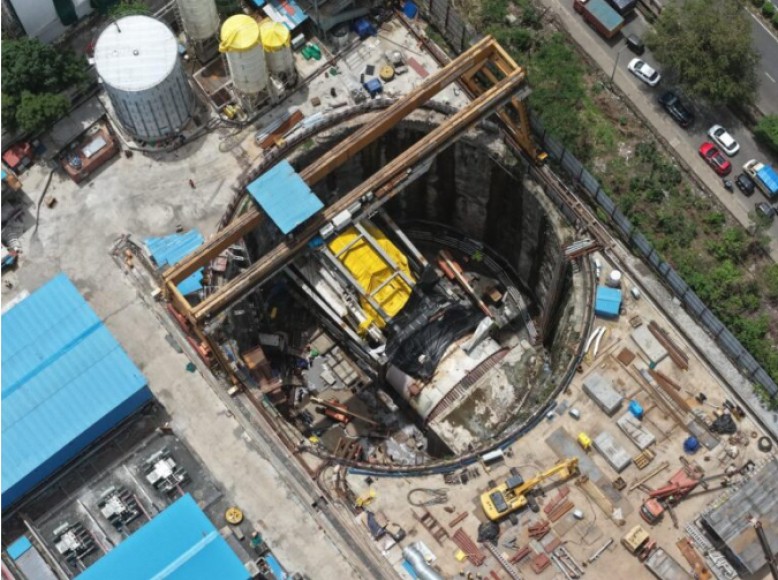

Haeundae LCT The Sharp construction started
Haeundae LCT The Sharp is a major urban development project in Jung-dong, Haeundae District, Busan, South Korea. Located in front of Haeundae Beach, it consists of a 411.6 m (1,350 ft), 101-floor supertall landmark tower and two 85-floor residential skyscrapers.
Shinbundang Line opened
The Shinbundang Line or DX Line for Dynamic Express Line is a 33.4 km (20.8 mi) long line of the Seoul Metropolitan Subway. It is the world's fifth subway to run completely driverless and the second completely driverless metro line to open in South Korea, after Busan Subway Line 4.
Rose Bowl (stadium) opened
The Rose Bowl is an outdoor athletic stadium located in Pasadena, California. Opened in October 1922, the stadium is recognized as a National Historic Landmark and a California Historic Civil Engineering landmark. At a modern capacity of an all-seated configuration at 92,542, the Rose Bowl is the 16th-largest stadium in the world, the 11th-largest stadium in the United States, and the 10th-largest NCAA stadium. The stadium is 10 miles northeast of downtown Los Angeles.
1891 Mino-Owari earthquake
The 1891 Mino-Owari earthquake struck the Japanese provinces of Mino and Owari (present-day Gifu Prefecture) in the Nobi Plain with a surface wave magnitude of 8.0 and moment magnitude of 7.5. The event, also referred to as the Nobi earthquake, the Great Gifu earthquake, or the Great Nobi earthquake, is the largest known inland earthquake to have occurred in the Japanese archipelago.
John Smeaton died
John Smeaton was a British civil engineer responsible for the design of bridges, canals, harbours and lighthouses. He was also a capable mechanical engineer and an eminent physicist. Smeaton was the first self-proclaimed "civil engineer", and is often regarded as the "father of civil engineering". He pioneered the use of hydraulic lime in concrete, using pebbles and powdered brick as aggregate.
1707 Hoei earthquake
The 1707 Hoei earthquake struck south-central Japan. It was the largest earthquake in Japanese history until it was surpassed by the 2011 Tohoku earthquake. It caused moderate to severe damage throughout southwestern Honshu, Shikoku and southeastern Kyushu. The earthquake, and the resulting destructive tsunami, caused more than 5,000 casualties. This event ruptured all of the segments of the Nankai megathrust simultaneously, the only earthquake known to have done this, with an estimated magnitude of 8.6 ML or 8.7 Mw. It possibly also triggered the last eruption of Mount Fuji 49 days later.