The effect of rock shape on rockfall risk assessment
A new study from ETH Zurich university and the WSL Institute for Snow and Avalanche Research SLF sheds light on the impact of rock shape on rockfall risk assessment.
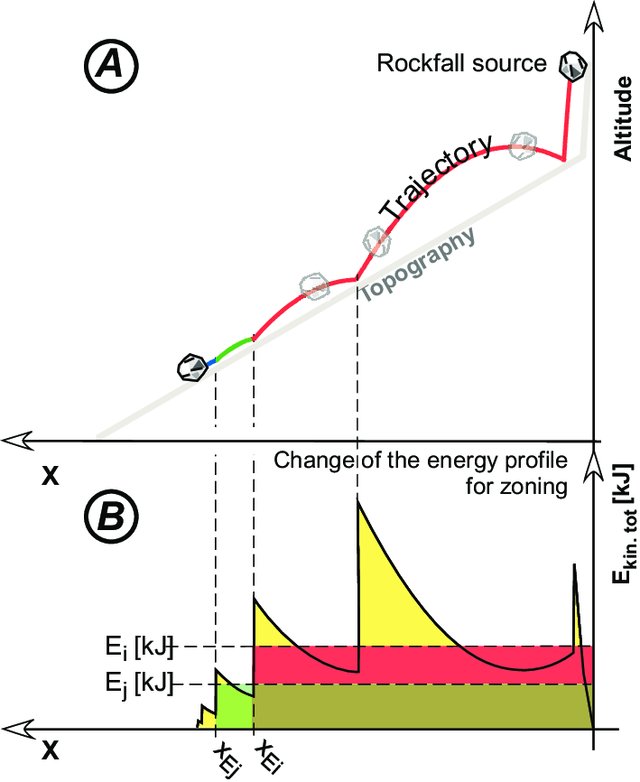
Evaluating the stability of rock masses prone to rockfall phenomena has been thoroughly assessed via multiple methods involving the evaluation of discontinuity sets, the shear strength that develops between them and other factors. Nonetheless, a complex issue that has not been fully understood yet is what trajectory will a rock block follow once a failure occurs. This matter is of great importance as it determines the distance that a rock block will travel and the energy that will carry throughout its course. This way, geotechnical engineers can protect infrastructure and establish rock nets at strategic locations to capture the falling blocks (nets are usually placed where the rock blocks carry less energy).
The new study focuses on the impact of rock shape and mass on lateral spreading and trajectory of blocks from experiments conducted in Flüelapass, Switzerland. The rock blocks were wheel- and cube-shaped and were artificially made of concrete. Their weight varied between 45kg and 2670kg. The blocks were released from a specific point and their trajectory was recorded via advanced techniques. In total, 82 trajectories were reconstructed in 4-dimensions (spatial coordinates, 3 and time, 1).
The purpose of the research was twofold: 1. Derive the lateral dispersion of the blocks in the natural terrain and 2. Determine the changes in translational and rotational kinetic energy of blocks once impacts with the ground occur. The latter defines the jump heights, the velocity and ultimately, the distance that a rock block will travel downwards.
A major finding of the study is that the direction of the trajectory is heavily dependent on the shape of the blocks rather than their mass. In particular, the cubic blocks followed the line with the higher inclination of the slope whilst wheel-shaped blocks followed a curving course towards one side of the terrain. In terms of energy factors, the researchers emphasize the impact of site-specific relationships for energy dissipation.
The accumulated data can be utilized to calibrate state-of-the-art models that will accurately take into consideration the shape effects of rock blocks in risk assessment. The study also aims to serve as a building ground for future, more complex scientific endeavors. In addition, the adaptation of the data in different site conditions is of major interest for future works.
Certainly, the trajectories and energy distributions of rockfall phenomena is a highly complex matter that needs further understanding. The irregularity of the natural blocks' shape coupled with the unique terrain parameters that each site presents, make the possible outcomes difficult to predict. It is probable that advanced techniques such as Machine Learning would provide an efficient solution in the future.
The footage below shows the trajectory of a massive boulder that destroyed a barn in northern Italy in 2014. Scientific research aims at predicting such incidents and apply preventive measures where possible.
Source: Caviezel et al. (2021)
Media
- Huge boulder destroys buildings in South Tyrol, Italy
- On Demand News
Want to read more like this story?

Rockfall Hazard Mitigation
Jun, 22, 2023 | EducationIn general, protection measures can be distinguished into two main categories...

Block Model Import & Slope Analysis in Slide3
Jul, 02, 2021 | NewsThe industry insight you have as a practicing engineer is valuable. At Rocscience, we are always op...

ROCK3D
Jun, 13, 2023 | Software
RocTunnel3
Apr, 08, 2025 | Software
RocSlope3
Jul, 11, 2023 | SoftwareSimulating Rockfall Hazards from Overhanging Slopes Using DEM
Jul, 08, 2025 | EducationThe Discrete Element Method (DEM) is a computational technique that has become indispensable in ana...

Rainfall triggered rockfall disrupts on Highway 18 in Southern California
Dec, 27, 2025 | NewsA recent rockfall incident on Highway 18 in San Bernardino County has highlighted the geotechnical...

RocTunnel3; Your New Software for 3D Underground Rock Stability Analysis and Design
Jul, 09, 2024 | NewsLooking for a more intuitive way to model complex underground geometry? It’s about to get easier...
Rock Mass Characterization
Mar, 18, 2020 | EducationRock mass is a matrix consisting of rock material and rock discontinuities. Its characterization...
On This Day
August 7th 2010
READ MORE
Related Video

Trending

Quick Clay Failure on Norway’s E6 at Levanger

Keller North America announces recent leadership changes

Fulgurite: A rare phenomenon
Stop Guessing, Start Designing: Introducing Support Designer in Slide2
Development program prepares new engineers for success