
New foundation design to tackle the effect of earthquake induced deformations
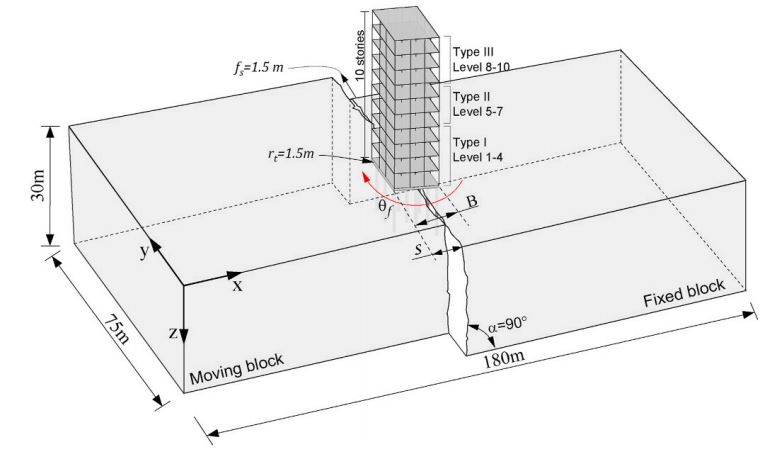
Scientists from the University of Technology (UTC) in Sydney, Australia, have introduced a new method to protect buildings from earthquakes.
An earthquake can be devastating for civil engineering infrastructure since dynamic loads are applied to the structures and can result in failures. Seismic design has been highly optimized over the past years with regulations introducing strict standards for buildings (especially those near earthquake-prone regions).
However, even though the induced seismic loads have been accounted for in the design, the applied deformation that a fault rupture can trigger is not generally being considered. An earthquake is triggered when a fault rupture occurs and is accompanied by certain deformations. The deformation patterns spatially affect a large region in which the ground experiences movements. Any building founded in the vicinity of an active fault can be impacted by those deformations which are most prominent in strike-slip faults. In particular, the foundation is subjected to a certain deformation that cannot always be borne due to the brittleness of the material from which it consists (usually reinforced concrete).
A solution to this problem could be avoiding areas where active faults exist but, this is not always efficient for infrastructure development. Moreover, there is a lot of uncertainty regarding the tectonic regime of a region since a lot of active faults have not been yet identified.
The researchers from UTC state that the existing regulations cannot protect structures from this phenomenon. Therefore, they present a new method that solves the problem via a deformable foundation. The findings were recently published in Geotextiles and Geomembranes.
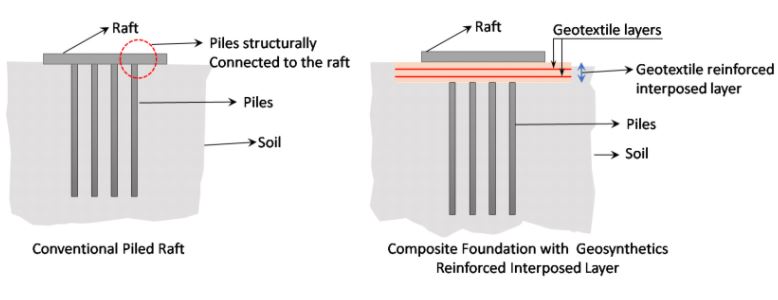
The approach concerns deep foundations which are mainly associated with the utilization of piles. When subjected to deformation, piles will develop high shear stresses and bending moments and are prone to failures. For this reason, the team suggests that a layer of soil with reinforced geotextiles can be placed between the piles and the raft foundation to bear the imposed deformation.
The research team conducted a three-dimensional, finite element simulation to derive the behavior of a 10-story building founded both on a conventional pile foundation and on a composite foundation. The building was situated on top of a strike-slip fault which caused certain deformation to the system. The fault was simulated by dividing the model into two sections which were then moving with respect to each other at a rate of 10mm/s. Before the fault displacement, the initial conditions of the model (the soil stress state, the weight of the foundation, the weight of the building and a live load of 5 kPa) were applied.
The results of the analyses show that the new technique proposed is beneficial for the structure which behaves better when the composite type of foundation is utilized. The authors of the study suggest that further evaluation needs to take place in the future in order to verify the beneficial impact of the proposed, composite foundation.
Sources: UTS, Rasouli and Fatahi (2020)
Image Gallery
Want to read more like this story?
Sixteen new locations listed as major active fault zones in Japan
Feb, 22, 2017 | NewsThe total number of major active faults in the country has now increased to 113, as the Headquarters...
Foundation Design / Construction
Apr, 29, 2020 | EducationFoundation is the lowest part of a structure which transfers loads from the superstructure to the...

An active fault zone poses a threat for infrastructure in Salt Lake City, Utah
Jun, 03, 2021 | NewsAccording to a new study, a complex fault system beneath Salt Lake City can pose a severe threat to...

Deep Foundations
May, 29, 2019 | EducationA deep foundation is a type of foundation which is placed at a greater depth below the ground surf...
Shallow Foundations
Apr, 29, 2020 | EducationShallow foundations, often called footings, are situated beneath the lowest part of the structure...

Functional requirements of foundation structures
Apr, 12, 2019 | NewsEven if a foundation structure meets all the strength requirements, it should also satisfy another c...

A supposedly dormant fault may cause a large earthquake in Los Angeles
Sep, 16, 2019 | NewsAccording to a new study, a fault previously considered as dormant may cause a Mw 6.4 earthquake in...

Comparison of Residential Foundation Repair / Remediation options
May, 20, 2022 | NewsCHANCE Foundation Solutions Engineer Shawn Downey compiled a comparison of foundation repair option...

Soil Subgrade Reaction
Sep, 04, 2020 | EducationIntroduction The interaction between a foundation system and the underlying ground is the defin...
On This Day
August 7th 1995
READ MORE
Related Video

Trending


PLAXIS example: Westergaard's added mass for hydrodynamic pressures

Rock Mass Classification Systems: A Global Review of Use and Dominant Approaches

How does the Leaning Tower of Pisa survive earthquakes

Tiebacks vs. soil nails: Choosing the right earth retention solution
Asbestos remains a deadly infrastructure risk across the UK
Major earthquake in southern Philippines causes deaths and widespread damage