
Highway embankment gives way in Kollam, investigation begins

A newly built embankment along National Highway 66 at Mylakkadu in Kollam collapsed without warning, trapping several vehicles, including a school bus, and causing deep ground fissures across the service road. Although all occupants were safely evacuated, the failure created significant disruption along the Mevara–Kadampattukonam stretch and forced authorities to seal the area for emergency stabilisation. Early observations indicate that the collapse originated at the retaining wall supporting the under-construction flyover, which subsequently pulled the adjacent service road downward. The event has revived longstanding concerns regarding the geotechnical suitability of NH-66 alignments, particularly where construction has advanced rapidly on soft or reclaimed terrain.

Initial statements from NHAI officials suggest that the embankment may have been founded on paddy field soils with low shear strength and high compressibility. Similar failures were recorded in May 2025 at Malappuram, where elevated sections collapsed near reclaimed paddy land. Such ground conditions require rigorous pre-construction investigation, staged embankment loading, surcharging, and robust retaining structures. Following the collapse, structural assessments began immediately, alongside reinstatement of water supply systems and partial traffic restoration. An expert team from Delhi will conduct a detailed investigation, while heavy machinery is being deployed to remove unstable material and secure the site.
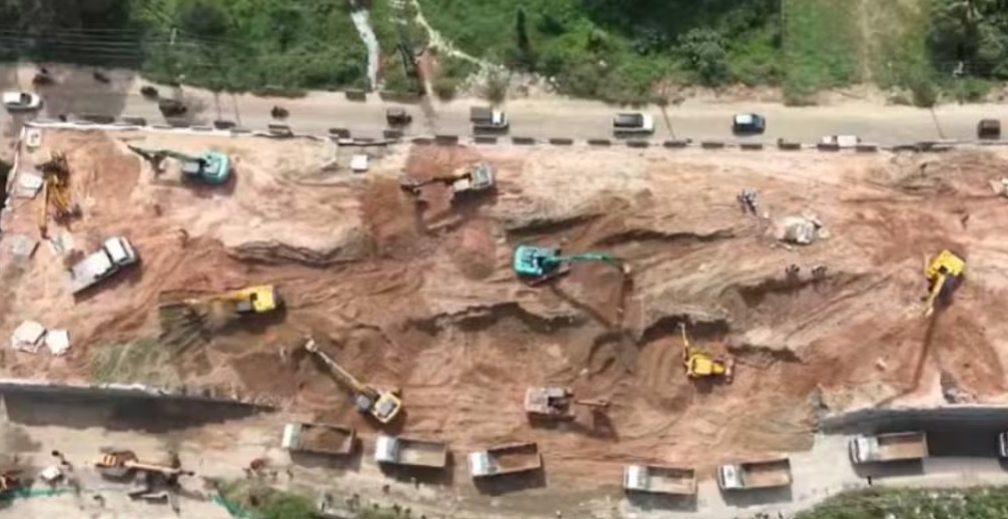
Political leaders and technical reviewers have highlighted possible deficiencies in design quality, construction supervision, and slope stabilisation practices. Congress representatives cited repeated beam failures and collapses along NH-66 and called for a comprehensive safety audit. The incident also echoes earlier expert reviews, which recommended stricter geotechnical assessments at 17 additional sites. Meanwhile, NHAI has initiated disciplinary actions in previous collapses, signalling an increasing focus on contractor accountability. The latest failure underscores the importance of reliable subsurface investigations, conservative design for soft-soil corridors, and transparent oversight mechanisms to prevent recurring infrastructure instability.

Sources: timesofindia, telegraphindia.com, thehindu.com, swarajyamag.com, onmanorama.com, english.mathrubhumi.com
Want to read more like this story?

Embankment Collapse on NH-66 in Kooriyad Triggers Engineering and Oversight Review
May, 19, 2025 | NewsOn May 19, 2025, a section of the under-construction NH-66 in Kooriyad, Malappuram, experienced a s...
Heavy rain triggers retaining wall collapse at highway construction site in Karnataka
Jul, 02, 2026 | NewsA retaining wall and part of a hillside collapsed at an under-construction National Highway site nea...

Road collapses into a construction site in southern China
Jun, 08, 2019 | NewsOn June 8, 2019, a large part of a road suddenly collapsed into a building construction site in sou...

Landslide collapses hotel and shops along Jammu-Srinagar highway
Oct, 12, 2025 | NewsA substantial landslide along the Jammu–Srinagar National Highway (NH-44) caused the collapse of a...

China's Shenzhen Construction Collapse has left 13 workers missing: The Geotechnical Perspective
Dec, 04, 2024 | NewsA catastrophic ground collapse at the construction site for the Shenzhen-Jiangmen railway in Bao’an...

Road collapse in Rize shows the risk of unsupported excavation near urban buildings
Jul, 11, 2026 | NewsA road collapsed suddenly in Rize, Turkey, after ground movement developed beside an active building...

Unstable Foundations: Soil Saturation Behind Mombasa Building Collapse
Dec, 23, 2024 | NewsOn November 11, 2024, a tragic building collapse in Mombasa’s Majengo area claimed the life of one...

Embankment failure drains Llangollen Canal, triggering major incident in Shropshire
Dec, 22, 2025 | NewsA major geotechnical incident unfolded in the early hours of Monday morning along the Llangollen Ca...

Swanscombe Cliff Collapse: Unveiling the Geological Mysteries
Aug, 06, 2024 | NewsThe Initial Incident On April 10, 2023, a significant cliff collapse occurred on the A226 Galley H...
On This Day
August 12th 1953
READ MORE
Related Video

Trending


PLAXIS example: Westergaard's added mass for hydrodynamic pressures

Rock Mass Classification Systems: A Global Review of Use and Dominant Approaches

How does the Leaning Tower of Pisa survive earthquakes

Tiebacks vs. soil nails: Choosing the right earth retention solution

Emergency ground stabilisation protects rail works near Salford Central