GeoStudio 2024.2 New Release: Enhancing Geotechnical Analysis and User Experience Sponsored

This latest release provides important updates and new features for GeoStudio users conducting slope stability, seepage, and consolidation analysis, particularly for defining conditions within the unsaturated zone and assessing the probability of failure.
UI/UX Improvement: Context Menus
GeoStudio 2024.2 now includes an enhanced user experience with the addition of context menus. The right-click context menu provides quick access to relevant actions, reducing the need for navigating through the UI to find specific commands. The enhanced usability and streamlined interactions make for a more enjoyable and efficient user experience.
Logarithmic Reliability Index in Results
The reliability index is an additional probabilistic analysis output that provides crucial value to the slope safety measure, as it represents the number of standard deviations that separate the mean Factor of Safety from the critical Factor of Safety. When analyzing the reliability of a system or structure, engineers often use this index to assess the safety margin and ensure that the design meets acceptable risk levels. Thus, a higher reliability index indicates a more robust and reliable design against failure.
Slope Stability: Unique Material in Unsaturated Zone
The geotechnical properties that govern stability are often different in the unsaturated zone. For example, an undrained strength definition might be needed in the saturated zone while a Mohr-Coulomb material model is required in the unsaturated zone. Similarly, liquefied strengths might be needed below the water table while drained effective stress strengths are required above. SLOPE/W and SLOPE3D now provide the option to use a unique material model in the unsaturated zone, removing the need to split regions along the piezometric surface.

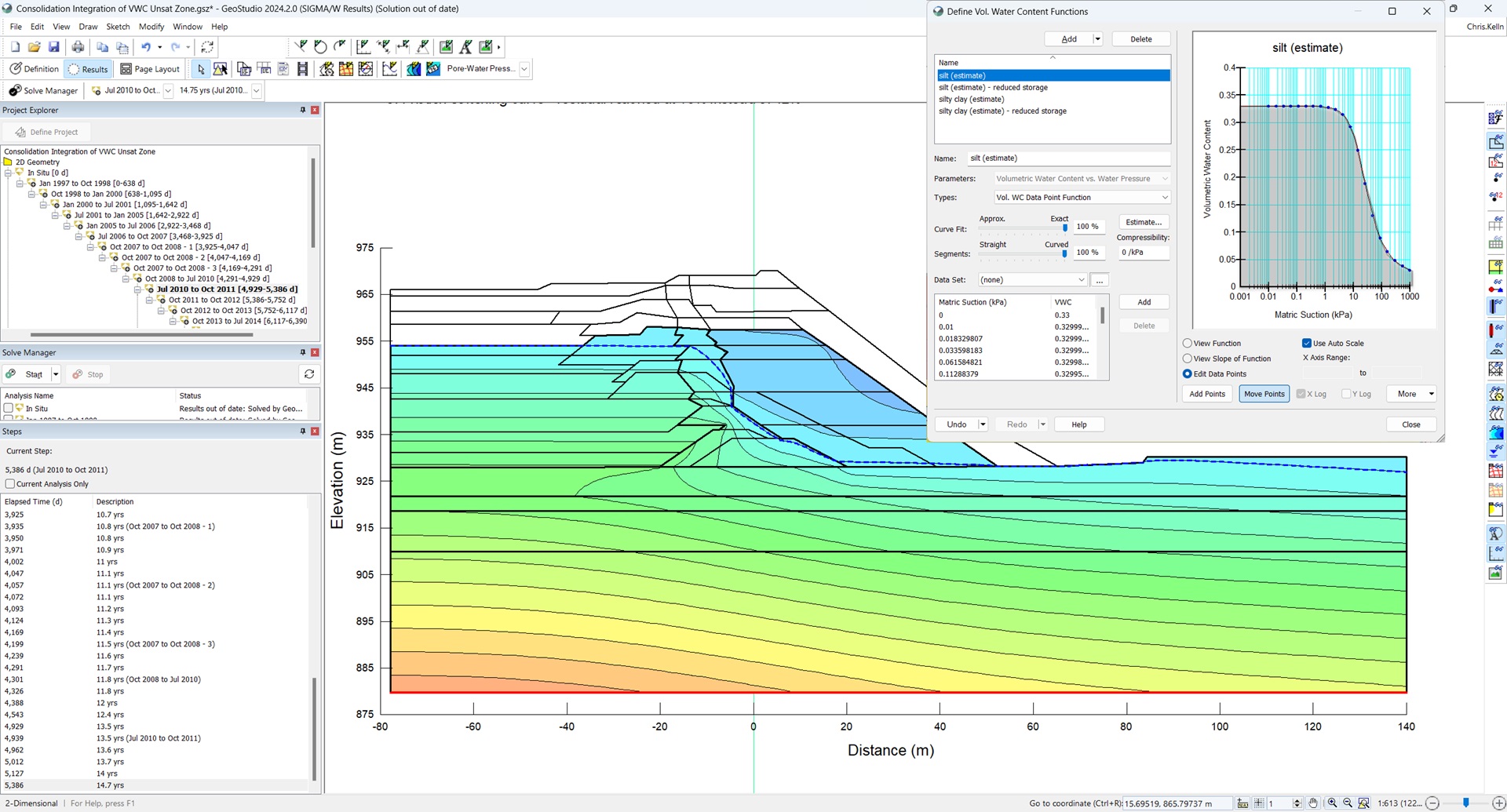
Improve Consolidation Analysis in the Unsaturated Zone
Improve the handling of the unsaturated zone in a Consolidation analysis. The effective saturation (S_e) controls the influence of pore-water pressure changes on the deformations, and therefore effective stress changes, in the unsaturated zone. The value of S_e is now obtained as an average over the time step to improve the accuracy of the solution. This is particularly important if the pore-water pressures cycle in the unsaturated zone; however, it also improves the simulation of staged construction of an embankment since the fill material normally desaturates after placement.
Exclude B-bar or Ru in the Unsaturated Zone
SLOPE/W and SLOPE3D now include an option to exclude B-bar or Ru in the unsaturated zone. B-bar is often used to model the pore-water pressure response due to loading, while Ru is used to capture spatial variation in pore-water pressure as a function of effective overburden stress. In both cases, the pore-water pressure definition is often not valid in the unsaturated zone. This new option allows GeoStudio to better reflect field conditions.

Probabilistic and Sensitivity Analysis in SLOPE3D
Probabilistic analysis enhances slope stability assessments by embracing variability, acknowledging geological uncertainties, and providing a more comprehensive understanding of the failure probabilities. The release of GeoStudio 2024.2 sees the expansion of probabilistic analysis into 3D stability, providing a realistic assessment of the probability of failure, considering the probabilistic distribution of a wide-ranging set of input parameters.

Hydraulic Conductivity Anisotropy in SEEP3D
The hydraulic conductivity of porous media is often higher in one direction than in other directions. This directional dependency (i.e. anisotropy) is generally due to sedimentation, consolidation, dissolution, and/or homogenization of layered media as equivalent homogeneous media. In these cases, the hydraulic conductivity is assumed orthotropic; that is, unique, and independent, in three mutually perpendicular directions. SEEP3D now accommodates this type of anisotropy, allowing engineers and hydrogeologists to enter the dip and dip direction of the principal axis, along with anisotropy ratios defining the conductivity in the opposing directions of the rotated Cartesian coordinate system.

Add-In Support for Slope Stability Columns
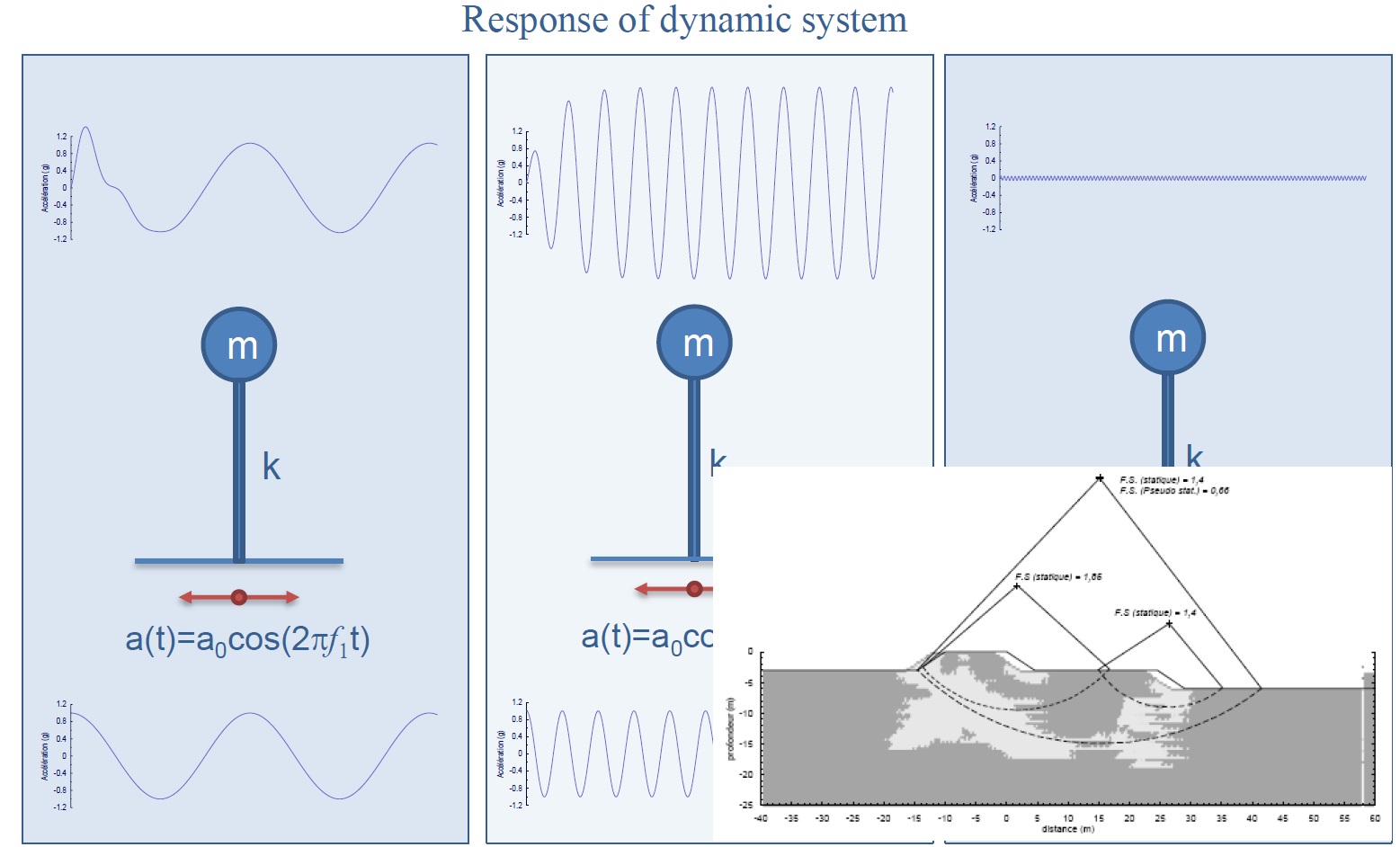
The new Column Force add-in API allows a force to be applied to every column of every slip surface. The add-in returns the force components and point of application on each column, allowing engineers to create add-ins to simulate the application of static or dynamic loads applied to a sliding mass. This new functionality provides users the ability to expand the current pseudo-static approach in slope stability and better accommodate spectral pseudo-static or similar seismic practices in LEM.
Want to read more like this story?

GeoStudio 2024.1 new release is here!
Mar, 21, 2024 | NewsGeoStudio 2024.1 continues to build on Seequent’s geotechnical analysis solution, adding new featur...

Slope Stability: Critical Failure Surface & Design Factor of Safety
Jun, 18, 2021 | EducationCritical Failure Surface As discussed in the previous chapters of the Geoengineer.org series on Slo...

Using GeoStudio to conduct 3D numerical analysis of groundwater seepage and stability at the Ripley Landslide site
Jul, 30, 2024 | NewsLandslides come with significant potential for loss of life and damage to integral infrastructur...

Importing pore-water pressure results from SEEP3D into a two-dimensional SLOPE/W analysis
Mar, 02, 2026 | NewsThis example replicates the “Rapid drawdown” examples illustrated in SEEP/W and SIGMA/W. The purpos...

Seequent unveils SLOPE3D: Advanced stability analysis tool to help engineers design safer slopes
Apr, 05, 2023 | NewsSLOPE3D extends capabilities of GeoStudio’s trusted 2D SLOPE/W product into 3D, significantly enhan...

Rocscience | Geotechnical Software for Open Pit Mining
Aug, 22, 2022 | NewsSurface mining, whether you call it open pit, opencast, or open cut is a common method of extractin...

SLOPE/W Fundamentals - Remote
Feb, 28, 2022 | EventThis course covers the basics of setting up a SLOPE/W stability analysis, in addition to reviewing...
Integrated analysis: A workflow from 3D site characterization to stability modelling
Mar, 27, 2026 | EventFor geotechnical professionals, converting complex ground conditions into reliable engineering inpu...

GEO5 Slope Stability – Water Flow
Jan, 19, 2023 | SoftwareForm
Looking for more information? Fill in the form and we will contact Seequent, The Bentley Subsurface Company for you.
On This Day
August 7th 1927
READ MORE
Related Video

Trending

Tiebacks vs. soil nails: Choosing the right earth retention solution
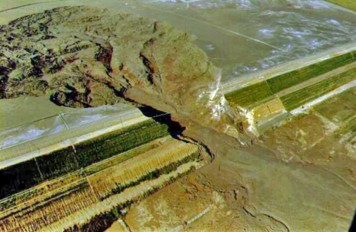
When Dams Fail: The Growing Crisis of Tailings Management
Mexico City’s sinking crisis mapped by next-generation satellite
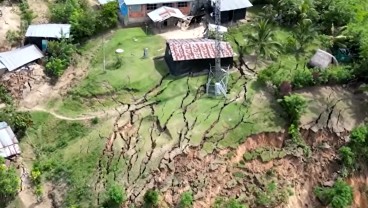
Landslide in Northern Peru Forces Evacuation of Over 170 Residents
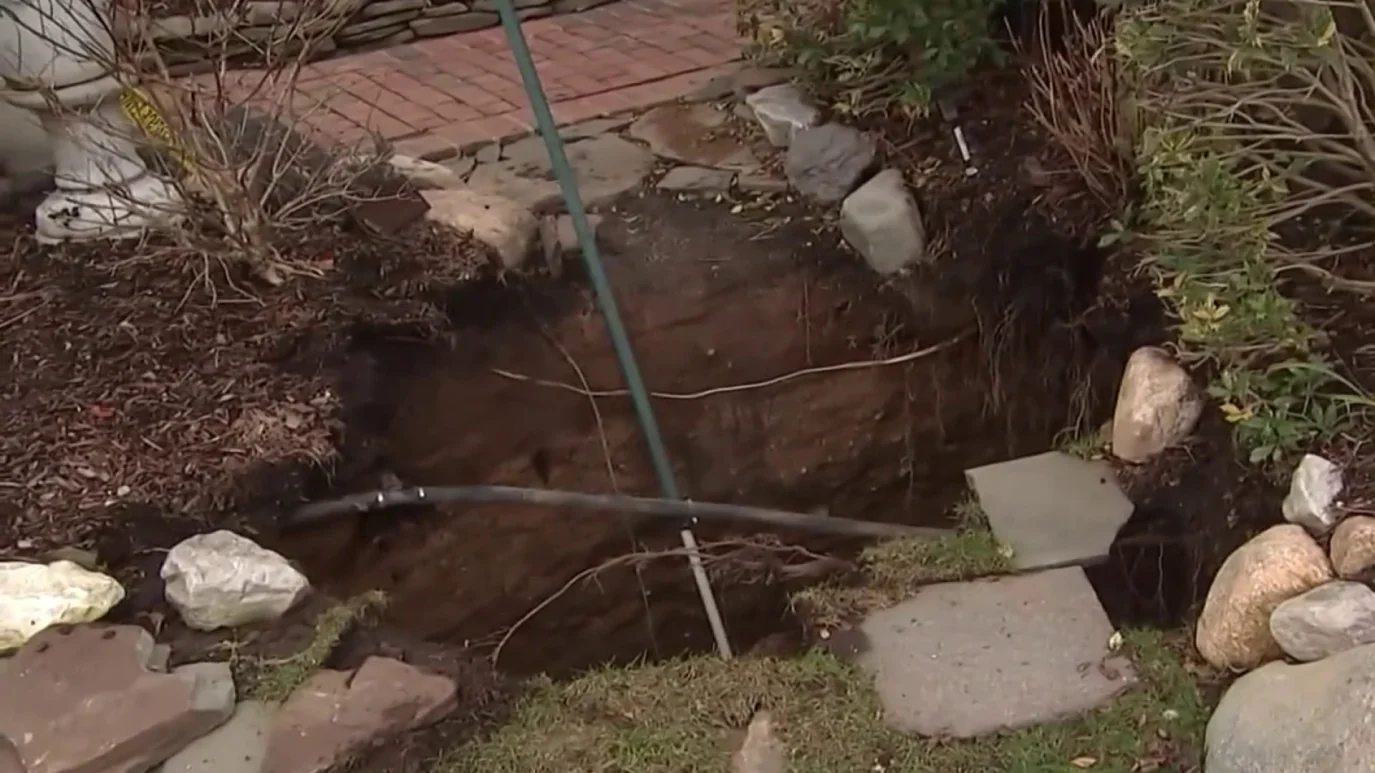
Sinkhole outside home in Huntington Station, on Long Island: 3 fall into
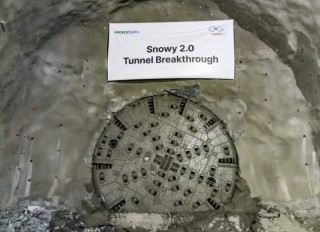
Tailrace tunnel breakthrough advances Australia’s largest renewable project

A Legacy of Leadership, Mentorship & Service: Gary L. Seider P.E.