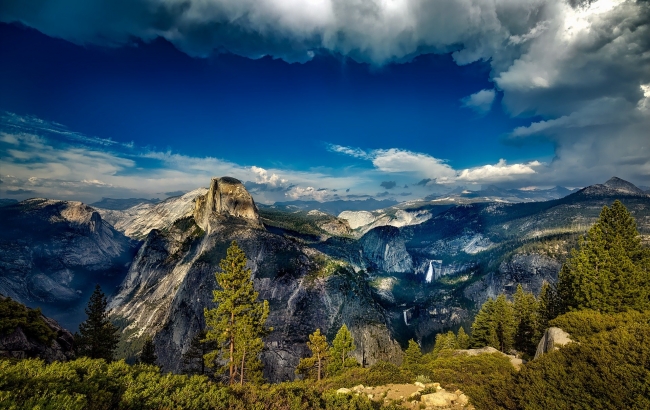
Yosemite granite could change the current geological history
The temperature of granite crystallization underpins the knowledge about many geological phenomena, but evidence is emerging that this temperature may not be well constrained.
Scientists including Carnegie's Michael Ackerson and Bjørn Mysen, in Nature, revealed that granites from Yosemite National Park contain minerals that crystallized at much lower temperatures than previously thought possible. This finding upends scientific understanding of how granites form and what they can teach us about our planet's geologic history.
Granite is a light-colored igneous rock with grains large enough to be visible with the unaided eye. It forms from the slow crystallization of magma below Earth's surface. Granite is composed mainly of quartz and feldspar with minor amounts of mica, amphiboles, and other minerals. It is nearly always massive (lacking any internal structures), hard and tough, and therefore it has gained widespread use throughout human history as a construction stone. It is also the link between igneous processes that occur within the Earth and volcanic rocks that solidified on Earth's surface. "Granites are the ultimate product of the processes by which our planet separated into layers and they are key to understanding the formation of the continental crust," Ackerson said. "Minerals from granites record almost all of our planet's history from 4.4 billion years ago to today."
Α temperature between 650 and 700 degrees Celsius (or between about 1,200 and 1,300 degrees Fahrenheit) is expected (until now) to be the limit of minerals crystallization as the molten rock cools down. Therefore, it is known that under certain conditions some of the minerals of which granite is comprised can solidify at lower temperatures. The team, which also included Nicholas Tailby of the American Museum of Natural History and Bruce Watson of the Rensselaer Polytechnic Institute, used lab analysis to determine the temperatures of granite crystallization in granites from Yosemite National Park. A technique called titanium in quartz thermometry was employed. By measuring the amount of titanium dissolved in the quartz crystals, the team was able to determine the temperatures at which it crystallized deep in the Earth when the granites formed 90 million years ago. They showed that quartz crystals in samples of granite body called the Tuolumne Intrusive Suite in Yosemite crystallized at temperatures between 474 and 561 Celsius (or 885 and 1,042 degrees Fahrenheit)—up to 200 degrees cooler than previously thought possible for granites. "These granites tell a different story," Ackerson added. "And it could rewrite what we think we understand about how Earth's continents form."
Researchers believe that the new data could influence the conditions in which the Earth's crust first formed during the Hadean and Archean. More recent observations, about the temperature at which volcanic magmas exist before eruption and the mechanisms through which important ore deposits form, could also be explained.
Sources: Carnegiescience.edu, Geology.com
Want to read more like this story?

Monitoring the temperature of oceans via Seismic Ocean Thermometry
Oct, 18, 2020 | NewsScientists from the California Institute of Technology (Caltech), U.S. and the Chinese Academy of S...

A sandstone fragment reveals valid information over climate change
Apr, 28, 2021 | NewsA cobble of green sandstone discovered near Antarctica has revealed crucial information regarding t...
History
May, 22, 2019 | Education

Study shows that hydropower dams reduce the temperature of rivers
Feb, 13, 2020 | NewsA new study, published in the Environmental Research Letters journal, focuses on the impact of hydr...

Scientific Advances in Core-Surface Material Exchange and Their Significance in Mineral Exploration
Jun, 25, 2025 | NewsNew geochemical evidence has confirmed that the Earth's core may not be as geologically sealed as o...

Uncovering Earthquake Energy: New Insights from Laboratory “Mini-Quakes”
Sep, 16, 2025 | NewsRecent research led by geologists at MIT has provided new understanding of how energy is partitione...

Potential $37 billion rare earth mineral deposit found in Wyoming mine
Dec, 18, 2023 | NewsAn old coal mine in rural Wyoming was recently found to contain deposits of rare earth minerals tha...

Huge granite stone balances on a slope (video)
Dec, 02, 2013 | NewsKrishna's Butter Ball, a granite glacial erratic stone, about five meters in diameter, is balan...

“Frost quakes” felt around Chicago during recent cold wave
Jan, 13, 2024 | NewsChicago recently experienced a cold wave, which started on January 13 and reached temperatures as l...
On This Day
August 12th 1953
READ MORE
Related Video

Trending

Unstable Ground: Lessons from the I-80 New Jersey Sinkhole Saga

Seequent announced extended gINT support until Dec 31, 2028

New Release: GeoStudio 2025.2


Artificial Ground Freezing: Applications, Techniques, and Key Considerations
Stop Guessing, Start Designing: Introducing Support Designer in Slide2
Development program prepares new engineers for success