New Release: GeoStudio 2025.2 Sponsored

GeoStudio 2025.2 makes modelling more accurate, automation easier, and the software accessible to more users worldwide. It introduces a 3D Sweep Option, improvements to the GeoStudio Python scripting API with better mesh queries, full Japanese language support, and high-DPI display compatibility.
New and improved features in GeoStudio 2025.2
High DPI support
GeoStudio now offers enhanced support for high-resolution displays, resolving longstanding UI scaling issues that previously impacted usability on modern screens. This update eliminates the need for users to manually adjust their screen resolution to achieve a readable interface, delivering a smoother and more visually consistent experience across devices. By addressing this technical debt, we have made a meaningful investment in software quality and user comfort, ensuring that GeoStudio looks and performs as expected in high-DPI environments.

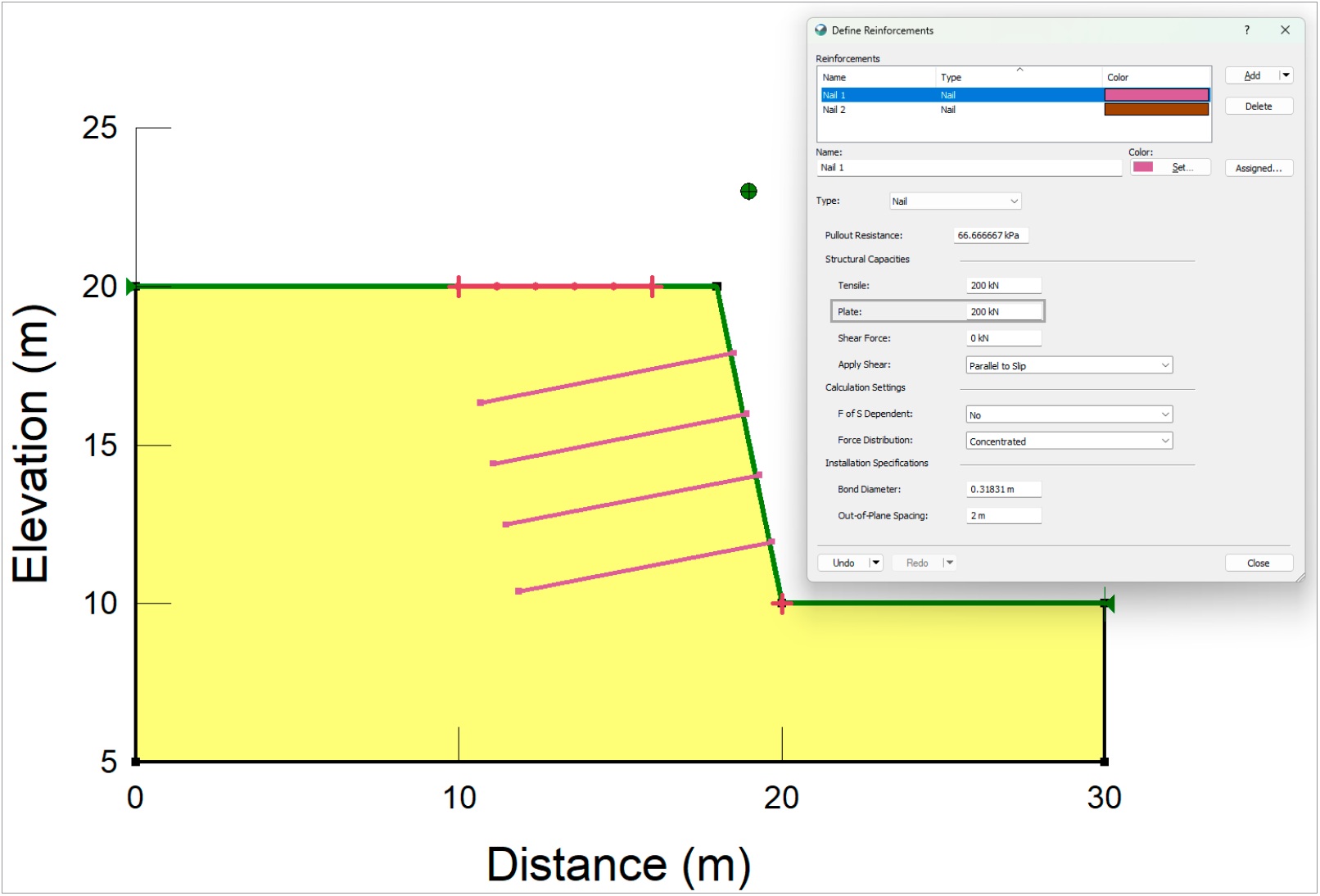
New Plate Capacity input for 2D and 3D reinforcement
GeoStudio now supports Plate Capacity inputs for anchors, nails, and geosynthetic reinforcement types in both SLOPE2D and SLOPE3D. This enhancement brings GeoStudio’s modeling capabilities in line with competitor tools and allows users to account for potential structural weaknesses at the soil-structure interface. By enabling consideration of plate bearing capacity, engineers can better evaluate failure mechanisms and design more robust reinforcement systems.
Japanese language support
GeoStudio now includes full Japanese language support. This localization effort ensures that engineers and geotechnical professionals in Japan can work more comfortably and efficiently in their native language, improving accessibility and user experience. By investing in multilingual capabilities, we are reinforcing our commitment to global usability and supporting our growing international user base.

Enhanced sweep options for 3D modelling
Sweeping is a widely used geometry creation technique where a profile, such as a cross section of a trench, is “swept” along a curve to produce a solid or surface. Unique profile conditions can sometimes lead to unexpected shapes or errors. With the new enhanced sweeping options, users gain greater control and flexibility to handle intricate geometry scenarios confidently. These improvements enable more predictable and accurate results that align with users’ design intent, by ultimately saving time and reducing modelling work.

Improved Python scripting API
This release introduces improvements to the GeoStudio Python scripting API, offering users greater control and efficiency when automating their workflows. Users can now query the mesh at any Cartesian coordinate, enabling more precise data extraction and analysis. Performance enhancements have been implemented, resulting in reduced solve times when operations are triggered via script. Additionally, the expanded documentation and the inclusion of more example scripts simplify the onboarding process and make it easier for users to leverage scripting capabilities. These updates demonstrate our ongoing commitment to improving usability, extensibility, and empowering advanced users with robust, scriptable access to GeoStudio.

Bug fixes and changes
GeoStudio
- Graphs copied/pasted from GeoStudio may have degraded resolution quality.
- Climate data functions were not displayed in the Graph window.
- Graph error messages were not correctly displayed in Chinese or Japanese languages.
- Major gridlines on graphs sometimes appeared with inconsistent thickness.
- Setting the minimum X-axis in ‘View Function’ mode could corrupt axis tick values.
- Labels did not honour the selected units, causing incorrect numerical values.
- Performance in Results View was poor when a structured mesh was used and visible.
- Sketch text failed to display when the object name contained spaces.
- User Terms link on Installer returned to an invalid path.
- Acceleration units were incorrect in Newmark deformation analyses.
- Mohr Circle axes disappeared after moving the ‘Draw Mohr Circle’ window in a stress-strain analysis.
- Objects could not be called in a Python script if the name contained quotes.
- Graphing displays are now better in several scenarios.
- Hydraulic function graphs would not display on high DPI monitors.
- Hydraulic function graphs did not respect user-defined increment settings and reset unexpectedly.
- Sensitivity graphs had the legend option disabled.
- Moving data points on time-based graphs resulted in incorrect x-values due to unit conversion.
- Material colors were missing in sketch text labels for upgraded files with legacy material tables.
- Importing any 2D section from Central failed with a “Source Unreachable” error.
- View Object Information failed when object names were duplicated.
- Remeshing does not occur when saving or solving a 2D model via the API.
GeoStudio 2D
- SLOPE2D displayed incorrect data instead of an error for invalid slip surfaces (E991/E998).
- Mesh error in SLOPE2D: Finite element analysis would not solve if the Parent was deleted and the Initial Condition redefined.
- SLOPE2D and SLOPE3D could crash if a weak surface without a material association was included in the analysis.
- Factor of Safety vs Lambda plot missing crossline highlighting.
- GeoStudio was non-responsive while switching slip surfaces with a probabilistic results graph open.
- Modifying material unit weight in parent analysis did not warn users that results were out of date if parent was not solved.
- SLOPE Kernel crashed during optimization routines when multiple analyses were being solved simultaneously.
- The presence of a ‘None’ material adjacent to a Region with a flux BC causes an erroneous solution in a seepage analysis.
GeoStudio 3D
- Task Manager time column was cut off and not resizable.
- Cylindrical bodies were not selectable from the side.
- Removing or changing materials via the Define Material would not immediately be reflected on the 3D geometry.
- Sketch became invalid after attempting to close a spline contour when all points were on the same line.
- Visual differences were created in the isosurface for upgraded files.
- Isosurfaces were displaying internal geometry lines that should have been hidden.
- Custom graph locations in 3D were inaccurate due to interpolation; now sampling points are calculated rigorously.
- Z coordinates were missing from 3D graph legends.
- Boundary conditions applied to vertices were not visible in Mesh View.
- GeoStudio could crash after deleting a reinforcement group and saving the file.
- Generating a 2D geometry from a cross section imported into 3D would fail if done a second time.
- SLOPE3D mesh geometry name collision caused a task log error message that would not clear after the issue was fixed.
- Opening a file with 3D geometry could trigger a re-mesh even if it was not warranted.
- Saved transformations in 3D failed to work in upgraded files due to changes to the default axis remapping in GeoStudio 2025.
- Custom graph locations along a line could result in inaccurate sampling locations.
- SLOPE3D performance was poor when loading results with a high-density column mesh.
Want to read more like this story?

New Release: GeoStudio 2025.1
Jun, 13, 2025 | NewsGeoStudio 2025.1 offers a balanced mix of new functionalities and enhancements to our core tools. T...

Adopting GeoStudio for PLAXIS LE users: A Resource Guide
Jun, 24, 2025 | NewsAs PLAXIS LE reaches the end of its development lifecycle, many users are beginning the transition...

GeoStudio 2024.1 new release is here!
Mar, 21, 2024 | NewsGeoStudio 2024.1 continues to build on Seequent’s geotechnical analysis solution, adding new featur...

GeoStudio 2022.1 new release is here!
Oct, 27, 2022 | NewsIn the latest GeoStudio version, you’ll notice improvements to speed up your geotechnical 3D workfl...

PLAXIS 2023.2 New release is out!
Sep, 07, 2023 | NewsThis latest release solidifies Seequent's Connected Geotechnical Workflow, reducing the need for du...

Seequent Webinar | GeoStudio: The Future of Limit Equilibrium Analysis
Jun, 10, 2024 | EventJoin us for a presentation where we will show you the capabilities of GeoStudio in Limit Equilibriu...

GeoStudio TechTalk Advancing the Digital Twin: Connecting 2D Numerical Analyses to the Geological Model
Dec, 14, 2021 | EventDive deep into the new 2D section import feature in GeoStudio 2021.4. This exciting new feature rec...

GeoStudio Answer Hour: New Features in GeoStudio
Feb, 20, 2024 | EventJoin us for the March GeoStudio Answer Hour. In this webinar, our technical experts will give an ov...
GeoStudio 2021.4 release is here
Dec, 09, 2021 | NewsGeoStudio 2021.4 continues Seequent's, a Bentley company, journey to a digital twin with greater in...
Form
Looking for more information? Fill in the form and we will contact Seequent, The Bentley Subsurface Company for you.
On This Day
August 10th 1874
READ MORE
Related Video

Trending

Lake Chippewa’s floating island that has to be boat-pushed every year
How to Model Piles in PLAXIS

3 Types of Retaining Walls and Revetments


How Do Dams Trigger Earthquakes?
Stop Guessing, Start Designing: Introducing Support Designer in Slide2

Development program prepares new engineers for success