The Underground Challenge: Why Traditional Tunneling Approaches Are Failing Sponsored
Going underground is a seemingly simple approach to addressing the increasing pressure for infrastructure in our fast-growing societies—but it is far from simple. Tunneling can carry enormous costs per kilometer, with impressive (but pricey) tunnel boring machines engineered and driven with great precision but operating in highly uncertain subsurface conditions. Any breakdown in collaboration between the multiple disciplines in the project can result in poor decision-making and create critical risks to project delivery and the profitability of the project.
But successful construction is just the start of the journey. Underground infrastructure is a long-term investment—just look at the London Underground. The metropolitan line opened over 150 years ago but now spans lines with 270 stations, carrying 4 million passengers daily. We need to set forth with ongoing operation and expansion in mind by bringing a multidiscipline digital twin approach from the outset.
As we respond to the challenge to do more with less, we can lean on the advantages offered by Seequent’s tunnelling solutions to increase agility while accelerating manual and repetitive tasks. We can provide engineers with more time to analyze potential errors and create alternatives for optimum design, safety, and performance prior to construction, and carry this into the operational phases.
The persistent paradox of underground engineering
Tunnel projects have long faced a uniquely challenging reality: engineers must design complex structures to last generations while having only fragmented glimpses of the environment those structures will inhabit. The ground doesn’t yield its secrets easily.
Pat McLarin, who leads the strategy for civil infrastructure at Seequent, the Bentley Subsurface Company, puts it neatly: “There is a degree of uncertainty that comes with understanding the subsurface because the measured data—which originates from a wide variety of different sources—is never enough.”
This reality isn’t just an engineering curiosity, it’s a critical business issue. Ground-related problems account for the vast majority of cost overruns and delays in major tunnel projects worldwide.
But what if we could tip the odds in our favor?
Static models limit collaboration
Traditional approaches to tunnel design have relied heavily on “photographs,” which are static geological models that represent our best understanding at a particular moment. These models have served us well, but they’ve also reinforced disciplinary silos between geologists, geotechnical engineers, structural designers, and civil engineering.
Think of it as the difference between a photograph and a conversation around a common view. A photograph captures a moment in time from a single perspective. A conversation around a shared visualization evolves, incorporates new information, and builds understanding over time. Critically, it’s the shared visual models that enable this productive conversation—without them, different disciplines tend to talk past each other, missing the common understanding essential for collaboration.
Delivery blocks: Data, uncertainty, and interoperability
Despite significant progress, several challenges continue to hinder effective collaboration:
The Data management burden
The 2023 Geoprofessionals Data Management report revealed that geotechnical professionals spend approximately 20% of their time, or one full day each week, simply managing data. This administrative burden reduces the time available for actual engineering analysis and interpretation.
The uncertainty communication challenge
While geotechnical engineers may have developed sophisticated methods for quantifying and managing uncertainty, communicating this uncertainty to other stakeholders remains difficult. Digital twins need visualization techniques that can effectively represent confidence levels, alternative interpretations, and ranges of possible outcomes.
The interoperability imperative
Despite significant progress, file compatibility and data translation issues remain obstacles for many organizations. These technical barriers reinforce organizational silos and limit the potential for true collaboration. Tunnelling software integration that allows the insights of one group to be used by another without breaking the chain of custody or compromising interoperability and data lineage are essential to success.
Progress requires not just technical solutions, but also industry alignment around common standards and protocols, plus open BIM standards have yet to be fully extended to tunneling.
Learn more about Bentley’s geotechnical engineering solutions.
Want to read more like this story?

Building the Future Underground: Implementation Strategies and What’s Next
Oct, 30, 2025 | NewsThe implementation of digital twins isn’t simply about adopting new software tools. It requires dev...

Digital twins underground: The paradigm shift from static models to living systems
Oct, 29, 2025 | NewsDigital twins have revolutionized projects in engineering circles for years, but its application to...

How geotechnics can make life simpler, safer and more certain for infrastructure projects
Dec, 10, 2021 | NewsFor any transportation project it’s essential to have a clear view of the subsurface and any proble...

Mitigating Risk: Disparate Data in the Mining Industry
Aug, 12, 2024 | NewsWith operations often spread across various locations and the involvement of multiple teams, data c...

Rocscience | Geotechnical Software for Tunnelling
Jun, 24, 2022 | NewsTunnelling is a specialized civil engineering discipline for designing and constructing underground...

Leapfrog Works
Dec, 29, 2022 | Software
Ground Control: Six ways transportation projects can meet their subsurface challenges
Apr, 01, 2022 | NewsThere are 167.5 million crossings every day on 43,578 US bridges considered structurally deficient ...
Brownfield success: Engineering excellence starts below ground
May, 06, 2026 | NewsWhy environmental and geotechnical teams must unite data and work as one to better manage risks in b...

Material Reuse through geoBIM at HS2 Phase 1 – Area North Earthworks: Winner of Bentley Systems Going Digital Awards on Geotechnical Engineering
Nov, 24, 2022 | NewsThe 90-kilometer HS2 Phase 1 rail route has approximately 25 million cubic meters of material ear...
Form
Looking for more information? Fill in the form and we will contact Bentley for you. Alternatively, you can visit Bentley's website and speak with a Bentley Geotechnical Expert.
On This Day
August 11th 1979
READ MORE
Related Video

Trending

China's Three Gorges Dam under pressure: Flood hazard downstream

Functional requirements of foundation structures


Landslide in Papua New Guinea: At least 12 people dead

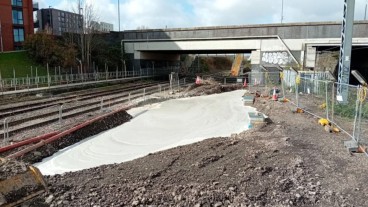
Emergency ground stabilisation protects rail works near Salford Central