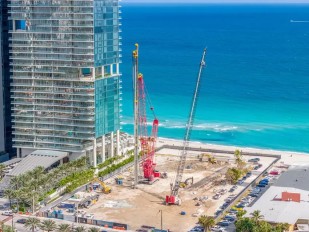
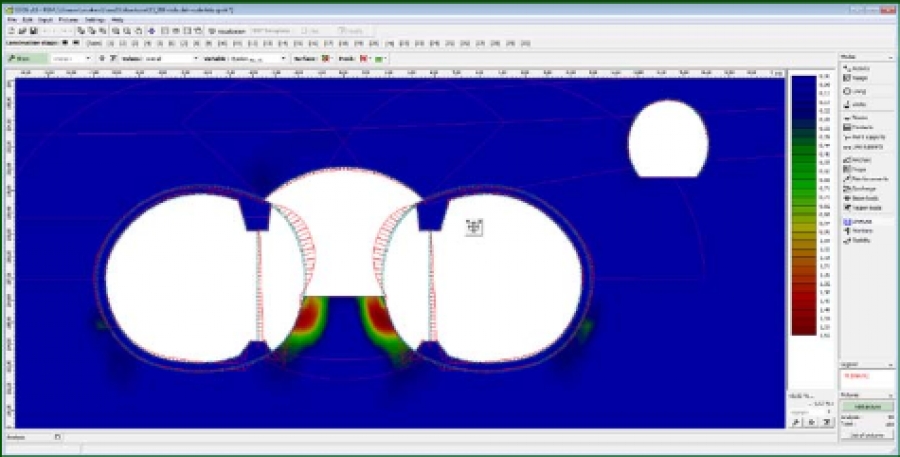
The station construction started by driving the right-hand and left-hand station tunnels. The so-called horizontal excavation sequence consisted of top heading and invert. The 300mm thick primary lining is in C20/25 shotcrete. Two hinges were artificially created in the structure designed to make easier breaking of the lining in the area of the central bay possible. When the excavation of the side tunnels had been completed, EPB shields driving the interstation sections were pulled through them. After removing all auxiliary structures required for the pulling of tunnelling machines through, the waterproofing system consisting of a ray-on membrane and subsequently the secondary lining were installed. Water-retaining concrete C30/37 was used for RC structures, or C45/55 concrete for columns and longitudinal beams.
You can read the full article here.
Source: Fine Software
Want to read more like this story?

PLAXIS 2D – Traditional Tunnelling Method: Application Of MTM
Jun, 05, 2024 | NewsThe Traditional Method of Madrid is a method for tunnel construction that has been used for tunnell...

GEO5 FEM - Tunnel
Aug, 16, 2019 | Software
New sprayed concrete lining guide reshapes soft-ground tunnelling standards after decades of lessons
May, 03, 2026 | NewsThe publication of a new best-practice design guide for sprayed concrete linings (SCL) in soft groun...

The PLAXIS Tunnel Engineer’s Toolbox: Everything You Will Need In One Place
Jun, 28, 2024 | NewsPLAXIS offers a wide range of tools to the Tunnel Engineer, which can be combined to generate almos...

Real-Life Projects: Green Line Metro - Design of Underground Metro Stations with PLAXIS 2D
Dec, 10, 2021 | NewsTel Aviv, Israel has the largest economy per capita in the Middle East. In recent years...

Using Finite Element Analysis to Verify the Stability of the Melbourne Metro Tunnel
Oct, 14, 2022 | NewsComplex geological compositions and existing underground structures can significantly impact your t...

Bentley Webinar | Modeling With Tunnel Designer in PLAXIS 2D & 3D
Mar, 21, 2023 | EventTunnels are created to make it easier to navigate through challenging topographical and geological...

I-70 twin tunnels to be lined with concrete
Sep, 17, 2014 | NewsThe Colorado Department of Trasportation is going to line the I-70 twin tunnels, near Idaho Springs&...
Earth Retaining Structures
May, 25, 2020 | Education
On This Day
August 12th 1978
READ MORE
Related Video

Trending
Active landslide threatens long-term connectivity in southern Bulgaria


PLAXIS example: Westergaard's added mass for hydrodynamic pressures

Rock Mass Classification Systems: A Global Review of Use and Dominant Approaches
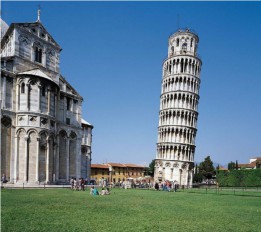
How does the Leaning Tower of Pisa survive earthquakes
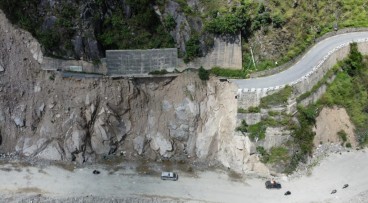
Nepal’s Himalayan settlements face escalating flood and landslide threats