
2001 Nisqually earthquake
The 2001 Nisqually earthquake occurred at 10:54:32 local time on February 28, 2001, and lasted nearly a minute. The intraslab earthquake had a moment magnitude of 6.8 and a maximum Mercalli intensity of VIII (Severe). The epicenter was in the southern Puget Sound, northeast of Olympia, but the shock was felt in Oregon, British Columbia, eastern Washington, and Idaho. This was the most recent of several large earthquakes that occurred in the Puget Sound region over a 52-year period and caused property damage valued at $1-4 billion. One person died of a heart attack and several hundred were injured.
1997 Ardabil earthquake
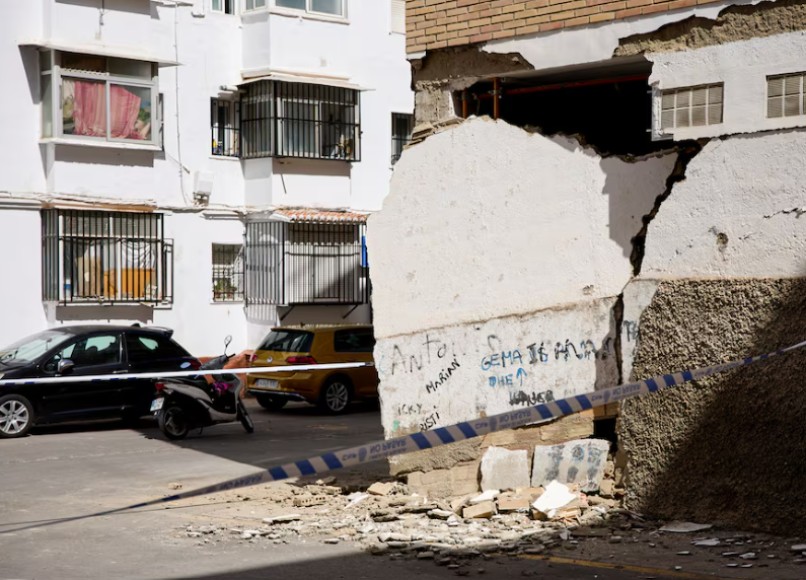
The 1997 Ardabil earthquake occurred on 28 February with a moment magnitude of 6.1 and a maximum Mercalli intensity of VIII (Severe). The strike-slip earthquake occurred in northern Iran, near the city of Ardabil. At least 1,100 people were killed, 2,600 injured, 36,000 homeless, 12,000 houses damaged or destroyed and 160,000 livestock killed in the Ardabil area of northwestern Iran. Severe damage was observed to roads, electrical power lines, communications and water distribution systems around Ardabil. Hospitals and other medical buildings were overflowing with patients as a result of the earthquake. Roughly 350 aftershocks followed the main Ardabil earthquake.
Moorgate tube crash
The Moorgate tube crash occurred on 28 February 1975 at 8:46 am on the London Underground's Northern City Line; 43 people died and 74 were injured after a train failed to stop at the line's southern terminus, Moorgate station, and crashed into its end wall. It is considered the worst peacetime accident on the London Underground. No fault was found with the train, and the inquiry by the Department of the Environment concluded that the accident was caused by the actions of Leslie Newson, the 56-year-old driver.
1969 Portugal earthquake
The 1969 Portugal earthquake struck western Portugal and Morocco on February 28 at 02:40 UTC. Originating west of the Strait of Gibraltar, the earthquake registered a magnitude of 7.8 and the maximum felt intensity was VII (Very strong) on the Mercalli intensity scale. In total, 13 people died and 80 sustained minor injuries. It is the largest earthquake to hit Portugal since the 1755 Lisbon earthquake.
1925 Charlevoix-Kamouraska earthquake
The 1925 Charlevoix-Kamouraska earthquake struck northeastern North America on February 28, reaching 6.2 on the moment magnitude scale. It was one of the most powerful measured in Canada in the 20th century, with a maximum perceived intensity of VIII (Severe) on the Mercalli intensity scale at its epicentre in the area of Charlevoix-Kamouraska along the Saint Lawrence River near ile aux Lievres and not greater than VI (Strong) in the United States. The quake was felt in Quebec City, Shawinigan, Montreal, as far south as Virginia, and as far west as the Mississippi River.
Maurice Levy was born
Maurice Levy was a French engineer and member of the Institut de France. Levy changed the assumption, "the directions of principal strains coincide with those of the principal stresses", stated by Saint-Venant, to "the directions of increments of principal strains coincide with those of the principal stresses" and that was also the first attempt of using an incremental flow rule.