Where Geotechnical Engineering Is Heading: What 1,257 ICSMGE 2026 Papers Reveal
A data-driven analysis of every paper accepted to the 21st International Conference on Soil Mechanics and Geotechnical Engineering finds a discipline consolidating around its traditional core — foundations, numerical modelling and seismic behaviour — even as a second, faster-growing layer of research on energy geotechnics, AI-assisted design and offshore wind takes shape alongside it.
ICSMGE 2026, held in Vienna from 14 to 19 June, drew 1,257 accepted papers from authors in 82 countries. To map where the field is heading, each paper's title, author list and keywords were extracted and cross-referenced against the author's stated institutional affiliation to identify a country of origin. Papers were then classified into a 21-category geotechnical taxonomy spanning foundations, ground improvement, seismic and numerical modelling among others, and separately run through an unsupervised text-clustering pass that groups papers purely by shared terminology, independent of any fixed category list. The two views are complementary: the taxonomy shows how the discipline's traditional structure is holding up, while the clustering surfaces cross-cutting themes — such as energy geotechnics or AI-assisted calibration — that a fixed list of subfields would otherwise split apart or miss.
A European-Anchored, Globally Distributed Field
Europe accounts for 615 of the 1,257 papers (48.9%), reflecting both the conference's Vienna venue and the density of European geotechnical research institutes. Asia-Pacific is the clear second bloc at 364 papers (29.0%), led by Japan, Australia, South Korea, China and India. The Americas contribute 166 papers (13.2%) and Middle East & Africa 88 papers (7.0%); 16 papers (1.3%) could not be attributed to a country from the available affiliation text. At the country level, the United Kingdom leads with 102 papers, ahead of Japan (98), Germany (83), France (66), Italy (62), the United States (61) and Australia (60) — a top tier dominated by countries with either large, established geotechnical research programmes or significant seismic exposure.
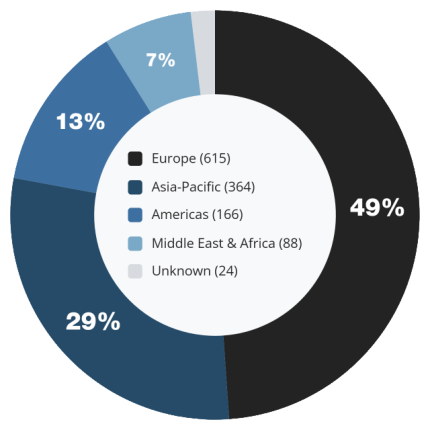
Figure 1. Share of ICSMGE 2026 papers by author-affiliation region, based on country attribution for 1,233 of the 1,257 accepted papers.
Foundations, Modelling and Seismic Work Remain the Core
Across the full corpus, Foundations & Piles is the single largest subfield at 174 papers (13.8%), followed by Numerical & Constitutive Modelling (158 papers, 12.6%), Soil Dynamics, Seismic & Liquefaction (146 papers, 11.6%) and Site Characterization & Testing (138 papers, 11.0%). Together, these four traditional subfields account for just under half of all submissions. Ground Improvement (103 papers, 8.2%) and Environmental & Sustainable Geotechnics (84 papers, 6.7%) round out the largest categories, while a further 114 papers (9.1%) covered topics — expansive soils, granular material microstructure, thermal behaviour of soils, and similar fundamental or niche subjects — that did not fit cleanly into any single established subfield.
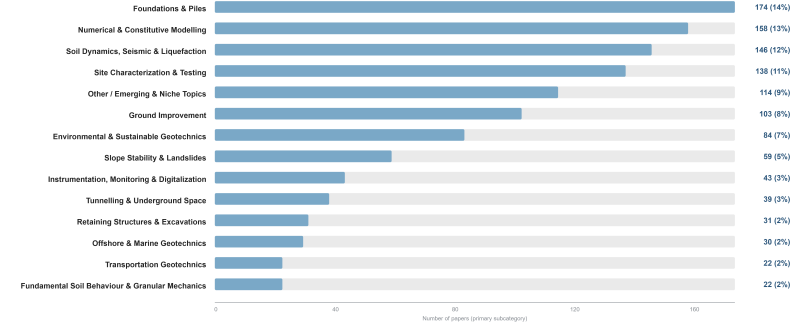
Figure 2. Papers by primary geotechnical subfield across all 1,257 ICSMGE 2026 submissions.
Regional Priorities Diverge Sharply
Breaking the subfield totals down by region shows that the discipline's centre of gravity is not the same everywhere. Europe's top subfields are Foundations & Piles (98 papers), Numerical & Constitutive Modelling (81) and Site Characterization & Testing (65) — a profile consistent with a mature market managing dense urban infrastructure and ageing assets. Asia-Pacific, the Americas, and Middle East & Africa all rank Soil Dynamics, Seismic & Liquefaction as their top or near-top subfield instead (49, 30 and 17 papers respectively), tracking the geography of seismic hazard: Japan and Turkey sit on active fault systems, and Pacific Rim and Latin American contributors bring their own liquefaction case histories. At the individual-subfield level, the United Kingdom leads both Foundations & Piles (18 papers) and Numerical & Constitutive Modelling (21 papers); Japan leads Soil Dynamics, Seismic & Liquefaction (13 papers); and Italy leads Slope Stability & Landslides (10 papers), consistent with its long-running national landslide-monitoring programme.
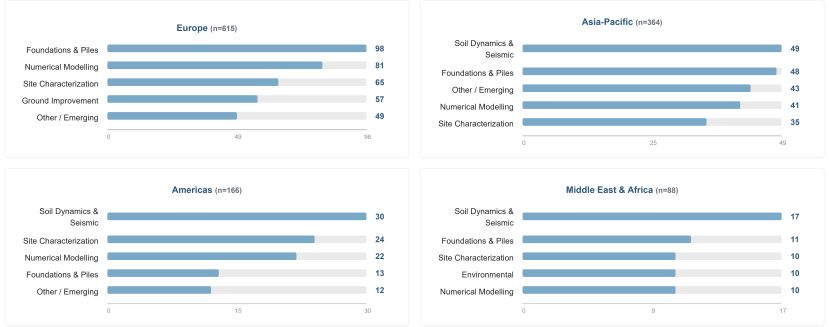
Figure 3. Top five subfields by primary-author region: Europe, Asia-Pacific, the Americas, and Middle East & Africa.
Beyond the Fixed Categories: Energy, AI and Climate Risk
The independent, unsupervised clustering pass — which groups papers by shared terminology rather than a predefined list — surfaces several cross-cutting themes that do not map onto any single classical subfield. The largest is a 71-paper cluster on energy geotechnics: geothermal piles, energy geostructures, and coupled thermo-hydro-mechanical soil behaviour, a body of work larger than the fixed categories for tunnelling or geosynthetics. A second cluster of 78 papers centres on machine learning and artificial intelligence applied to geotechnical problems, including neural-network-based prediction, machine-learning-driven ground-improvement design, and optimisation algorithms coupled directly to finite element software to automate parameter calibration. A 47-paper cluster links climate-change-driven ground movement to satellite-based InSAR and remote-monitoring techniques, while a further 38 papers cluster around distributed fibre-optic sensing, real-time monitoring and the Observational Method. Offshore wind forms its own 30-to-33-paper cluster spanning monopile driveability, cyclic lateral loading and suction-anchor design, and 37 papers cluster specifically around the critical-state behaviour and stability of tailings storage facilities. A smaller, 15-paper cluster addresses the profession's transition to the second-generation Eurocode 7, indicating that codified design practice, not just research method, is itself in flux.
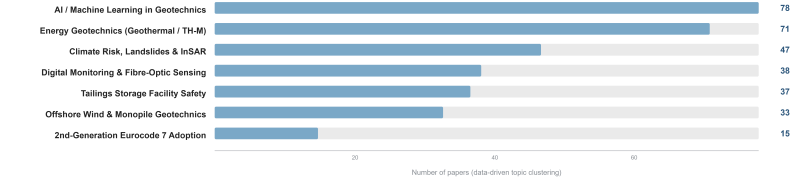
Figure 4. Size of each emergent, data-driven topic cluster, identified independently of the fixed subfield taxonomy.
Reading the Data Together
Taken together, the taxonomy and the clustering results point to a field that is consolidating and diversifying at the same time. The traditional core of foundations, numerical modelling, site characterization and seismic behaviour still accounts for roughly half of all submissions, concentrated in the United Kingdom, Japan, Germany, France and Italy. Layered on top of that core, energy geotechnics, AI-assisted design and calibration, digital and fibre-optic monitoring, offshore wind foundations, and tailings and climate risk are each now large enough to stand as their own research clusters, despite none of them corresponding to a long-established ISSMGE technical committee. The data suggest a discipline whose technical centre of gravity is shifting outward — from the building foundation to the energy borehole, from the single site investigation to the continuously monitored asset, and from national case histories toward globally shared risk problems such as tailings safety and climate-driven slope movement.

METHODOLOGY & SOURCE
Source: Proceedings of the 21st International Conference on Soil Mechanics and Geotechnical Engineering (ICSMGE 2026), Vienna, Austria, 14–19 June 2026, published by ÖGG (Austrian Society for Geomechanics). Country attribution is based on each paper's stated author affiliation; subfield classification combines a 21-category keyword taxonomy with an independent, unsupervised TF-IDF clustering pass used as a cross-check. This analysis reflects patterns in published conference submissions and is not a comprehensive industry census.
Want to read more like this story?
DFI's 7th Annual Student Paper Competition- CALL FOR PAPERS
Jan, 12, 2011 | NewsThe Deep Foundations Institute Educational Trust announces the 2011 Student Paper Competition. Stude...
9th Annual Student Paper Competition - CALL FOR STUDENT PAPERS
Jan, 12, 2011 | NewsThe Deep Foundations Institute Educational Trust announces the 2011 Student Paper Competition. Stud...
New Award for Outstanding Paper in ISSMGE's CaseHistories Journal!
May, 25, 2012 | NewsLearn more about the award, and more reasons to submit your paper to ISSMGE’s International Journal...
7th Annual Young Professors Paper Competition
Jan, 12, 2011 | NewsThe Deep Foundations Institute Educational Trust announces the 2011 Young Professor Paper Competitio...

Rocscience International Conference 2027: Geotechnics, Structures & Hydro in the Age of AI
Apr, 30, 2026 | EventThe Rocscience International Conference 2027 (RIC2027) will bring together engineers, researchers, a...

Keynetix Present Two Papers at the Second International Conference on Information Technology in Geo-Engineering
Aug, 06, 2014 | NewsThe Second International Conference on Information Technology in Geo-Engineering took place this Jul...

Paper documents failure at Payatas landfill in the Philippines that killed 330
Jul, 10, 2000 | NewsA paper published by Jafari, Prof. Tim Stark and Prof. Scott Merry describes the conditions under wh...

Call for Papers on Geoenvironmental Engineering Case Histories for Publication in the ISSMGE International Journal of Geongineering Case Histories
Oct, 07, 2016 | NewsThe Technical Committee on Environmental Geotechnics (TC215) of the ISSMGE announced a Call for...

Vol. 5, Issue 1 of the IJGCH has been released!
Sep, 12, 2019 | NewsWe are pleased to announce the special Issue #1 of Volume #5 of the International Journal of Geoeng...
On This Day
August 26th 1833
READ MORE
Related Video

Trending
Active landslide threatens long-term connectivity in southern Bulgaria


PLAXIS example: Westergaard's added mass for hydrodynamic pressures

Rock Mass Classification Systems: A Global Review of Use and Dominant Approaches
How does the Leaning Tower of Pisa survive earthquakes
Emergency ground stabilisation protects rail works near Salford Central