Investigation reveals combined failures behind the fatal Seoul sinkhole collapse
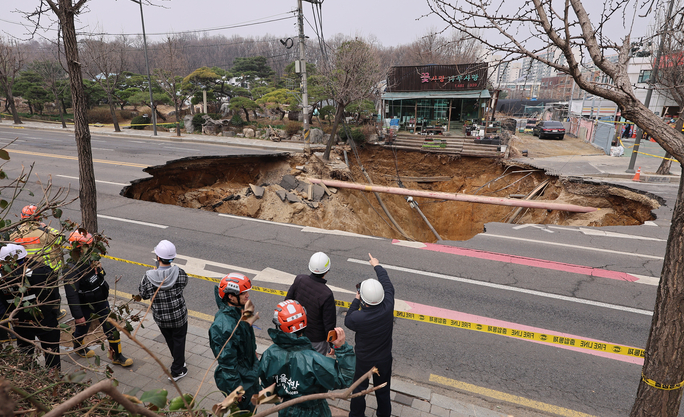
A government investigation has concluded that the March 2025 sinkhole in Myeongil-dong, which resulted in one fatality, was caused by weakened ground conditions driven by human-related factors. The Central Underground Accident Investigation Committee under the Ministry of Land, Infrastructure and Transport found that long-term groundwater decline, combined with leakage from deteriorated sewage pipes, critically reduced the stability of a deep weathered zone beneath the roadway.
The collapse occurred above an active excavation site for the Seoul Subway Line 9 extension. Investigators determined that a discontinuity surface within the weathered rock mass had not been identified during earlier design stages. Over time, the drop in groundwater levels, linked to past tunnel construction for the Sejong–Pocheon Expressway, altered stress distributions and reduced effective support and in turn shear strength within the subsurface. Measurements showed groundwater depths decreasing from 3.1–6.9 metres in 2017 to as much as 25.5 metres by 2022.

Additional weakening occurred due to continuous leakage from aging sewage pipes. Although a condition survey in 2022 identified defects, no structural repairs were carried out. This allowed progressive soil softening and loss of confinement around the tunnel crown. When the discontinuity slipped, the resulting load exceeded the tunnel’s design capacity, causing structural failure and rapid ground subsidence.
The committee used field drilling, laboratory testing, drone-based 3D geological reconstruction and numerical modelling to validate the collapse mechanism. A wedge-shaped block bounded by multiple discontinuities was confirmed as the critical failure element.
To prevent similar incidents, the investigation recommends reducing ground investigation spacing, improving groundwater management procedures, and adopting non-drainage tunnelling methods such as TBM in deep weathered zones. It also calls for accelerated replacement of aging underground utilities and enhanced real-time monitoring during urban excavation works. On the other end of the spectrum, a civic group has criticised the investigation, stating that design and construction faults were overlooked and that the response was significantly delayed. They argue that the late formation of the committee and inadequate analysis weakened public confidence. The group demands restructuring of the committee and insists that victims and local residents participate directly in future investigations.
Following, our recent article, discussing the ground stability concerns for Seoul's underground infrastructure.
Sources: chosun.com, chosun, asiae.co.kr, mk.co.kr, railjournal.com
Want to read more like this story?

Seoul’s Underground Infrastructure Raises Ground Stability Concerns
May, 15, 2025 | NewsSeoul’s recent sinkholes have raised public safety concerns and questions on how existing and futur...
Izmir Metro Tunnel: How Geological Factors Can Impact Your Tunnel Construction
Nov, 14, 2022 | NewsThe population of the world has grown rapidly, and advanced infrastructure like metro tunnels has b...

Sand, Water, and Collapse: The Geotechnical Puzzle of the Godstone Sinkhole
Feb, 21, 2025 | NewsA massive sinkhole in Surrey’s Godstone High Street has triggered urgent investigations into its ca...

Rocscience | Geotechnical Software for Tunnelling
Jun, 24, 2022 | NewsTunnelling is a specialized civil engineering discipline for designing and constructing underground...

Deep cement mixing linked to deadly quick clay failure in Norway
Mar, 18, 2026 | NewsA fatal landslide that occurred during a railway expansion project in Levanger, Norway, has been li...

Large sinkhole opens in Mexico near a house
May, 30, 2021 | NewsA massive sinkhole that threatens a house suddenly emerged in Mexico. The sinkhole opened in a fiel...

Ground Shifts and Gaps in Safety: What Caused the Gwangmyeong Subway Failure?
Apr, 11, 2025 | NewsOn April 11, a devastating collapse occurred at a subway construction site in Gwangmyeong, South Ko...

Sinkhole swallows soda in Iztapalapa, Mexico City
Sep, 15, 2025 | NewsA truck carrying bottled soda fell into a sinkhole in Iztapalapa, Mexico City, after a section of p...

The Los Angeles Clearwater Collapse. Insights On The Causes and Technical Response
Jul, 09, 2025 | NewsOn the evening of July 9, 2025, a structural failure occurred deep beneath Wilmington, Los Angeles,...
On This Day
August 10th 1966
READ MORE
Related Video

Trending

New crustal stress map of North America

Using Terzaghi’s Equation in Foundation Design

Parameters Variation: Model Customization and Sensitivity Analyses

UK geothermal projects expand from Cornwall power to Birmingham heating
Emergency ground stabilisation protects rail works near Salford Central