

Tailings ponds are critical components of mining operations and are engineered to contain the remnants of mined materials. As mines extract more resources, the volume of waste increases, and the ponds need to be expanded – one way to do this is by raising their embankments.
This necessary growth poses significant risks; a breached pond can unleash toxic substances that devastate ecosystems and communities downstream.
In this case study, we’ll highlight how our RS2 software effectively addressed critical challenges of tailings pond management, as seen in recent research from Surender Singh, Abishek Kumar, and T G Sitharam. First, we’ll cover what the environmental impact of tailings pond failures looks like, and then we’ll dive into their research about the stability of a specific tailings pond’s embankments before its closure.
For the full scientific insights from the study, you can also read the full research paper here.
What Happens When a Tailings Pond Fails?
The failure of a tailings pond can lead to devastating environmental, economic, and human safety consequences. Tailings ponds store the byproducts of mining operations — mixtures of water and mining residues — which can contain harmful chemicals and heavy metals. When these structures fail, they release these toxic substances into the environment, causing immediate and long-term impacts.
The released tailings can contaminate rivers, lakes, and groundwater with chemicals such as arsenic, mercury, and lead, posing serious threats to drinking water sources and aquatic life. Surrounding soil can then become contaminated, which affects agriculture and natural vegetation. This can all lead to a loss of biodiversity and stop ecosystems from functioning properly.
The Research Objectives
To mitigate the environmental damage that comes with rises in mining activity, more research was needed on tailings ponds to optimize their use and safely expand them.
This new research had two objectives: to ensure the structural stability of a tailings pond at the brink of its life, and to prepare it for safe closure and prevent environmental disaster. The high failure rates of tailings ponds documented globally shows the urgency of this research, and it highlights the need for enhanced analytical methods and better construction practices.
The Research Methods
RS2 was used for a comprehensive analysis of a tailings pond near the end of its life, across several phases of its expansion. Here are the main ways the software was used.
Finite Element Modeling: With RS2, researchers created detailed models of the tailings pond's embankments, and incorporated various construction phases and the specific geotechnical properties of materials used. The construction techniques modeled were the downstream (D/S) and upstream (U/S) methods, which are commonly used in the design and expansion of tailings ponds.

Seepage and Stability Analysis: RS2’s capability to perform partially coupled stress-seepage analysis was critical. This allowed for the integration of seepage effects directly into stability analyses, providing a realistic scenario of the pond’s behavior under operational conditions.
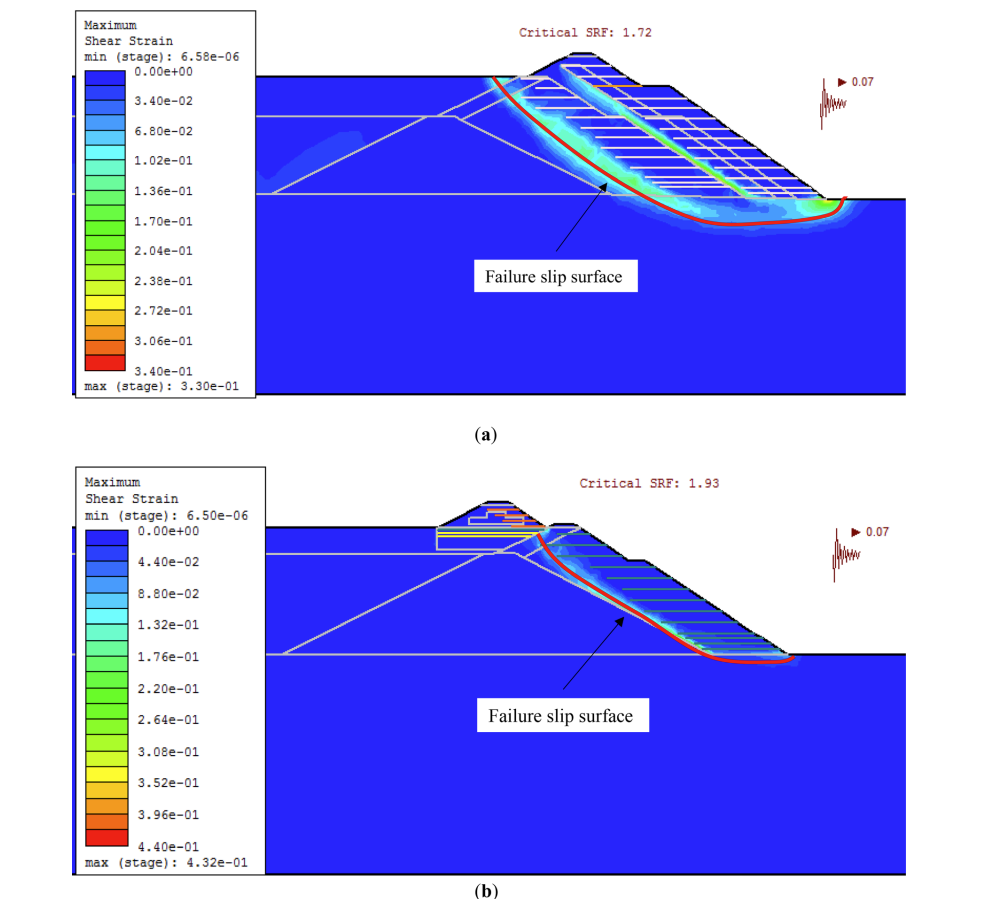
The strength reduction method implemented through RS2 helped in determining the critical strength reduction factor (SRF), a key metric for assessing the likelihood of failure under various scenarios.
Risk Assessment and Management: With RS2, researchers could identify and quantify potential failure risks within the tailings pond structure. Their evaluation focused on critical variables such as embankment stability under various load conditions, the impact of water levels on seepage, and the effectiveness of geosynthetic reinforcements in mitigating structural weaknesses. See Figure 3 to see how the horizontal displacement would be affected with the U/S method.

RS2’s advanced simulation capabilities were used to model stress distribution and deformation patterns under hypothetical failure scenarios, enabling researchers to evaluate the resilience of the pond against environmental stresses such as heavy rainfall or seismic events.
With this proactive approach, researchers can develop targeted management strategies aimed at strengthening vulnerable areas, adjust operational practices to reduce risk, and implement contingency plans for emergency response.
The Research Conclusions
Key findings from the analysis include:
The Stability of the Tailings Pond: RS2 models confirmed that the pond was stable under both D/S and U/S conditions at the end of phase 3 construction. This stability was quantified through the critical strength reduction factor (SRF), which remained well above the safety thresholds set by industry standards, ensuring that the pond could support additional capacity without risk of structural failure.
The Influence of Seepage: The introduction of seepage effects into the simulations led to a decrease in stability. The critical SRF values showed a significant drop, particularly at lower beach width to height ratios (L/H). For example, the critical SRF decreased by 35.57% for D/S and 29.97% for U/S cases when seepage was considered, highlighting L/H ratios of 0 and 1 as particularly vulnerable. This finding was crucial in recommending that higher L/H ratios, ideally greater than 1, are necessary to maintain stability and prevent potential environmental disasters.
The Role of Geosynthetic Reinforcements: The simulations clearly demonstrated the effectiveness of geosynthetic reinforcements. In the reinforced scenarios, the critical SRF values improved substantially. Specifically, the SRF increased by 28.71% in D/S configurations and 15.60% in U/S configurations when geosynthetic reinforcements were used. This allowed for the construction of steeper slopes within the pond’s design and effectively increased the pond's capacity while ensuring structural integrity.
That Closure Was Recommended: The stability analysis deemed the pond stable and suitable for closure, which provides a methodological foundation for closing similar structures securely.
Want to Use RS2 In Your Research? Here’s More Applications It’s Suited For:
- Liquefaction: Groundwater and dynamic analysis tools are included in the software, in addition to a vast library of advanced constitutive models, that can capture the sudden loss of strength due to liquefaction.
- Mining: Developed for both open-pit and underground excavations, you can analyze stability, stress/deformation, bench design and support design of underground caverns.
- Tunneling: You can design and analyze tunnel excavations and support systems using multi-stage analysis, 3D simulation of support installation and tunnel profile wizard.
- Foundations: Bearing capacity, settlement, and overall stress/deformation behaviour of shallow and deep foundations can also be analyzed, with features including multi-stage analysis, simulation of support installation, and extensive groundwater analysis capabilities.
Overall, this case study demonstrates RS2’s capability to accurately predict and enhance the stability of tailings ponds. By using detailed simulations, the research provided a validated approach to managing tailings pond expansions and closures safely and effectively.
Want to read more like this story?

RS2
Nov, 28, 2014 | Software
Transient Analysis of Seepage in Complex Tailing Dams Case Study
Oct, 13, 2022 | NewsProviding a comprehensive monitoring strategy for tailings dams requires a more holistic view, wit...

Rocscience | Geotechnical Software for Open Pit Mining
Aug, 22, 2022 | NewsSurface mining, whether you call it open pit, opencast, or open cut is a common method of extractin...

How RS2 Validated the Tunnel Support Design of the Jakarta-Bandung Railway
Aug, 19, 2024 | NewsWhen it comes to tunnel support design in complex terrains, empirical methods alone are often not e...

Predicting Tailings Dam Failures: Are Numerical Models Up to the Task?
Jan, 13, 2025 | NewsTailings dams, essential for storing mining byproducts, represent one of the most significant geote...

Risk Management in Mining: The Importance of Geotechnical Analysis
Apr, 01, 2025 | NewsGeotechnical analysis involves studying the physical properties of soil and rock to determine their...
Tailings Dams
May, 22, 2019 | EducationTailigns dams are embankment dams constructed to contain and store waste (tailings) of mines. Durin...

Slide3 and RS2 : The Tools of Choice for Back-Analysis of an Open Pit Mine Highwall Failure
Aug, 29, 2022 | NewsThe Methodology Step 2 – Iterative calibration of the base case model reproduced the observed fail...

Developing Safe Mine Re-Entry Plans Using RS2: Case Study
Jan, 21, 2021 | NewsDeveloping Safe Mine Re-Entry Plans Using RS2 It would be a perfect world if slope failure didn’t...
Form
Looking for more information? Fill in the form and we will contact Rocscience Inc. for you.
On This Day
August 11th 1979
READ MORE
Related Video

Trending

Lake Chippewa’s floating island that has to be boat-pushed every year

How to Model Piles in PLAXIS

3 Types of Retaining Walls and Revetments


How Do Dams Trigger Earthquakes?
Major wastewater tunnel procurement begins in southern Sweden