
Thermal Integrity Profiling recognized by American Society of Civil Engineers and Deep Foundations Institute Sponsored
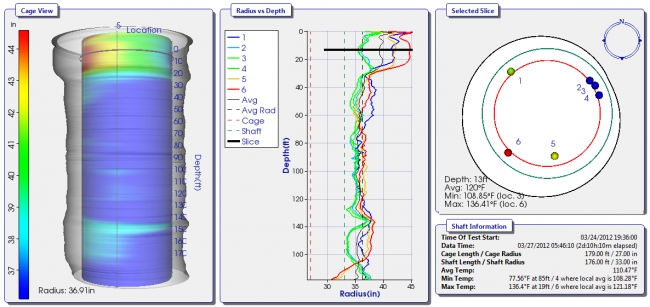
The American Society of Civil Engineers, ASCE, announced on July 24th the Thermal Integrity Profiler (TIP) as the 2015 winner of the Charles Pankow Award for Innovation. This Award celebrates collaboration in innovative design, materials, or construction-related research and development transferred into practice in a sustainable manner. The Award also rewards innovative approaches that help achieve at least one of the National Construction Technology Goals. The Award will be presented in March of 2015.
The innovative TIP, which uses the heat generated during cement curing to assess the shape and integrity of concrete foundations, was recognized by ASCE in part due to the collaborative efforts that were key to its development. "The thermal integrity profiling technology was developed initially at the University of South Florida (USF) where it evolved throughout three Florida Department of Transportation funded research project”, said Gray Mullins, PhD, PE, the USF Professor who led the research team. A fourth study was performed in cooperation with Washington State Department of Transportation. A joint effort was then undertaken by Foundation & Geotechnical Engineering, LLC (FGE), using the USF-licensed technology, and Pile Dynamics, Inc. (PDI). The 2 firms transformed the thermal integrity profiling technology into the Thermal Integrity Profiler.
Asked about TIP’s contributions to achieve National Construction Technology Goals, Pile Dynamics’s Garland Likins, P.E., focused on the goal of Reduction on Project Delivery Time, explaining that current test methods of evaluating the quality of cast-in-place foundation elements are performed after the concrete of the foundation has cured, a process that takes several days. Typically, construction cannot proceed until foundations are approved. An evaluation performed with TIP may yield evaluation result as early as 12 to 24 hours after concrete casting, depending on shaft diameter. This aspect is only one of the advantages of this breakthrough testing procedure. Thermal Integrity Profiling is also less labor intensive than other integrity testing methods, and examines portions of the cross sectional area of the foundation that are in the ‘’blind zone” of those other tests.
Exactly a week earlier, on July 18th, the Deep Foundations Institute announced that Prof. Mullins and his research team at the University of South Florida, were the recipients of the 2014 Ben C. Gerwick Award for Innovation in the Design and Construction of Marine Foundations. That honor was granted “for practical research on multiple subjects”, among them thermal integrity profiling of drilled shafts.
For more information on the Thermal Integrity Profiler, you can visit www.pile.com/tip
Want to read more like this story?
Thermal Integrity Profiler wins 2013 C. William Bermingham Award for Innovation
Sep, 24, 2013 | NewsThe Deep Foundations Institute (DFI) has announced the Thermal Integrity Profiler (TIP) as the winn...

Inventors from Pile Dynamics and the University of South Florida receive International NOVA Award for Thermal Integrity Profiler (TIP)
Nov, 18, 2013 | NewsGeorge Piscsalko, P.E., and Dean Cotton, with Pile Dynamics, Inc. (PDI), of Cleveland, and Gray Mul...

Pile Diameter Modeled Using Thermal Integrity Profiling Verified with Extracted Pile Measurements
Mar, 27, 2018 | NewsThermal Integrity Profiling is a non-destructive integrity test method used for evaluating the post...

Pile Dynamics Inc.: TIP Receives Charles Pankow Award for Innovation
Jul, 02, 2015 | NewsThe American Society of Civil Engineers recognized the Thermal Integrity Profiler (TIP) with its Ch...

Thermal Integrity Profiling of Concrete Foundations
Apr, 22, 2019 | EventWhen: Tuesday, September 23, 2014 Who should attend:Geotechnical, structural and construction engin...
Innovations in Non-Destructive Testing for Deep Foundations - Thermal Integrity Profiler (TIP)
Jun, 27, 2013 | NewsThursday, June 27, 1:00-3:00 pm EST This webinar provides a general overview of a non-destructive...

Webinar on Thermal Integrity Profiling of Concrete Foundations
Apr, 22, 2019 | EventWhen: Tuesday, March 3, 2015 Who should attend: Geotechnical, structural and construction en...

Thermal Integrity Profiler (TIP) manufactured by Pile Dynamics meets the new ASTM Standard
Jan, 09, 2015 | NewsThe American Society for Testing and Materials has issued a new standard, ASTM D7949 – 14, “Standar...

Cloud-Based Remote Thermal Integrity Profiling
Aug, 22, 2020 | NewsPile Dynamics remote testing technologies for the deep foundation industry help keep projects movin...
On This Day
August 12th 2004
READ MORE
Trending

Chesapeake Bay Bridge-Tunnel: An ‘engineering wonder’ of the modern world

What controls the height of the world's mountains?

AI-enhanced landslide model ready for 2026 deployment in Hong Kong
Nepal’s Himalayan settlements face escalating flood and landslide threats