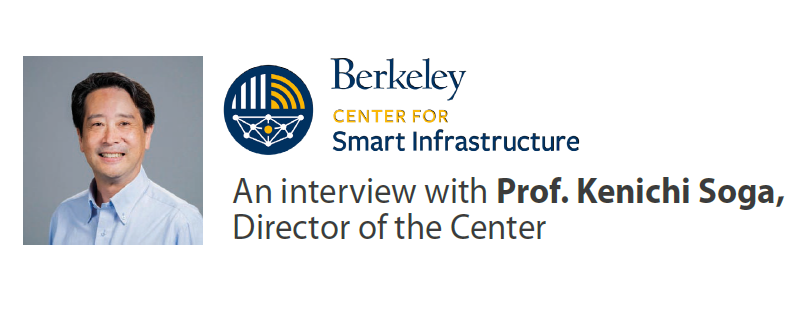
The Berkeley Center for Smart Infrastructure: An interview with Prof. Kenichi Soga, Director of the Center
The following interview is from 2024 Special USA and Canada Geotechnical Business Directory edition, available as an e-book and in-print, and was distributed for free during the Geo-Congress 2024 through ARGO-E GROUP’s booth.
Professor Soga, you're a professor in the Department of Civil and Environmental Engineering at the University of California, Berkeley. You are also the director of the Berkeley Center for Smart Infrastructure (CSI). Can you provide a brief overview of the mission and objectives of the CSI?
The mission is really about our society, sort of dealing with aging infrastructure and with the uncertainty of sustainability and natural hazards, and how we deal with emergency and community preparedness. And then also in our case, with water supply. How we deal with natural resources in terms of resource use. These can be seen as part of the infrastructure, and the objective of the CSI is to provide an answer on how we use the data to answer these questions and to make things better in terms of how we manage our infrastructure.
We tend to design our infrastructure for 100 years and we also like to extend / prolong the life of it to 150 years. But the demand changes every 20-30 years and subsequently it is difficult to make changes to the infrastructure because their designs are usually rigid. So what we're trying to do is to make our infrastructure more adaptive to change, in terms of design and construction.
Ιf the demand changes, the infrastructure has to change too, which means that we need to understand its performance. That is where sensor technology or data analytics tools can be used to offer a better assessment of the actual performance of the infrastructure. Our vision is to provide these set of solutions to the infrastructure industry.
So, one of the scopes of CSI is to make the infrastructure adaptive and another scope is to optimize it. What tools do you use to achieve these goals?
We like to think in three pillars. The first pillar is really about sensors, technology, and data analytics, which we do in our research all the time and then trying to see what's the value of that. At the same time, we do research in what we call digital twin, where we incorporate not just the structural performance, but also linking to how the people are using the infrastructure. So we are thinking not only on an asset scale but also on a network scale, with the large-scale simulations that we do (second pillar).
We then have a sensing and a virtual pillar. So how do we link those together? Here is where we conduct field and lab testing to prove that the concept works (third pillar). That's what we're doing in terms of the Center activities.
Can you share with us some of the ongoing research projects or initiatives at CSI which are related to smart infrastructure?
One of the projects that we do is on buried infrastructure, especially in this case water pipeline infrastructure. Many of our water infrastructure, the pipeline infrastructure, all around the world is very old, like here in California or in the East Bay, where I live in, many pipes are over a hundred years old. We need to replace many of them every year to renew our infrastructure. To do that efficiently, we have to find where the problematic ones are, or the ageing ones, which are not necessarily the oldest ones! Some pipes, even though they are very old, perform very well.
So we don't want to dig a trench and find out that the pipe, though old, still performs well. It is a waste of money. By using data analytics, machine learning and AI, we can do a better job in predicting the remaining life of the pipelines and how we can replace them more efficiently.
Also, we are interested in how we maintain that particular infrastructure for another 100 years. Combined with the AI tools we are also using tools like ground penetration radar to map underground, so that the construction crews can do more targeted excavations and replacements, with less problems and therefore saving construction time.
If we can do that, we can reach a significant mileage in terms of pipeline replacement. At the moment in East Bay where I live, we replace about 20 miles (30 kilometres) of pipeline every year. At this rate it will take 200 years to replace them all!
We are continuously kicking things to the next generations. So, what we really want to do is to be more efficient with pipe replacements. And that leads to embedding sensors in the replaced pipeline, so the next generation can use the data and they don't have to simply guess what's happening, but they do have actual datasets to make their decisions. For example, we're putting fiber optic sensors on the new replaced pipeline, hoping that the next generation will start using them.
How do you prioritise the problems the pipes could have according to their significance?
Everything is obviously empirical. We also do analysis in terms of how much the ground is moving, or what the ground induced breakage is, for example. But they are very empirical based.
But we start to get lots of data now. The infrastructure owners have various data such as water pressures. They're putting a lot of sensors in the system trying to deliver water to the customers in a more efficient way.
And with more and more data, we are able to start detecting patterns?
Yes. There are quite a few startup companies which use the modern tools of AI and machine learning with the intent to do that. But these techniques are often used for what we call “average problem”, but they are not very good at what we call “tail end” problems - like what is starting to fail - because we don't have much data yet. Our goal is to do better in terms of predicting the extreme conditions and performing in extreme situations.
I think the AI age is coming, but sometimes the infrastructure owner does not know why the machine learning models give the results they do. So, another thing we are trying to do is to make machine learning and AI be a little bit more interpretable, so that an engineer can learn from the datasets and make better decisions when an extreme event happens.
How do you see technology addressing issues like sustainability, resilience and urbanisation in infrastructure development?
That is a very important question because we need to show the value. And the value is the confidence in delivery of that technology. But then we need to understand what the social and infrastructure owners’ demand is, and currently it's really about sustainability. Equity and resilience are something that society is requesting us to work on, which, like sustainability 20 years ago, was not discussed as much.
So, maybe in 20 years from now different demand comes in, as we solve the current problems. We need to work with infrastructure owners, but also with social scientists, who really understand and study how the community works, or how the public as a society works. In our Center, we have several social scientists interested in infrastructure collaborating to showcase how we can demonstrate the value of sustainability or resilience at various community levels.
I understand that an interdisciplinary mentality is essential in this area. We know that CSI often involves collaborations across scientific disciplines. Also, we know that it is a partnership between infrastructure owners, regulators, Academia and industry. How does CSI foster interinstitutional and interdisciplinary collaboration between researchers, students, regulators and practitioners? It doesn’t seem an easy task.
Yeah, it's not an easy task and this is something I've been working on for the past 20-30 years! Obviously, we hope that the technology adoption will provide the value to infrastructure owners to make savings in the way they maintain it, or reduce the time of looking after the infrastructure. Because in infrastructure, the money comes mainly from the taxpayers so you can't ask more from the customers. You have a fixed amount of funding every year and hope that it will suffice. But then if we can do savings and better time management, then you can do more with the given funding and that's what we want to showcase. If we have that vision as a common vision, then infrastructure owners, the consultants, technology providers and social scientists will have a set of common goals for how we are going to look after our infrastructure for the next decade or 100 years. So, I think that's where we want to have a common vision, so that we can work together, each answering their own issues in their disciplines, but at the same time going for the same common goal.
In your opinion, what are the defining features that make an infrastructure “smart”?
Yes, that's a great question. Let’s take smartphones. We call them smartphones because they have become an essential part of our life. And everybody has it. Why? Because if you have one, you can communicate with somebody better, exchanging ideas very quickly. In the past we had to write a letter which would take days to be delivered and was generally a time-consuming process. But now the data is sent in real time. So that really allows you to communicate effectively.
By doing something with a smartphone, you have apps where you can do things quicker, so you're saving time, e.g. rather than going to the bank on foot, you can do it over your smartphone. So, for me it's about benefit, it's sort of a monetary value, but more about saving time. Because we have limited resources, saving time, money, having better communication, quicker interaction, for me that is what smart means.
So, if the infrastructure can be like that, communicate what's going wrong with it quickly, we can understand its actual performance and can do a better job in looking after it. So rather than reactive maintenance, fixing the pipeline after it bursts, we can do a more proactive maintenance, monitoring what's going on and then doing something before the big event happens. That will save money as well as time and the organisation or the public becomes more efficient, so that's how I call it smart. Of course, everybody has a different definition for it.
Are the goals of addressing small but frequent problems and less frequent but more catastrophic problems distinguished? Or do they constitute a common goal?
At the CSI we're working on all problems. Regarding the water pipeline system, the question is how we can avoid the main water breaks that happen every day somewhere in the city. How can we make the breaks fewer and how can we predict them? Can we avoid the big splash of water coming underground?
Because if that splash happens then there will be side issues: Did that affect the ground movement? Did that affect the landslide happening? Were the nearby buildings damaged? And then there will be litigation.
We would like to avoid that because that's where money can be saved. That is an example of a short-term issue, but then at the same time we use that same kind of sensing for larger, big consequence problems.
Sensors can provide value for the short term or daily operations and the value for the rarer, more significant issues with big consequences.
And in addition to saving money, we can see that a smart infrastructure system has a positive impact on environmental sustainability and helps better manage resources by reducing water wastage.
Yes. Sustainability from my point of view is how we use the material more effectively and think of it within the life cycle of the system. Is there some circular economy in the sense that, once we use a pipe, can we use the pipe afterwards? What is the plan for that?
That kind of a circular economy way of thinking in our engineering practice is something that we should do more, I think. And if in our technologies and the research we do realise that, then that's something that we should aim for.
Smart infrastructure is closely tied to the concept of smart cities. How can smart infrastructure contribute to more effective urban planning and development? Being now not in the repair stage, but in the planning stage.
That’s where we see many urban planners using GIS and thinking about how to plan urbanisation or change the urban settings. The goal is to incorporate a digital twin in their model so that it links together. And then we also see how social scientists can use that to think about how the community thinks about urbanisation or infrastructure usage. We feel that the digital twin concept will hopefully bring the Smart Cities colleagues and the smart infrastructure colleagues together!
Most existing infrastructure is not initially designed with smart technologies in mind. How can smart infrastructure technologies be effectively integrated with legacy systems? Are there any retrofitting challenges that professionals in the field commonly face?
That's the biggest challenge we have! It’s how do we deal with our current infrastructure. Let's not do it like what we did in the past. We can put more intelligence while embedded in our system? So the next generations may benefit, whereas obviously we're dealing with the current system now.
Obviously, the sensor sometimes may be difficult to put where you want to put it, because the place is not easily accessible. But new technologies like satellites or Lidar allow us to get data not otherwise accessible. We're trying to use these as much as possible, trying to derive features through data analytics, and probably that's the only way we can deal with our legacy projects. But also, many of our infrastructure owner colleagues say that they have various types of data - paper data, PDF data, other data – but we don’t know what their value is.
So, we also need to figure out what are the values of that data, and then, can use it? At the same time, we don't know a construction record that happened 100 years ago because there's no data sets and typically, we started to get data from 1990 - 2000 which is past 20 years or so. So, we have an actual problem of having lots of data missing. Add to all this, that we're often dealing with events at the tail ends.
But on the other hand, when you look at human beings, we go to hospitals to see doctors. When we get older, more. And perhaps the more frequently you go, the earlier you may detect symptoms of something happening. Even though we don't know how we were born, maybe the current little bit of data sets, in the past 20 years or so, may give some signatures of that. So, it's really formulating our data analytics tools, without needing to assume that we have data from day one. What is the formulation of the data, the formulation of the engineering evaluation method that utilises only the recent data, to look at the next step. But it is a good thing to be able to monitor from day one, so if we can put the sensor from day one, it's going to help us in the long run.
Do you think the regulations and standards are a great burden to the implementation of smart infrastructure projects? How do they influence a project? Do you see that the establishment of global standards for smart infrastructure technologies is a feasible target?
I think it is good to have a common language. We're currently speaking English, but then nowadays probably you can speak in your own language and then it is automatically translated. And maybe that's happening right now! Maybe you're talking Greek and I'm speaking in Japanese and our speech is translated in English. That may happen, right? But then it's a common way to appreciate the local issues and have a global communication. But we don't want to say, “this is the global standard, and you must adopt it” because we understand that every infrastructure and people are different. We appreciate that efficiency and saving doesn't come from global, but it comes from the local. And that's what we want to showcase.
Can you outline some applications of smart infrastructure in geotechnics?
Yes! Because I'm a geotechnical engineer myself, we tend to do a lot of applications like piles, pipelines, or retaining walls to showcase the value of data so that the data can be used to check whether your model assumptions or the mechanism that you assume in design or construction is indeed correct or not. Then, if it's correct, you learn and you are trying to improve it more. If it is not, you try to find what you missed and why you missed it. That learning process is applied a lot in geotechnical engineering, and for example with deep foundations. So, we have projects on monitoring piles, big shafts, big diameter piles.
There's a complicated construction process and therefore we make a lot of assumptions in design. But what we're trying to figure out is what is the actual performance and hopefully that will reflect in the design. And then many of the empirical relationships were developed from shorter piles, shallow piles, but now we go for very big diameter, large, long piles, because we can make it. We are extrapolating empirical relationships a little further and maybe that is a source of over design. This poses the question: can we do better than this or is there an issue in terms of the performance. So again, if we can monitor, we can do better. So many of the projects that we do are in that domain.
So, we can use the smart infrastructure tools as confirmation tools, to confirm our assumptions.
To confirm our assumptions or criticise our assumptions! We confirm them or not, then we learn from it and then we adapt to the next one.
Thank you very much Professor Soga. One last question, is there a particular method or key takeaway you'd like to convey to the readers, especially to fellow professionals in the geotechnical engineering field?
I think we are truly in an exciting time in our profession. There are a lot of new technologies which emerged in the past ten years, presenting a great opportunity to elevate our approach. How can we integrate these technologies into our infrastructure from the design and construction to the maintenance of our geotechnical structures? It's indeed an exciting period for me! Of course, some may express contentment with our current state, stating that we are satisfied with the current safety factors and design adequacy. It's acceptable to continue with our routine ways of doing things. But we have to make a choice, right?
A choice that may be suboptimal.
Maybe, yes. So, how do we embrace that? How do we make it exciting? Inspiring our younger colleagues to be enthusiastic about our profession and exploring ways to apply our skills in contributing to society is key. It's something that we want to promote and I think that's the choice to make. I'm encouraging you to join me in giving it a try.
Kenichi Soga currently holds the Donald H. Mc-Laughlin Chair in Mineral Engineering and serves as a Chancellor’s Professor at the University of California, Berkeley. His academic background includes obtaining his BEng and MEng degrees from Kyoto University in Japan, followed by a Ph.D. from the University of California at Berkeley. Prior to his tenure at UC Berkeley, he was a Professor of Civil Engineering at the University of Cambridge. With a prolific publication record, including over 350 journal and conference papers, he co-authored the "Fundamentals of Soil Behavior, 3rd edition" alongside Professor James K. Mitchell. His research spans diverse areas such as infrastructure sensing, performance-based design, maintenance of underground structures, energy geotechnics, and geotechnics from the micro to macro scale. Recognized for his contributions, he is a Fellow of the UK Royal Academy of Engineering and the Institution of Civil Engineers. He has received prestigious awards, including the George Stephenson Medal, Telford Gold Medal, and Walter L. Huber Civil Engineering Research Prize. As a Bakar Fellow at UC Berkeley, he actively promotes the commercialization of smart infrastructure technologies.
Want to read more like this story?

"Introducing the Berkeley Center for Smart Infrastructure", part of "The future of Infrastructure today!" webinar series
Oct, 13, 2023 | EventLecture date: Friday November 3, 9:00-10:00AM PST The “Future of Infrastructure today!” is a mo...

Geoengineer.org interviews Seequent's CEO at the 2024 Year in Infrastructure
Oct, 09, 2024 | NewsIntroduction The Geoengineer.org team attended Bentley Systems’ 2024 Year in Infrastructure &...

How geotechnics can make life simpler, safer and more certain for infrastructure projects
Dec, 10, 2021 | NewsFor any transportation project it’s essential to have a clear view of the subsurface and any proble...

Bentley Systems Issues Call for Nominations for the 2023 Going Digital Awards in Infrastructure
Mar, 02, 2023 | NewsBentley Systems, Incorporated (Nasdaq: BSY), the infrastructure engineering software company, today...

"The Future of Water and the Vision for the CSI", part of "The future of Infrastructure today!" webinar series
Nov, 15, 2023 | EventLecture date: Friday December 15, 9:00-10:00AM PST "The future of Infrastructure today!” is a month...

Bentley Systems Recognizes the Year in Infrastructure 2023 as Groundbreaking for Infrastructure Intelligence
Oct, 13, 2023 | NewsAt its annual Year in Infrastructure conference, Bentley Systems, Incorporated (Nasdaq: BSY), the i...

Bentley Systems Issues Call for Submissions to the Year in Infrastructure 2018 Awards for Going Digital: Advancements in Infrastructure
Mar, 08, 2018 | NewsBentley Systems, Incorporated, a leading global provider of comprehensive software solutions for adv...

Bentley Systems Issues Call for Nominations for the 2024 Going Digital Awards in Infrastructure
Mar, 15, 2024 | NewsEXTON, Pa. – March 14, 2024 – Bentley Systems, Incorporated (Nasdaq: BSY), the infrastructure engin...

Year in Infrastructure Conference and Going Digital Awards(YII 2021)
Nov, 25, 2021 | EventJoin Bentley virtually on December 1 and 2 for The Year in Infrastructure and Going Digital Awards...
On This Day
August 11th 1959
READ MORE
Related Video

Trending

Lake Chippewa’s floating island that has to be boat-pushed every year
How to Model Piles in PLAXIS

3 Types of Retaining Walls and Revetments


How Do Dams Trigger Earthquakes?
Nepal’s Himalayan settlements face escalating flood and landslide threats