
National Workshop on Assessment & Mitigation of Liquefaction Hazards for Seismic Microzonation
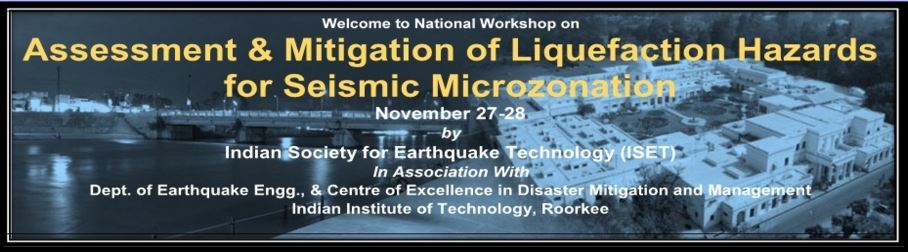
When: November 27-28, 2015
Liquefaction is one of the most important seismic hazards during strong ground shaking, which has drawn the worldwide attention of practicing engineers and researchers. It is the primary cause of many other seismic hazards. As evident from the recent damaging earthquakes, liquefaction hazard can ultimately lead to structural damages or even their collapse. Liquefaction could be one of the possible future threats for our rapidly growing urbanization.
Estimation of liquefaction hazard is a fundamental step towards its mitigation. However, its proper estimation is highly challenging and requires in-depth knowledge of underlying principles of liquefaction. There has been a lot of research carried out on the liquefaction and associated phenomenon. Very often, it is confusing to a practicing engineer to confidently use liquefaction estimation methodologies due to the complexity involved, lack of knowledge on the background of concerned methods and associated limitations, etc. For instance, there is a lot of ambiguity over the liquefaction resistance of silty sands. There are different schools of thought over the influence of fines on liquefaction and post-liquefaction strength of sands. Furthermore, recent case histories have revealed the liquefaction potential of gravels as well as clayey soils.
Important Dates:
15 November 2015: Last Date for Poster Submission
20 November 2015: Last Date for Paper Submission
20 November 2015: Last Date for Registration at Discounted Fee
27 November 2015: Last Date for Registration at Regular Fee
See Schedule here!
Want to read more like this?

Plaxis 2D/3D Basic Course – Online Training
Apr, 27, 2026 | EventJoin us for a 3-day PLAXIS 2D and a 3-day PLAXIS 3D interactive training course hosted by Geoenginee...

Rocscience International Conference 2027: Geotechnics, Structures & Hydro in the Age of AI
Apr, 30, 2026 | EventThe Rocscience International Conference 2027 (RIC2027) will bring together engineers, researchers, a...
Denver, US | Public GeoStudio Workshop: 2D+3D Slope Stability and Groundwater Flow Analysis
Feb, 28, 2025 | EventThis instructor-led course will provide you with the fundamentals skills for conducting stability i...

Piling & Ground Improvement Conference 2026 (DFI-PFSF)
May, 20, 2025 | EventThis joint conference between Deep Foundations Institute (DFI) and the Piling and Foundation Specia...
On This Day
July 22nd 1915
READ MORE
Related Video

Trending