
CPT Interpretation: Soil Parameters φ’, E, Vs, M
Contents [show]
Acknowledgement: This page has been reproduced from P. K. Robertson, K.Cabal, Guide to Cone Penetration Testing, 7th Edition. Gregg Drilling LLC, 2022 with permission from P. K. Robertson.
Peak Friction Angle (φ’)
The shear strength of uncemented, coarse-grained soils is usually expressed in terms of a peak secant friction angle, φ'.
Significant advances have been made in the development of theories to model the cone penetration process in sands (e.g., Yu and Mitchell, 1998). Cavity expansion models are popular since they are relatively simple and can incorporate many of the important features of soil response. However, empirical correlations based on calibration chamber test results and field results are still the most used.
Robertson and Campanella (1983) suggested a correlation to estimate the peak friction angle (φ') for uncemented, unaged, moderately compressible, predominately quartz sands based on calibration chamber test results. For sands of higher compressibility (i.e., carbonate sands or sands with high mica content), the method will tend to predict friction angles values that are too low.
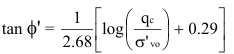
Kulhawy and Mayne (1990) suggested an alternate relationship for clean, rounded, uncemented quartz sands, and evaluated the relationship using high quality field data.

Jefferies and Been (2006) showed a strong link between state parameter (ψ) and the peak friction angle (φ') for a wide range of sands. Using this link, it is possible to link Qtn,cs with φ', using:

Where φ'cv = constant volume (or critical state) friction angle depending on mineralogy (Bolton, 1986), typically about 33 degrees for sub-rounded quartz sands but can be as high as 40 degrees for felspathic and carbonate sands.
Hence, the relationship between normalized clean sand equivalent cone resistance, Qtn,cs and φ' becomes:

The above relationship produces estimates of peak friction angle for clean quartz sands that are like those by Kulhawy and Mayne (1990). However, the above relationship based on state parameter has the advantage that it includes the importance of grain characteristics and mineralogy that are reflected in both φ'cv, as well as soil type through Qtn,cs. The above relationship also tends to predict φ' values closer to measured values in calcareous sands where the CPT tip resistance can be low for high values of φ', due to a high value for φ'cv.
For fine-grained soils, the best means for defining the effective stress peak friction angle is from laboratory on high quality undisturbed samples. An assumed value of φ' = 26° for clays and 30° for silts is often sufficient for many low-risk projects. Alternatively, an effective stress limit plasticity solution for undrained cone penetration developed at the Norwegian Institute of Technology (NTH: Senneset et al., 1989) allows the approximate evaluation of effective stress parameters (c' and φ') from piezocone (u2) measurements. In a simplified approach for normally to lightly-overconsolidated clays and silts (c' = 0), the NTH solution can be approximated for the following ranges of parameters: 20º ≤ φ' ≤ 40º and 0.1 ≤ Bq ≤ 1.0 (Mayne 2006):

For heavily overconsolidated soils, fissured geomaterials, and highly cemented or structured clays, the above will not provide reliable results and φ' should be determined by laboratory testing on high quality undisturbed samples. The above approach is only valid when positive (u2) pore pressures are recorded (i.e., Bq > 0.1).
Stiffness and Modulus
CPT data can be used to estimate modulus in soils for subsequent use in elastic or semi-empirical settlement prediction methods. However, correlations between qc and Young’s moduli (E) are sensitive to stress and strain history, aging, soil mineralogy and microstructure.
A useful guide for estimating Young's moduli for young, uncemented predominantly silica sands is given in Figure 32. The modulus has been defined as that mobilized at about 0.1% strain. For more heavily loaded conditions (i.e., larger strain) the modulus would decrease (see “Applications” section).

Modulus from Shear Wave Velocity
A major advantage of the seismic CPT (SCPT) is the additional measurement of the shear wave velocity, Vs. The shear wave velocity is measured using a downhole technique during pauses in the CPT resulting in a continuous profile of Vs. Elastic theory states that the small strain shear modulus, Go can be determined from:

Where: ρ is the mass density of the soil (ρ = γ/g) and Go is the small strain shear modulus (shear strain, γ < 10-4 %). Hence, the addition of shear wave velocity during the CPT provides a direct measure of small strain soil stiffness.
The small strain shear modulus represents the elastic stiffness of the soil at shear strains (γ) less than 10-4 percent. Elastic theory also states that the small strain Young’s modulus, Eo is linked to Go, as follows:
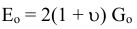
where: υ is Poisson’s ratio, which ranges from 0.1 to 0.3 for most soils.
Application to engineering problems requires that the small strain modulus be softened/reduced to the appropriate strain level. For most well-designed structures, where the average shear strain is relatively small, the degree of softening is often close to a factor of about 2.5. Hence, for many applications the equivalent Young’s modulus (E’) can be estimated from:

Further details regarding appropriate use of soil modulus for design is given in the section on Applications of CPT Results.
Vs can also be used directly for the evaluation of liquefaction potential. Hence, the SCPT can provide two independent methods to evaluate liquefaction potential in soils with little or no microstructure.
Estimating Shear Wave Velocity (Vs) from CPT
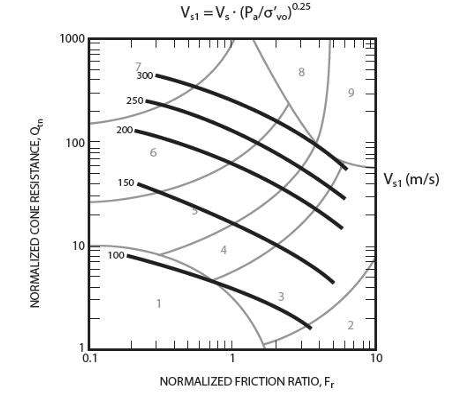
Shear wave velocity (Vs) can be correlated to CPT cone resistance as a function of soil type and SBT Ic. However, shear wave velocity is sensitive to age and cementation, where older deposits of the same soil have higher Vs (i.e., higher stiffness) than younger deposits and likewise for cemented soils. Based on extensive SCPT data (Robertson, 2009), Figure 33 shows a relationship between normalized CPT data (Qtn and Fr) and normalized shear wave velocity, Vs1, for uncemented Holocene and Pleistocene age soils, where:

Vs1 is in the same units as Vs (e.g., either m/s or ft/s). Younger Holocene age soils tend to plot toward the center and lower left of the SBTn chart whereas older Pleistocene age soil tend to plot toward the upper right part of the chart.

Constrained Modulus
Consolidation settlements can be estimated using the 1-D Constrained Modulus, M, where:

Where mv = equivalent oedometer coefficient of compressibility.
Constrained modulus can be estimated from CPT results using the following empirical relationship:

Sangrelat (1970) suggested that αM varies with soil plasticity and natural water content for a wide range of fine-grained soils and organic soils, although the data were based on qc. Meigh (1987) suggested that αM lies in the range 2 – 8, whereas Mayne (2001) suggested a general value of 5. Robertson (2009) suggested that αM varies with Qt, such that:
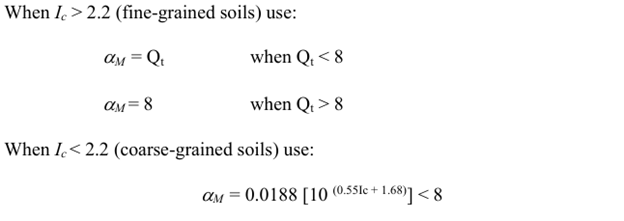
Robertson (2009) set the limit for αm = 14, but experience has shown that better results are obtained when reduced to 8. Robertson (2009) also suggested a factor αm = 0.03, but experience shows that a factor of 0.0188 provides a slightly more conservative estimate of M when Ic < 2.2 and is consistent with the observation by Mayne (2001) that M ~ Go in sands. Estimates of drained 1-D constrained modulus from undrained cone penetration will always be approximate. Estimates can be improved with additional information about the soil, such as plasticity index, natural water content and shear wave velocity. Also αM can be lower in organic soils and soils with high water content.
Want to read more like this?

CPT Interpretation: Soil Parameters OCR, Dr, ψ
Oct, 06, 2024 | EducationAcknowledgement: This page has been reproduced from P. K. Robertson, K.Cabal, Guide to Cone Penetr...

CPT Interpretation: Soil Behavior Type (SBT)
Mar, 21, 2024 | EducationAcknowledgement: This page has been reproduced from P. K. Robertson, K. Cabal, Guide to Cone Pe...

CPT Interpretation: Soil Parameters N60, γ, su
Sep, 30, 2024 | EducationAcknowledgement: This page has been reproduced from P. K. Robertson, K. Cabal, Guide to Cone Penet...
The Hardening Soil Model
Jul, 11, 2025 | EducationThe Hardening Soil constitutive model (HS) was proposed by Schanz (1998); Schanz et al. (1999) in...

Vertek CPT: What is Seismic Cone Penetration Testing?
Mar, 12, 2015 | NewsGet an introduction to Vertek's Seismic CPT in the following article and discover its unique capabil...
Angle of Internal Friction
Jul, 29, 2025 | EducationThe angle of internal friction (φ) is the measure of the shear resistance of soil due to particle...

Bearing Capacity of Pile Foundations: Calculation Methods for Qs
May, 28, 2024 | EducationIn this third, and last, article about pile foundations’ load-bearing capacity, we are going to...

Bearing Capacity of Pile Foundations: Calculation Methods for Qp
May, 23, 2024 | EducationFollowing the previous section that explained the general background and universal equations...

VertekCPT: Do you know about Soil Shear Strength ?
Jun, 24, 2015 | NewsShear strength is the ability of a material to resist shear forces - that is, forces that produce a...
On This Day
June 29th 1764
READ MORE
Trending

Point Load Test

Slope Stability: The Bishop Method of Slices

Slope Stability: Introduction to the Method of Slices
Exploring the World’s 10 Tallest Dams

Splitting Tensile Strength Test (Brazilian)
7.5. Example Problems
Triaxial Test
