Salty Aquifer Discovered Under Antarctic Surface
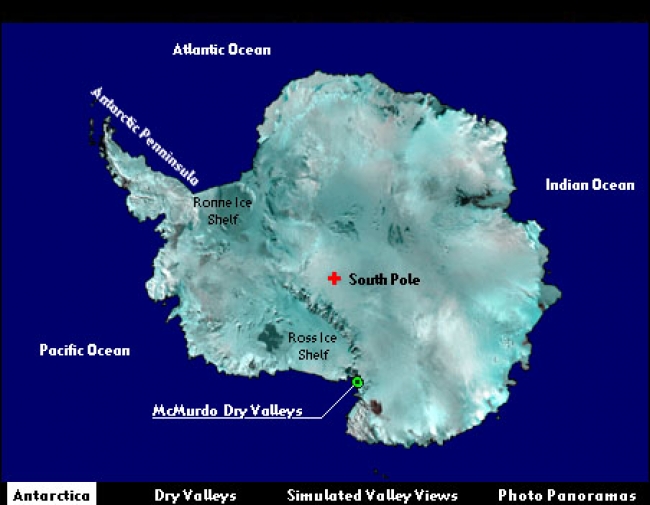
Researchers from the National Science Foundation (NSF) have gathered evidence for the existence of a salty aquifer beneath Antarctica's ice-free McMurdo Dry Valleys, by using an airborne electromagnetic (AEM) sensor, known as SkyTEM, mounted to a helicopter-borne sensor. The salty aquifer may support microbial ecosystems and play an important role in contemporary biological processes in the Dry Valleys.
Jill Mikucki, an assistant professor of microbiology at the University of Tennessee, Knoxville and the study's lead author says that "These unfrozen materials appear to be relics of past surface ecosystems and our findings provide compelling evidence that they now provide deep subsurface habitats for microbial life despite extreme environmental conditions. We believe the application of novel below-ground visualization technologies can not only reveal hidden microbial habitats, but can also provide insight on glacial dynamics and how Antarctica responds to climate change."
This research enables scientists to get more information about unknown ecosystems, such as the surface of Mars, which has similarities to the Dry Valleys, since the Dry valleys ecosystem during the Antarctic summer, has resemblance to conditions on the surface on Mars.
Slawek Tulaczyk, a glaciologist and coauthor at the University of California, Santa Cruz says "Over billions of years of evolution, microbes seem to have adapted to conditions in almost all surface and near-surface environments on Earth. Tiny pore spaces filled with hyper-saline brine staying liquid down to -15 Celsius [five degrees Fahrenheit] may pose one of the greatest challenges to microbes. Our electromagnetic data indicate that margins of Antarctica may shelter a vast microbial habitat, in which limits of life are tested by difficult physical and chemical conditions."
The salty aquifer was found to flow towards the Antarctic coast, eventually discharging into the Southern Ocean, a biologically rich body of water that encircles Antarctica. In all likelihood, the biological productivity in that ocean could be influenced by the microbial weathering contained in these deep brines. However, the vast majority of Antarctica's coastal margins remain unexplored.
The Division of Polar Programs in NSF's Geoscience's Directorate supported the AEM sensor project through a collaborative award to Mikucki, Tulaczyk and Ross Virginia, a biogeochemist at Dartmouth College.
"This project is studying the past and present climate to, in part, understand how climate change in the future will affect biodiversity and ecosystem processes." said Virginia. "This fantastic new view beneath the surface will help us sort out competing ideas and theories about how the Dry Valleys have changed with time and how this history influences what we see today."
"Antarctica is by far the most challenging place we have been." Auken noted. "It was all worth it when we saw the raw data as it was offloaded from the helicopter; it clearly showed we were on to some extraordinary results which no one had been able to produce before. We were excited because we knew this would change the way scientists in the future would view the hydrological cycle in the Dry Valleys. For us, the project was the result of many years of developing the best mapping technology in the world, and now we were able to collaborate with scientists who had worked in the Antarctic environment for decades and were willing to take the risk of letting us prove this could be done with success."
Source: NSF.gov
Want to read more like this story?

A sandstone fragment reveals valid information over climate change
Apr, 28, 2021 | NewsA cobble of green sandstone discovered near Antarctica has revealed crucial information regarding t...
Revealing the fractured ice of Antarctica’s “Doomsday Glacier”
Apr, 18, 2024 | NewsDr Jamin Greenbaum and the team are working at the front line of climate change on the coldest cont...
Geoengineering West Antarctic glacier to prevent a 3-meter sea level rise
Jul, 29, 2019 | NewsA group of scientists suggests a revolutionary strategy to prevent the collapse of the west Antarct...

New theory on Martian landslides
Feb, 03, 2021 | NewsA new study suggests a theory on the triggering factors of specific Martian landslides. It has been...

Antarctica’s subglacial world revealed in unprecedented detail
Jan, 15, 2026 | NewsFor decades, Antarctica’s ice surface has been mapped in remarkable detail, yet the terrain beneath...

Soil hydraulic properties affected by climate change
Sep, 17, 2019 | NewsAccording to a new study, published in the journal Science Advances, soil hydraulic properties can...

How geotechnics can make life simpler, safer and more certain for infrastructure projects
Dec, 10, 2021 | NewsFor any transportation project it’s essential to have a clear view of the subsurface and any proble...

Antarctica's melting will result in higher sea-level rise than previously thought
Apr, 30, 2021 | NewsAccording to a new study, the global sea-level rise associated with the melting of Antarctica's ice...
Study presents new insights about the depletion of the world's groundwater storages
Aug, 27, 2020 | NewsAccording to a new study, the vast proportion of groundwater stores has not changed in recent years...
On This Day
August 7th 2010
READ MORE
Related Video

Trending

Tiebacks vs. soil nails: Choosing the right earth retention solution
When Dams Fail: The Growing Crisis of Tailings Management
Mexico City’s sinking crisis mapped by next-generation satellite
Landslide in Northern Peru Forces Evacuation of Over 170 Residents
Sinkhole outside home in Huntington Station, on Long Island: 3 fall into
Stop Guessing, Start Designing: Introducing Support Designer in Slide2
Development program prepares new engineers for success