Deep Excavation & Shoring Support in Bahrain (PLAXIS Real Life Project) Sponsored
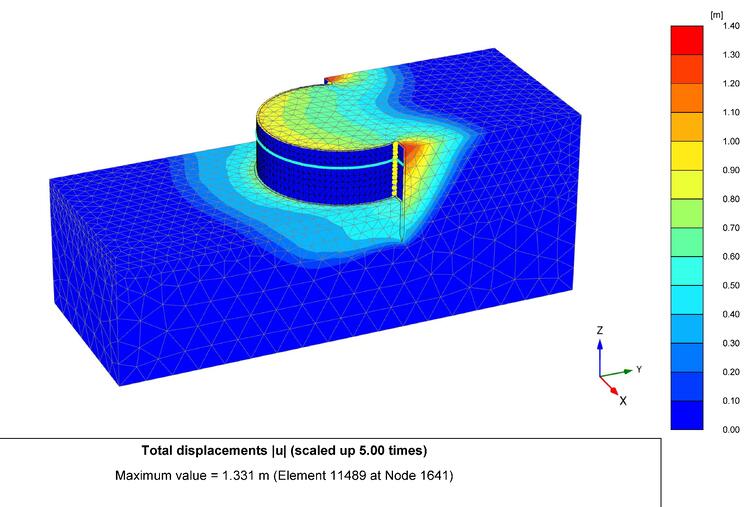
PLAXIS 3D is a game-changing tool for projects that are 3D in nature and, therefore, require 3D designs to provide appropriate, safe & value-engineering solutions.
Learn more about PLAXIS 3DThis is a Bentley PLAXIS case study by Strong Force-MGC W.L.L. that examines whether the semi-manual or 2D design methods are always applicable and the most conservative and economical in shoring support for deep excavation.
Strong Force-MGC W.L.L. was approached to provide a shoring support solution for a Bahrain project on a design-and-built basis. The project consisted of a high-rise structure with deep excavations in some areas.

The area of interest in Figure 1 is the roundabout. The shoring system installed at the roundabout area is a tangent piling wall (TPW), consists of piles with 830mm Dia., and ~ 15m deep, each, to support ~ 9m of deep excavation in a silty SAND layer followed by a weak SILTSTONE layer. The GWT is @ 2m begl.
An in-hand 2D design from an independent designer for the shoring support system was provided which covered a straight roadside and the roundabout side.
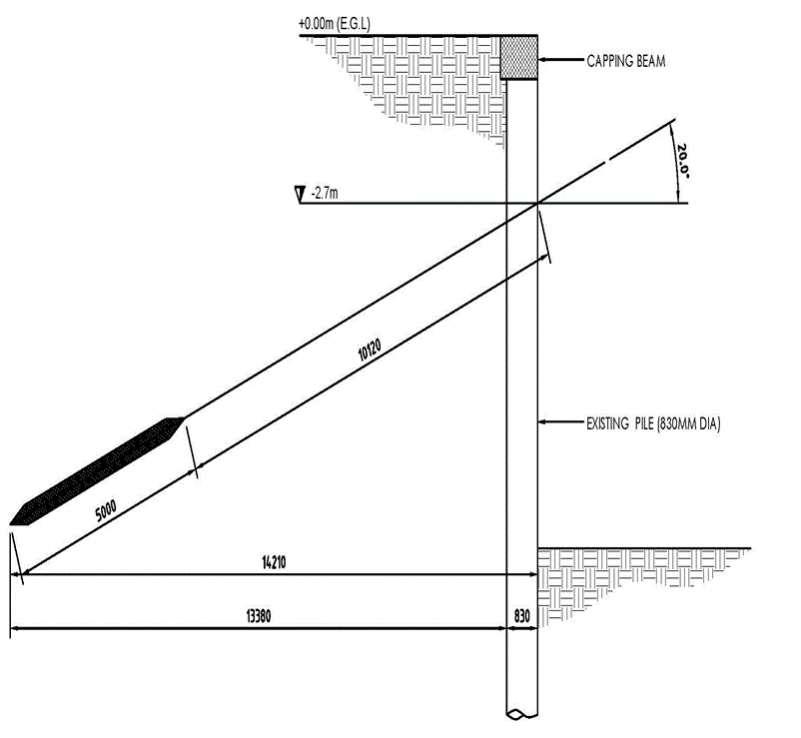
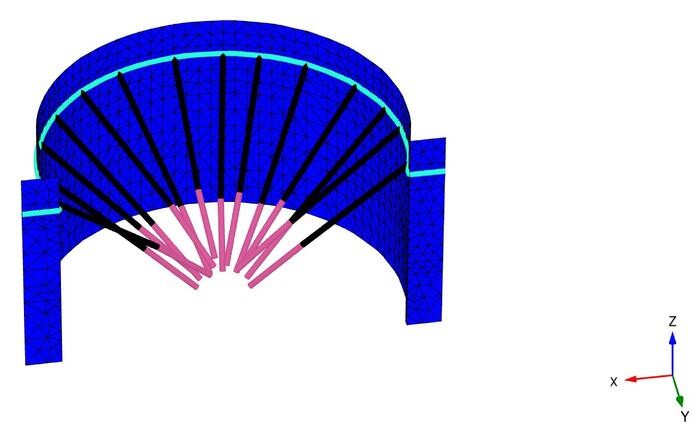
The proposed supporting system for the TPW at the roundabout side was 39 nos. of uniform single-level Ground anchors with 1.7m spacing, 20 degrees inclination, at 2.7m level & 15m total length. The provided 2D design had failed to address the actual 3D nature of the project (the curve of the roundabout side) because the 2D design assumed that the TPW is straight and continuous in the out-of-plane direction. However, all the proposed ground anchors are clashing & intersecting at one point, affecting their functionality.
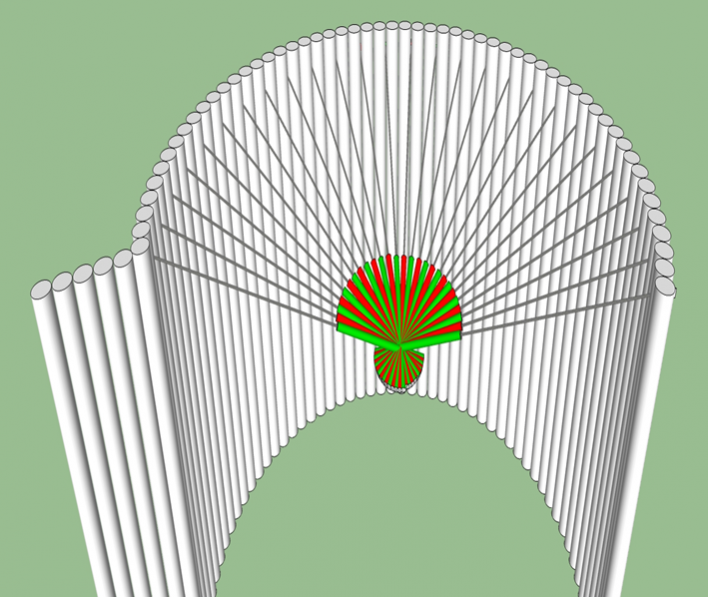
Strong Force-MGC W.L.L. decided to utilize PLAXIS 3D for the design and analysis of this case. The conceptual design was brain-stormed on papers, followed by the 3D drawings & sketches. The main idea was to manipulate the ground anchors arrangement in terms of various inclination, spacing, and lengths so the anchors will not intersect or affect each other. Different soil models were used (LE, MC, HS, HSS & GHS) for the sand, rock, and TPW materials covering the expected range of their properties (i.e., sensitivity analysis).
The model's size, quality of the mesh, boundary conditions, water flow regimes, and permeability of the system (fully permeable, impermeable, semi-permeable) were considered in the analysis. Moreover, the TPW was modeled as LE & elastoplastic equivalent plate element (which took less than an hour to analyze), as well as MC volume piles elements using soil clusters to represent the granular details of the actual scenario (which took a couple of days on an overclocked CPU needed to analyze ~ 3 millions of nodes).
The TPW modeled as a plate element might be enhanced by considering the custom connections between the plate panels and the expected water flow through the TPW using the interface permeabilities feature. Nonetheless, one of the major advantages of using plate elements is the straightforwardness of getting the structural forces acting on the TPW.
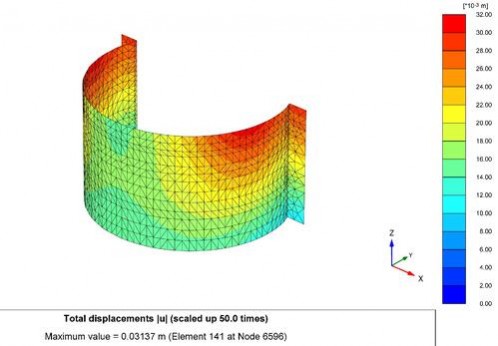
The final ground anchors arrangement is shown in Figure 4. The maximum deformation of the TPW was
Using Plaxis 3D resulted in reduced anchors of only 16 nos. and not clashing with each other considering all SSI's while the total savings in cost and time was ~ 58% compared to a 2D design approach.
Learn more about 2D-versus-3D analysis

Source: Real-Life Projects: Deep Excavation & Shoring Support in Bahrain
Want to read more like this story?

Why Run PLAXIS 3D Analysis?
Jun, 07, 2021 | NewsMost geotechnical engineers use FEA software packages for their geotechnical design. It is especial...
Numerical Analysis and Analytical Calculations of 3D Effects on Pullout Capacity of Anchor Blocks: Case Study in Dubai, United Arab Emirates
Dec, 14, 2021 | NewsIt is very common in practice that geotechnical engineers design earth retaining structures c...
Combining PLAXIS 2D and 3D Kept the Lueneburg Lock's Century Project Within 4 mm of Its Historic Neighbour
Aug, 12, 2026 | NewsEngineers designing the new Lueneburg Lock in northern Germany used a deliberately complementary com...

Bentley Webinar: FE and LE solution for Geotechnical Projects using PLAXIS WorkSuite
May, 11, 2022 | EventPLAXIS 2D/3D WorkSuite is the most comprehensive option of PLAXIS which includes PLAXIS 2D/3D Ultim...
How to Model Piles in PLAXIS
Jun, 17, 2021 | NewsThe problem of analyzing and designing deep foundations is relevant to many civil engineering struc...

Model Structures and Visualize Structural Forces
Jun, 08, 2021 | NewsSoil-structure interaction is a crucial aspect for both geotechnical and structural fields. There i...

2D or 3D LE? That is the Question - Yeager Airport Case Study
Jun, 02, 2021 | NewsWhen is 2D slope stability analysis sufficient and when should 3D analysis be used in conjunction w...

Plaxis 2D/3D Basic Course – Online Training
Apr, 27, 2026 | EventJoin us for a 3-day PLAXIS 2D and a 3-day PLAXIS 3D interactive training course hosted by Geoenginee...

3D Finite Element Analysis of a Deep Excavation & Ground Response Evaluation
Jun, 13, 2022 | NewsSignificant ground movements due to deep surface excavations can seriously impact neighbouring infr...
Form
Looking for more information? Fill in the form and we will contact Bentley for you. Alternatively, you can visit Bentley's website and speak with a Bentley Geotechnical Expert.
On This Day
August 26th 1833
READ MORE
Related Video

Trending
New Release: GeoStudio 2025.2

Artificial Ground Freezing: Applications, Techniques, and Key Considerations
Brownfield success: Engineering excellence starts below ground

Tailrace tunnel breakthrough advances Australia’s largest renewable project
A Legacy of Leadership, Mentorship & Service: Gary L. Seider P.E.