
Rio de Janeiro Metro opened
The Rio de Janeiro Metro is a rapid transit network that serves the city of Rio de Janeiro, Brazil. The Metrô was inaugurated on 5 March 1979, and consisted of five stations operating on a single line. The system currently covers a total of 58 kilometres (36 mi), serving 41 stations, divided into three lines: Line 1 (16 kilometres (9.9 mi)); Line 2 (30.2 kilometres (18.8 mi)), which together travel over a shared stretch of line that covers 10 stations of an approximate distance of 5 kilometres (3.1 mi); and Line 4 (16 kilometres (9.9 mi)). Metrô Rio has the second highest passenger volume of the metro systems in Brazil, after the São Paulo Metro.
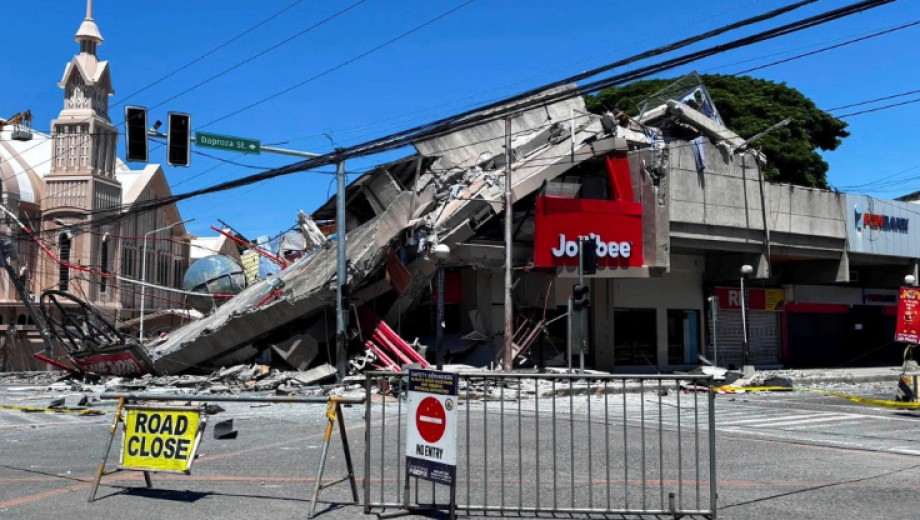
Roque Ruaño died
Roque Ruaño Garrido, was a Spanish priest-civil engineer. He was known after he drew up plans for University of Santo Tomas (UST) Main Building, the first earthquake-shock resistant building in Asia, which was constructed at the Sulucan property of the Dominican order in city of Manila.
Johan Jensen died
Johan Ludwig William Valdemar Jensen, mostly known as Johan Jensen was a Danish mathematician and engineer. He was the president of the Danish Mathematical Society from 1892 to 1903. Jensen is mostly renowned for his famous inequality, Jensen's inequality.
Britannia Bridge was completed
Britannia Bridge is a bridge in Wales that crosses the Menai Strait between the Isle of Anglesey and city of Bangor. It was originally designed and built by the noted railway engineer Robert Stephenson as a tubular bridge of wrought iron rectangular box-section spans for carrying rail traffic. Its importance was to form a critical link of the Chester and Holyhead Railway's route, enabling trains to directly travel between London and the port of Holyhead, thus facilitating a sea link to Dublin, Ireland. On 5 March 1850, Stephenson himself fitted the last rivet of the structure, marking the bridge's official completion.
Pierre-Simon Laplace died
Pierre-Simon, Marquis de Laplace was a French scholar and polymath whose work was important to the development of engineering, mathematics, statistics, physics, astronomy, and philosophy. He summarized and extended the work of his predecessors in his five-volume Mécanique céleste (Celestial Mechanics) (1799-1825). This work translated the geometric study of classical mechanics to one based on calculus, opening up a broader range of problems. In statistics, the Bayesian interpretation of probability was developed mainly by Laplace. Laplace formulated Laplace's equation, and pioneered the Laplace transform. Laplace is regarded as one of the greatest scientists of all time. Sometimes referred to as the French Newton or Newton of France